House of the Fortuna Annonaria
Dates
2nd century CE to 4th century CE
Excavation Dates
unspecified
Garden Description
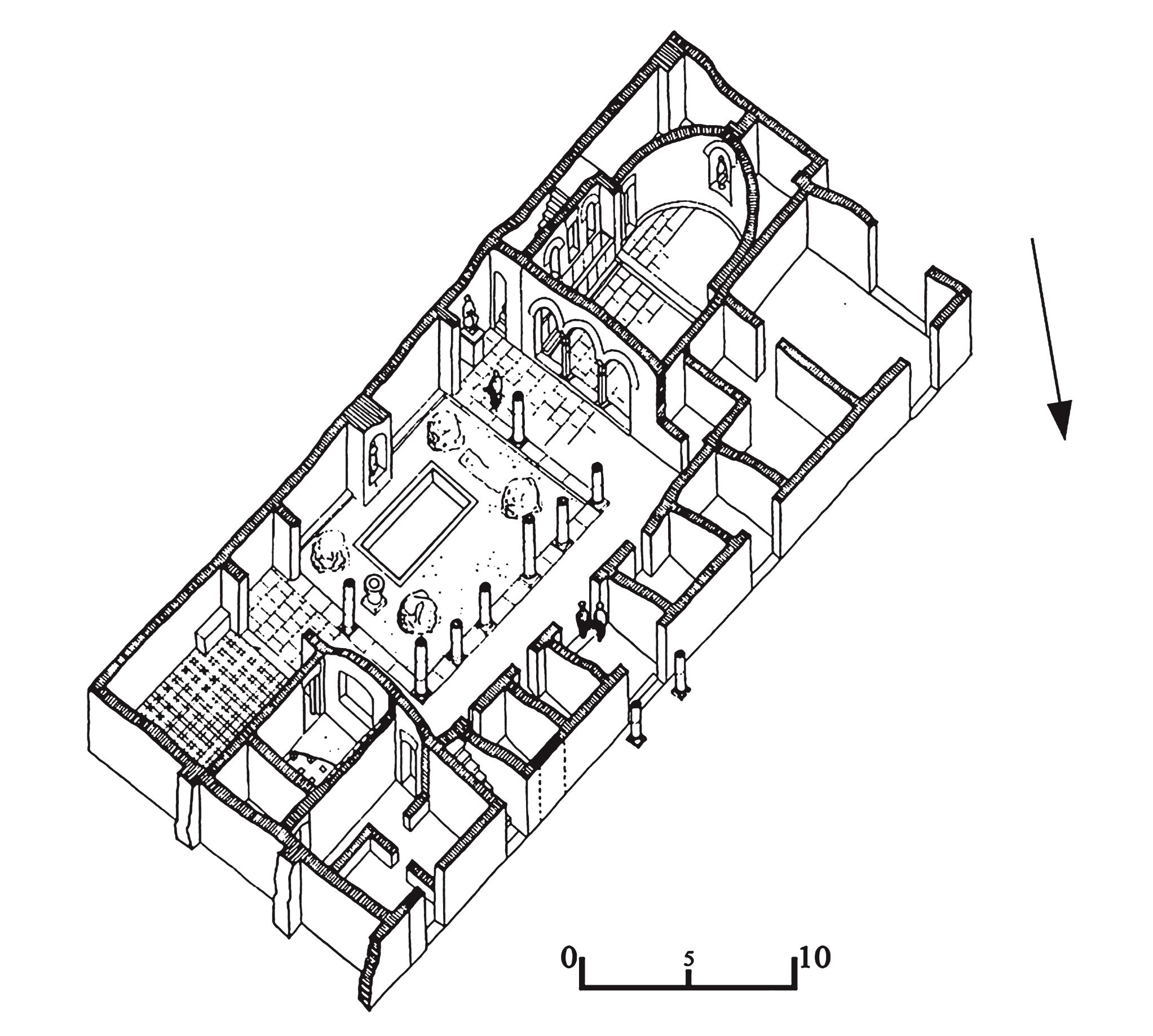
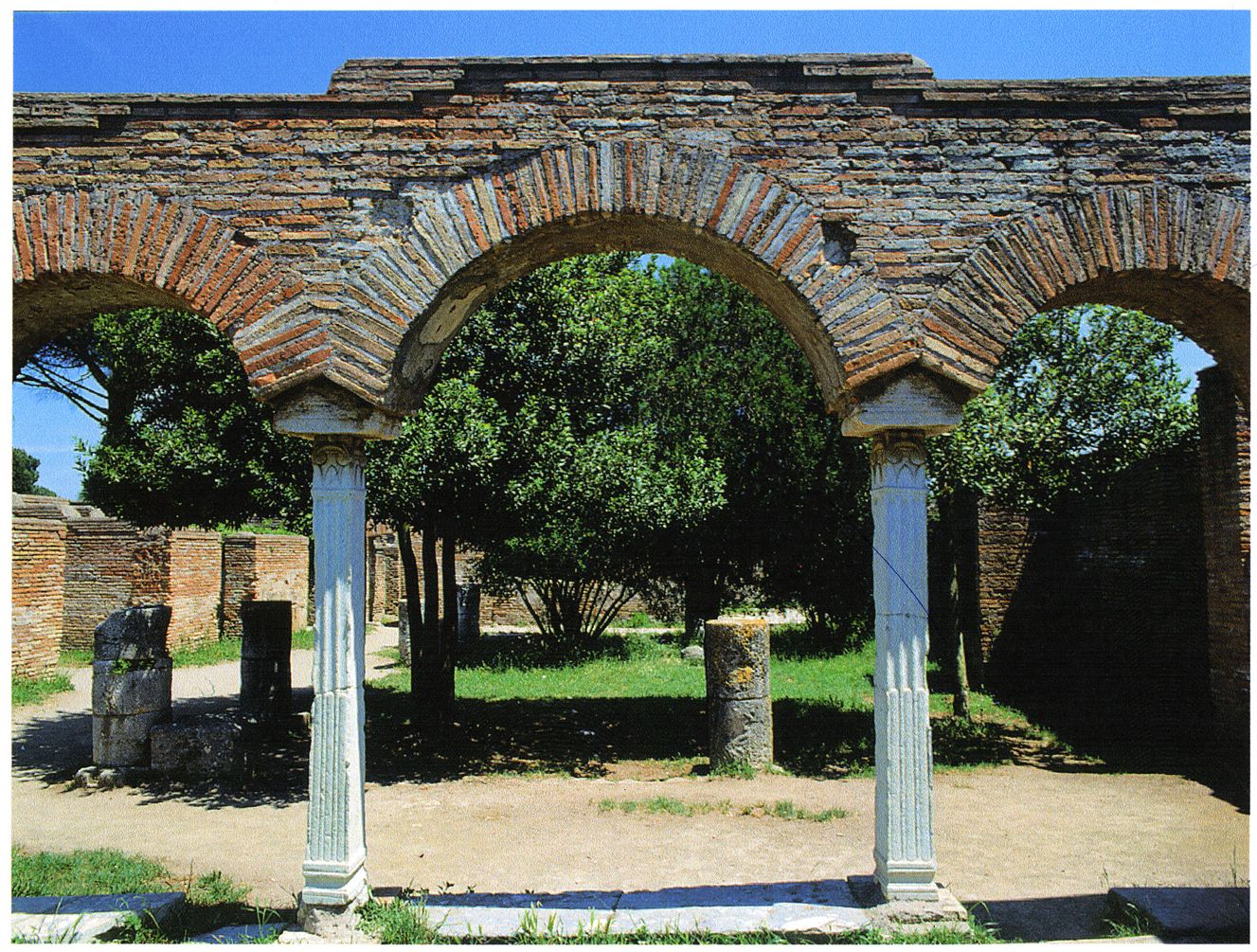
The peristyle garden (Fig. 1, a) has travertine columns on three sides. The fourth side coincides with the perimeter wall of the house, which forms part of the original plan, dating to the 2nd century CE. The last phase of the domus, lavishly decorated with precious marbles, dates to the 4th century CE. Against the rear wall of the garden is a brick niche (h. 194 cm.; w. 114 cm.) containing a statue of Juno or Demeter and two benches in opus listatum (w. 41 cm.; preserved h. 28 cm.). "The area inside the peristyle must undoubtedly have been kept as a garden (Figs. 2 and 3). The remains of a rectangular basin (3.10x5.40 m.) with drainage outlet at its north-east corner were found at its center" (Becatti).
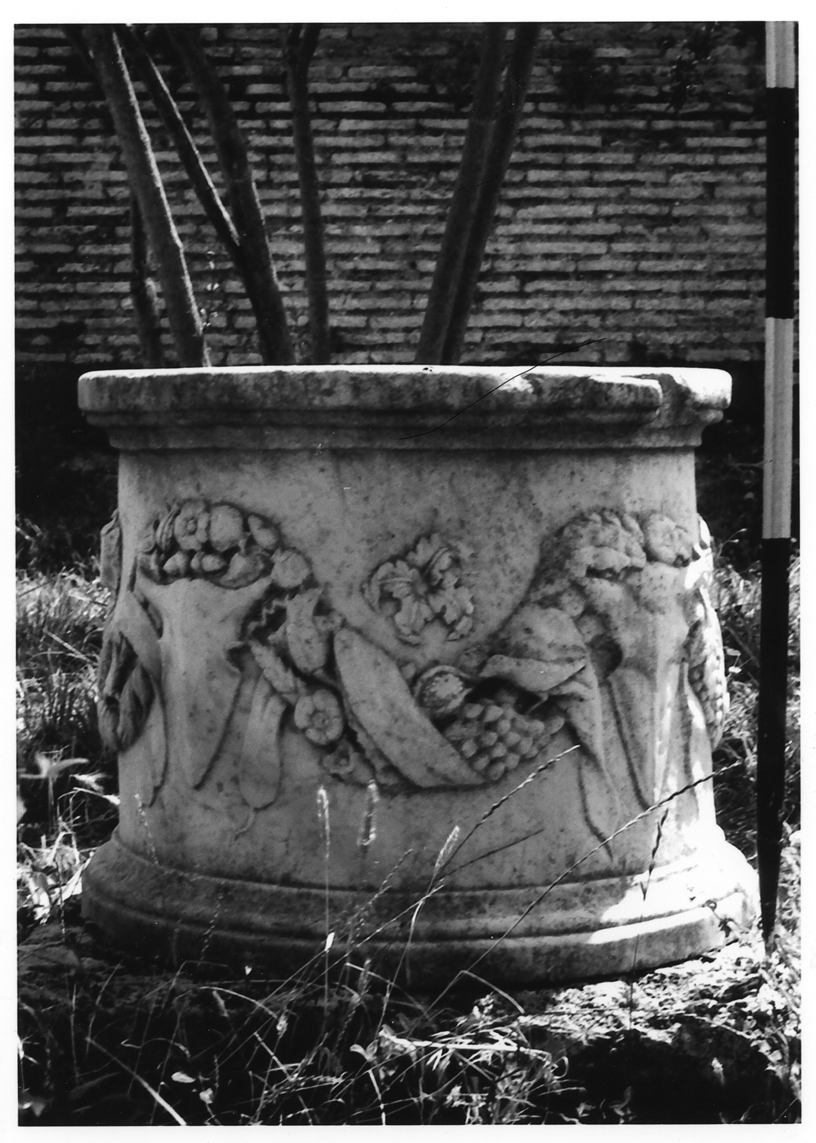
There is a well (diam. 49 cm.) in the eastern part of the garden; it is adorned with a marble well-head decorated with bucrania in neo-attic style, dating to the 2nd century CE (dia. 66 cm; h. 55 cm) (Fig. 4). Two small herms also formed part of the garden decoration.
A large female statue was found in situ on its pedestal, adhering to the end-wall of the western portico of the peristyle. Endowed with the attributes of trade (cornucopia and oar), the female figure has been identified as Fortuna Annonaria, the personification of Ostia's trading success.
The large apsidal reception room (oecus) (Fig. 1, b), with two columns marking its entrance, was located in the western part of the house. The garden, with flowering plants, onto which it opens, formed its natural continuation. This, together with the nymphaeum that decorated the south side of the room, its rear wall articulated with alternating semicircular and rectangular niches containing statues, provided a suitably splendid and prestige-enhancing setting for the public life of the owner, probably a wealthy trader.
The garden also forms the backdrop to the rooms in the east part of the house, a triclinium (Fig. 1, c) and a heated cubicle (Fig. 1, d), lit by a large window and decorated with a lavish black and white mosaic floor with mythological scenes.
Figures

Bibliography
- G. Calza, G. Becatti, I. Gismondi, G. De Angelis D'Ossat, H. Bloch, Topografia generale, Scavi di Ostia I, Rome, 1953.
- R. Meiggs, Roman Ostia. (worldcat)
- C. Pavolini, Ostia: Vita quotidiana. (worldcat)
- Jean-Paul Descœudres, Ostia: Port et porte de la Rome antique. (worldcat)
- E.J. Shepherd, P. Olivanti (eds), Giardini ostiensi, Bullettino della Commissione archeologica comunale di Roma, 109, 2008, pp. 69-98. (worldcat)
- M. De Vico Fallani, C. Pavolini, E. J. Shepherd, M. Pileri, "Le sistemazioni a verde di Michele Busiri Vici per Ostia Antica: un caso di studio," Rivista di Archeologia 43, 2019, pp. 165-176. (worldcat) (Rivista di Archeologia)
- M. De Vico Fallani, C. Pavolini, E. J. Shepherd, M. Pileri, "Un sogno lasciato a metà: il progetto di Michele Busiri Vici per le sistemazioni arboree e per i giardini nella zona di Ostia Antica Scavi (1939-1941)," Bollettino d'Arte, in press. (worldcat)
- Giornale degli Scavi, 1939, pp. 54-87.
- Giovanni Becatti, Case ostiensi del tardo impero, pp. 23-25. (worldcat)
- John S. Boersma, Amoenissima Civitas: Block V. ii at Ostia, Description and Analysis of its Visible Remains, Assen: Van Gorcum, 1985, pp. 151, 156-160. (worldcat)
- Bernard Andreae, Am Birnbaum: Gärten und Parks im antiken Rom, in den Vesuvstädten und in Ostia, 1996, pp. 123-124. (worldcat)
- E.J. Shepherd, P. Olivanti (eds), Giardini ostiensi, Bullettino della Commissione archeologica comunale di Roma, 109, 2008, pp. 82-84. (worldcat)
Keywords
- basins (vessels) (AAT:300045614)
- bucrania (AAT:300030853)
- columns (architectural elements) (AAT:300001571)
- cornucopias (motifs) (AAT:300303413)
- domus (AAT:300005506)
- herms (AAT:300047170)
- mosaics (visual works) (AAT:300015342)
- Neo-Attic (AAT:300020212)
- niches (AAT:300002704)
- nymphaea (garden structures) (AAT:300006809)
- oeci (AAT:300080791)
- opus listatum
- peristyles (Roman courtyards) (AAT:300080971)
- puteals (AAT:300443458)
- statues (AAT:300047600)
- travertine (AAT:300011329)
- triclinia (rooms) (AAT:300004359)
- water wells (AAT:300152327)
Places
- Ostia (Pleiades:422995)
- Ostia Antica (deserted settlement) (TGN:7007018)