Cite this place Gleason, K. (2026). "Jericho." Gardens of the Roman Empire, accessed June 18, 2026. https://roman-gardens.github.io/id/7a8816878c/

Jericho

Places in Jericho:

In one of the most beautiful spots of the Eastern Mediterranean, five km west of Jericho, the biblical "city of Palms," (Deut. 34:3) lie the remains of a royal complex of the late Second Temple Period (the end of the second century BCE continuing through the mid-first century A.D). Despite their location in the desert some 200 m. below sea level (one of the lowest occupied elevations on earth) these palaces were set amidst an abundance of vegetation and enjoyed a copious supply of water brought from the surrounding hills via water channels. The palaces are dramatically situated along Wadi Qelt where the gorge opens abruptly onto the Jordan Valley floor. (Fig. 1) They were set amidst the large palm and balsam groves for which the valley was famed. Water channels give archaeological evidence of groves to the north of the palace, but literary evidence suggests that royal holdings from Jericho to Ein Gedi were extensive. None of the gardens have been fully excavated, but many have been examined and the presence of rich soil rather than pavement, as well as water channels and ceramic planting pots provide conclusive evidence for the many gardens discussed below.

While some phases of the complex pre-date the Roman period, they were visited by Pompey the Great, by Cleopatra, and by later Roman officials during the reign of Herod the Great. The complex was damaged after the death of Herod, according to Josephus, and partially restored by his son, Archelaus.
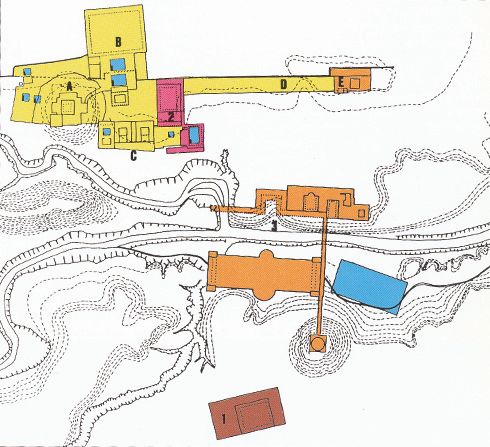
Plans

Figure 1: Plan of the Hasmonean and Herodian Winter Palace Complex, Jericho (Gleason after Netzer)

Places

8 garden articles in Jericho have been published:
Judaea / Jericho

Herodian First Palace

s Herod may have been a regular guest at the Hasmonean palace during his boyhood. Even after he effected his rule in 37 BCE, the Hasmoneans retained possession of their winter ...
Judaea / Jericho

Herodian Second Palace

The earthquake of 31 BCE destroyed the Hasmonean palace complex, and the political changes that took place after Actium enabled Herod to gain full possession of the winter ...
Judaea / Jericho

Palace of John Hyrcanus I

Erected on the southern margin of the royal estate around 120 BCE, north of Wadi Qelt, the palace has not yet been studied in its entirety, since at a later stage most of it was ...
Judaea / Jericho

Pool Complex of Alexander Janneaus

The ascent to the throne of Alexander Jannaeus in 103 BCE triggered a significant development in the above palace. He constructed another conduit from the "Auja and Na'aran" ...
Judaea / Jericho / Third Palace

Corinthian Peristyle

With porticoes on three sides and measuring 23 x 14.5m, this courtyard, known as area B55, is decorated with columns in the Corinthian order. (Fig. 3) The lower portions of these ...
Judaea / Jericho / Third Palace

Ionic Peristyle

This peristyle courtyard (19.1 x 18.7) lies adjacent to the banquet hall and near Roman baths constructed in opus reticulatum. It is referred to in excavation reports as area B64....
Judaea / Jericho / Third Palace

Sunken Garden

The monumental 'sunken garden' (B6), which measures 37.27 x 113.67m, lies largely unexcavated on the south side of Wadi Qelt, in alignment with the buildings and gardens ...