Water Sanctuary Aqua Septimiana Felix (Sanctuaire des eaux)
Dates
2nd-3rd century CE
Garden Description
The water sanctuary lies beneath the Byzantine fort in the Northern suburbs of the city. An inscription that was discovered during the Byzantine fort excavations enumerates the embellishments that were undertaken in 213 by the city of Timgad for the sanctuary, Aqua Septimiana Felix: one of which, a bronze balustrade surrounding the spring (a pool with marble slabs of 3,6 m x 13, 60 m) and a viridarium surrounded by porticoes decorated with paintings (porticus virdiari (sic) picturis ornatas).
Plans
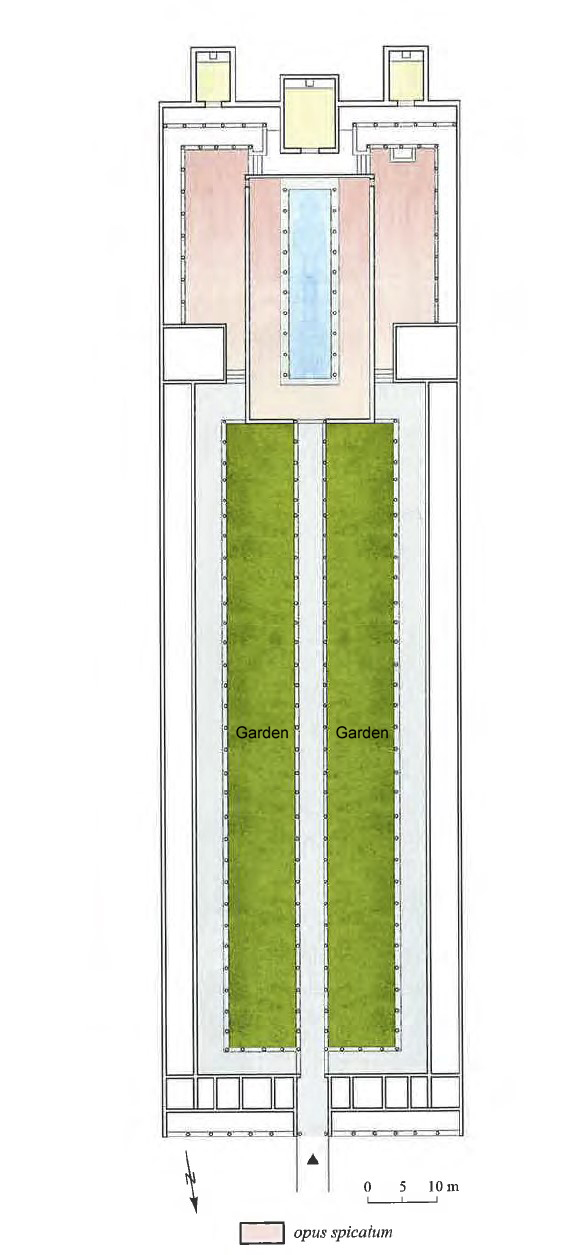
Credit: (Lassus, J., 1981, fig. 9)
Bibliography
- Courtois, C., Timgad, antique Thamugadi, Alger, 1951. (worldcat)
- Malek, A.-A., "Le Jardin Dans Les Sanctuaires De L'afrique Romaine: Premières Approches.", in Du Culte Aux Sanctuaires : L'architecture Religieuse Dans L'afrique Romaine Et Byzantine : Actes Du Colloque, 18-19 Avril 2013, Paris, Fondation Simone Et Cino Del Duca... -. (2018), p. 362, fig. 12. (worldcat)
- Lassus, J., La forteresse byzantine de Thamugadi, Fouilles à Timgad, 1938-1956, Paris, 1981, plan p. 25, fig. 9, pp. 215-17, fig. 174-76. (worldcat)
- Leschi, L., "Découvertes récentes à Timgad: Aqua Septimiana Felix", in CRAI, 1947, pp. 87-99. (worldcat)
- Leschi, L., Etudes d'épigraphie, d'archéologie et d'histoire africaines, Paris, 1957, pp. 240-45, ici pp. 242. (worldcat)
Keywords
- mural paintings (visual works) (AAT:300033644)
- viridarium
- temples (buildings) (AAT:300007595)
- sanctuaries (religious building spaces) (AAT:300004575)
- pools (bodies of water) (AAT:300008692)
- inscriptions (AAT:300028702)
Places
- Thamugadi (Pleiades:334636)
- Timgad (deserted settlement) (TGN:7001328)
- Numidia (Roman province) (Pleiades:981539)