Terrace House 2
Dates
first to third century CE
Excavation Dates
1967-1983
Garden Description
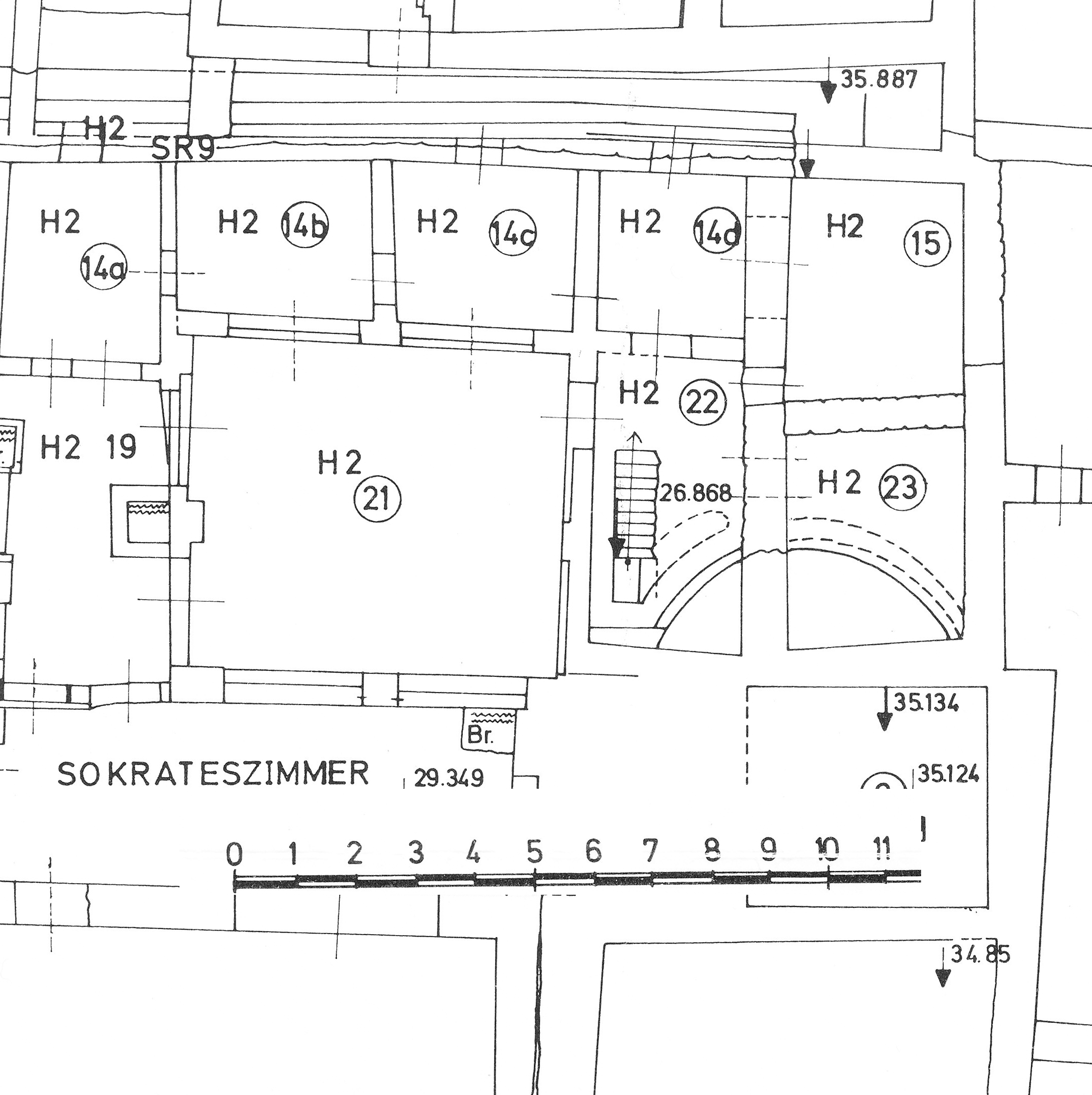
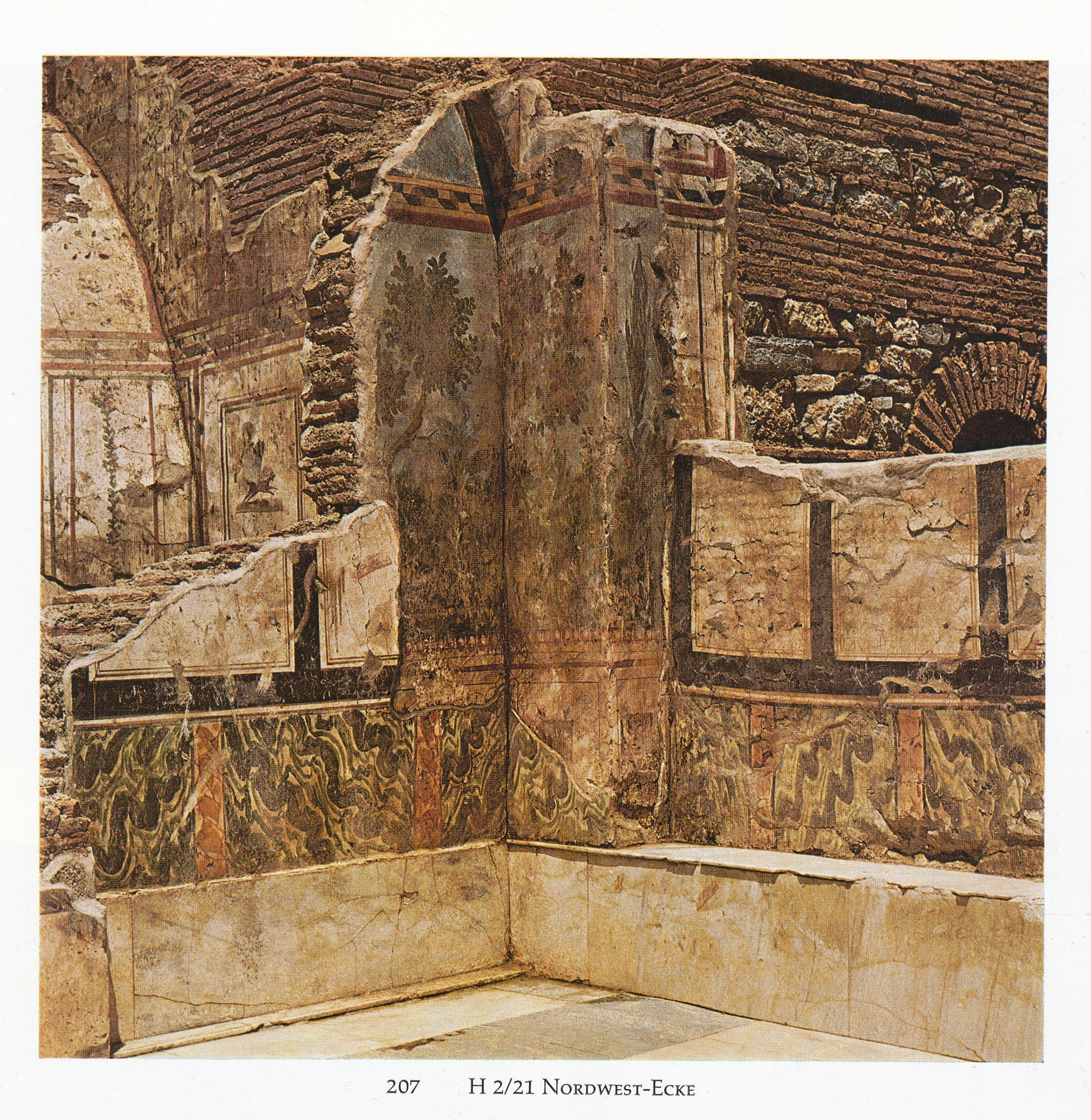
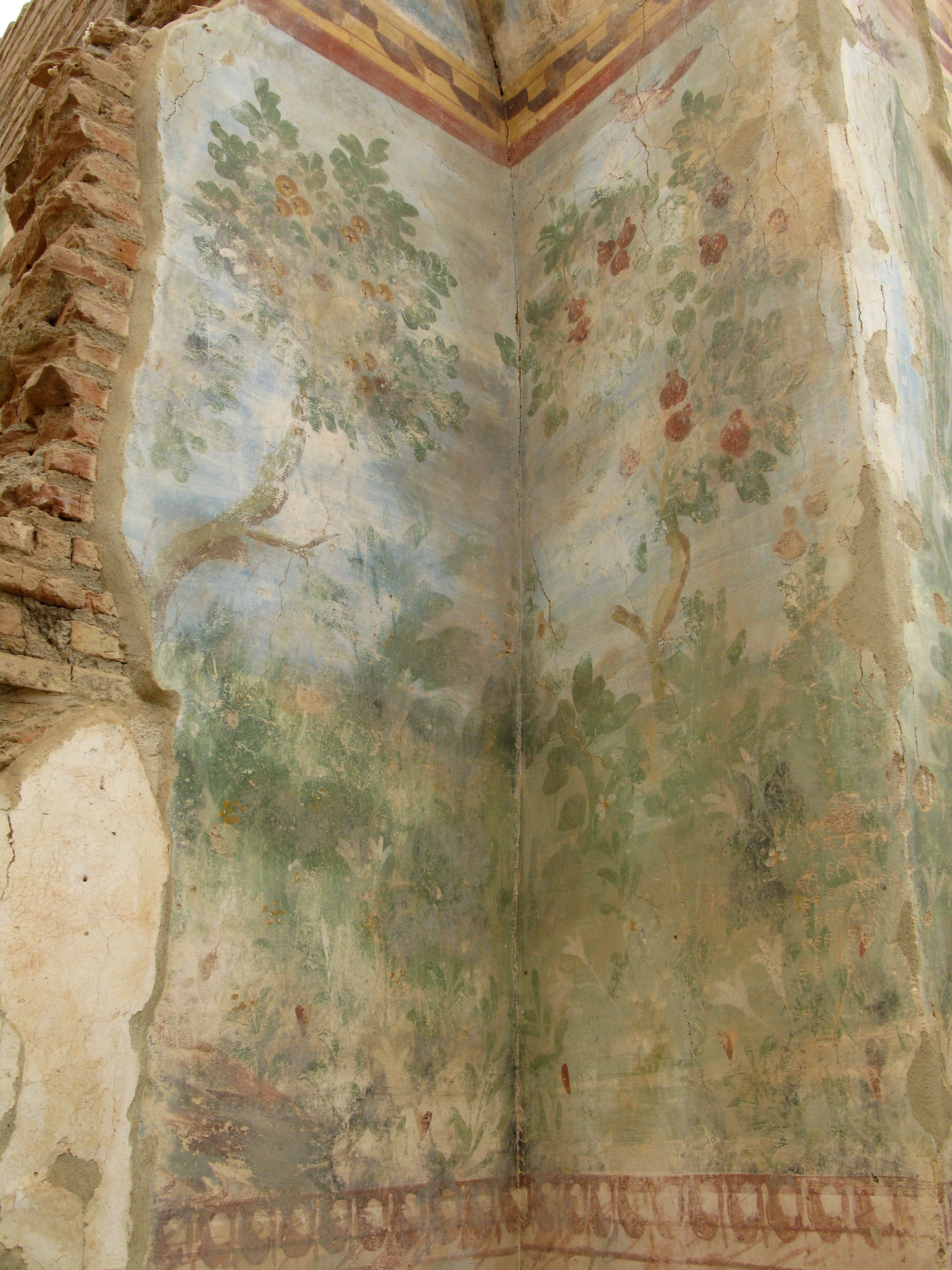
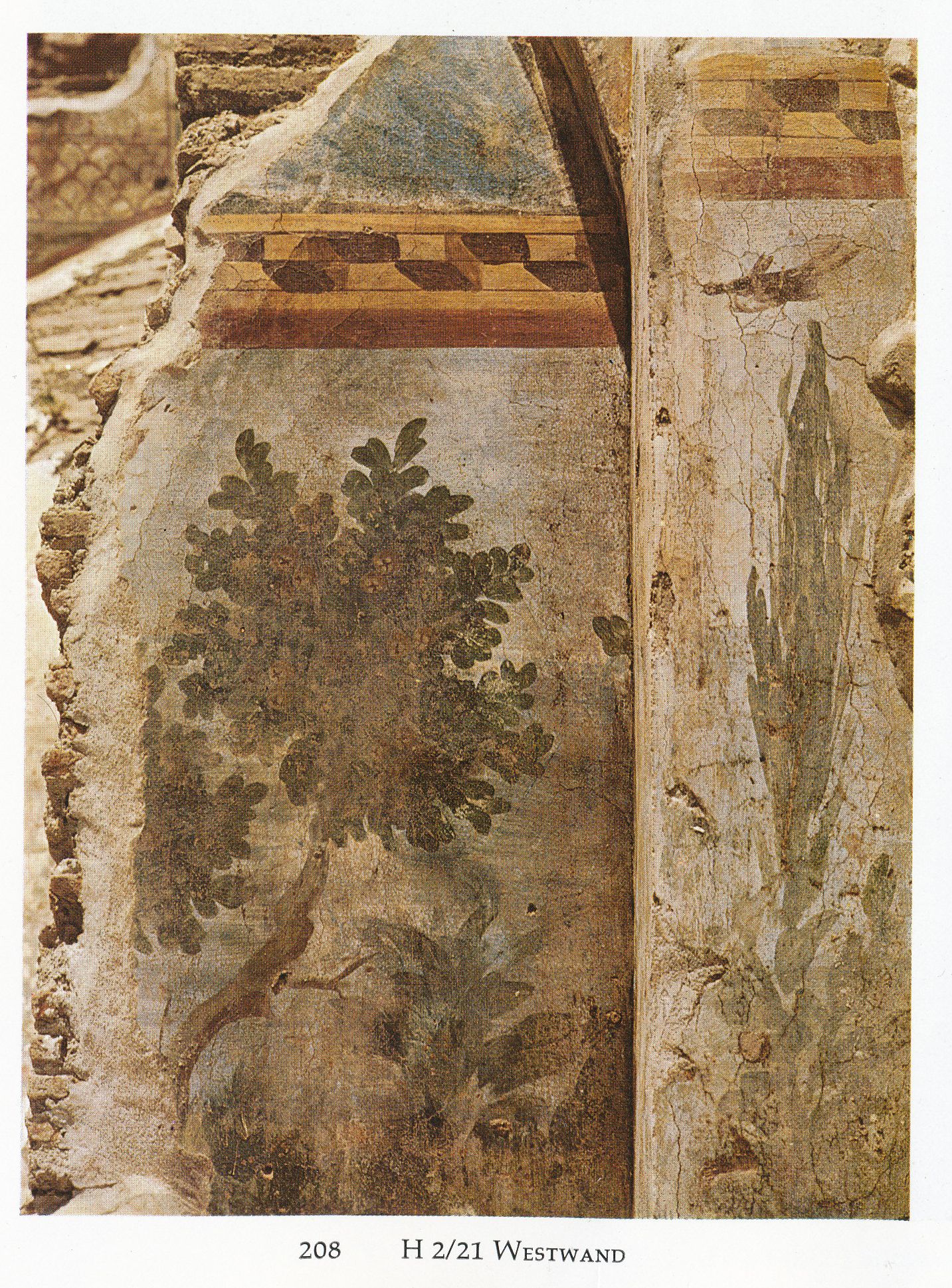
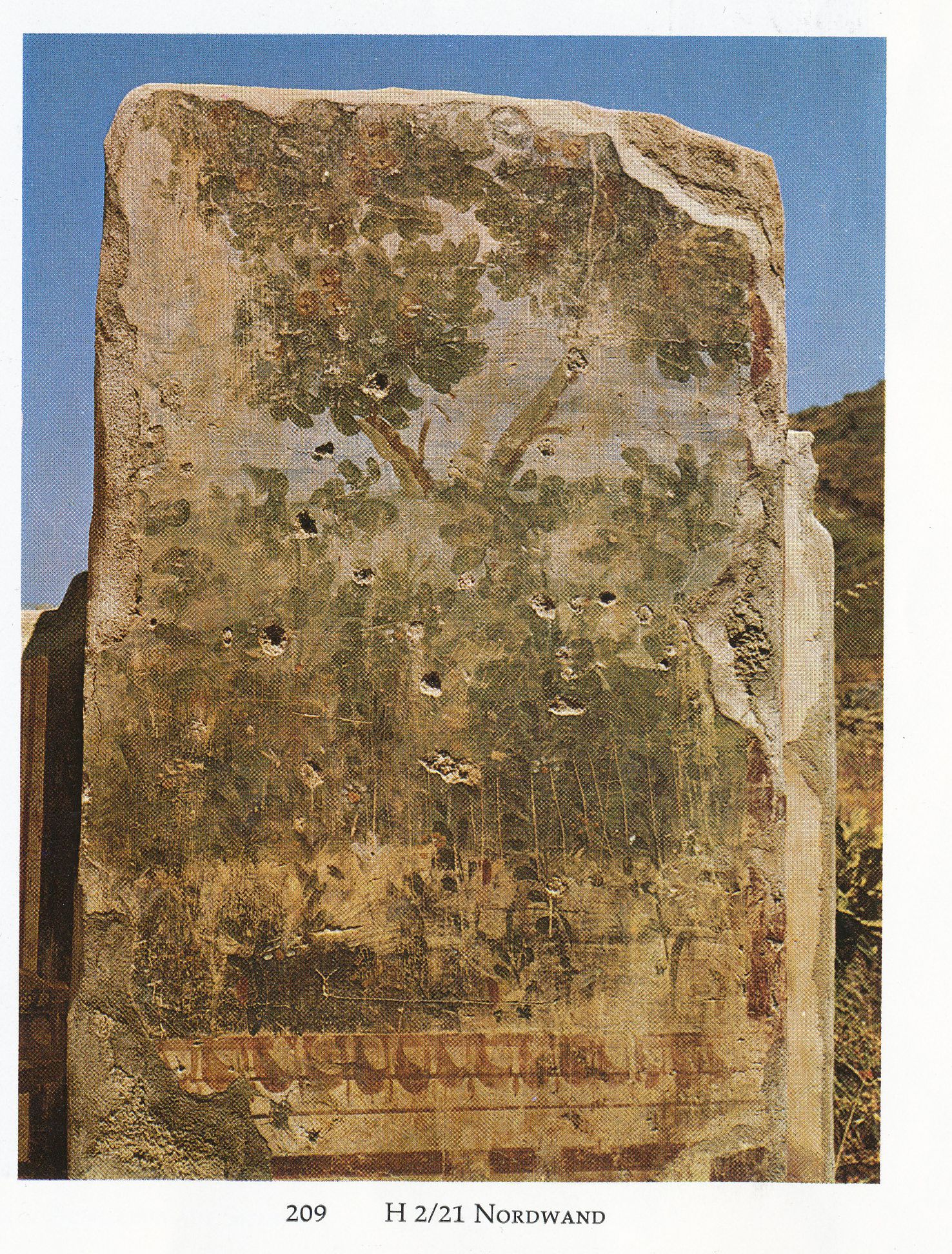
The most striking remains are in Terrace House 2, in Room 20 (Residence 4), excavated by H. Vetters between 1967-1983. Here, in a space originally designed as a courtyard, the walls are decorated with an elaborate garden scene. Much of the painting is covered by a later painting of marble panels, but on the north and west walls the garden scene has been partially revealed (Figs. 1 and 2). The viewer within the room looks out past a real marble dado on top of which is an illusionistic marble fence with an unusual egg and dart design along the top. Beyond is a garden scene, similar to those seen in Pompeii or the famous garden scene of Livia at Prima Porta. The scene is filled with luxuriant foliage, out of which apple trees rise up against the blue sky bearing apples or quinces. A bird flies over a young juniper or cypress. The illusion of the garden continues without a break around the corners. It allows the viewers to feel present in a garden, while knowing they are in a room looking out at it. The later painting completely destroys both the illusion and any recollection that the space had formerly been an open courtyard.
In the central peristyle of Residence 2 of Terrace House 2, Vetters uncovered a late Imperial mosaic of Dionysius and Ariadne in a niche. The peristyle itself is a paved courtyard, but the mosaic offers the viewer a rich view of a paradisiacal vineyard. A lunette features a mosaic of two peacocks holding a garland over a basket or urn of grapes and fruits, with white geese to each side standing on a green lawn with roses and lilies (Fig. 3). The ceiling of the niche features Dionysias and Ariadne in a central medallion set into a panel of blue, against which is arrayed a vine laden with grapes and doves (Fig. 4). In the upper corner, the vine emerges from the ground, and along the base of the wall, a winged putto leads two harnessed leopards or panthers. The opposite side is not preserved.
Just off the peristyle in Room 17, the walls feature a variety of birds, individually portrayed on white backgrounds either sitting on branches or standing among small plants. In Room 24, the landscape themes continue with a painting of stags in woodland, apparently being chased by a putto. Only a small fragment remains. In Room 14, mythological scenes of Achilles and Skyros (west wall) and Achilles and Priam (south wall) are set in a landscape of rocks and trees (Fig. 6). Bird and plant themes are represented through this house.
Plans
Images
Bibliography
- Jobst, W. 1977. Römische Mosaiken aus Ephesos I: Die Hanghäuser des Embolos 8/2, Figs. 109-130. Vienna: Verlag der Österreichischen Akademie der Wissenschaften. (worldcat)
- Kearns, C. 2013. “Visual Representations of Gardens: Diachronic Perspectives on the Art of Landscape.” In A Cultural History of Gardens. Vol. 1, Antiquity, edited by K.L. Gleason, 164–65. London: Bloomsbury Academic. (worldcat)
- Strocka, V.M. 1977. Die Wandmalerei der Hanghäuser in Ephesos. Forschungen in Ephesos 8/1, Figs. 207-219. Vienna: Verlag der Österreichischen Akademie der Wissenschaften. (worldcat)
Keywords
- courtyards (uncovered spaces) (AAT:300004095)
- dadoes (AAT:300001746)
- peristyles (Roman courtyards) (AAT:300080971)
- medallions (ornament areas) (AAT:300077354)
- putti (motifs) (AAT:300250465)
- mural paintings (visual works) (AAT:300033644)
- marble (rock) (AAT:300011443)
- mosaics (visual works) (AAT:300015342)
Places
- Ephesus/Arsinoe(ia) (Pleiades:599612)
- Ephesus (TGN:7002499)
- Asia (Roman Province) (Pleiades:981509)
- Asia Minor (general region) (TGN:7002294)