Villa Romana
Dates
first century CE
Excavation Dates
1942 to 1947
Garden Description
This large villa, with both a pars urbana and a pars rustica is on the right (south) bank of the Irati river just below the Foz de Lumbier, a gorge cut by the river through a limestone hill. The villa was discovered by chance in the course of agricultural work in 1921. A number of mosaics were immediately removed to the provincial museum in Pamplona. Systematic excavation was undertaken by Vázquez de Parga and Taracena in the summers between 1942 and 1947. Results were published by Taracena in 1949 and 1950.
It had a first phase dating perhaps from the end of the first century CE. Taracena believed it was destroyed by fire. Little is known of this early phase. A new villa was built in the first third of the 4th century. In addition to the elegant pars urbana there were extensive facilities for cereal, wine, and oil production.
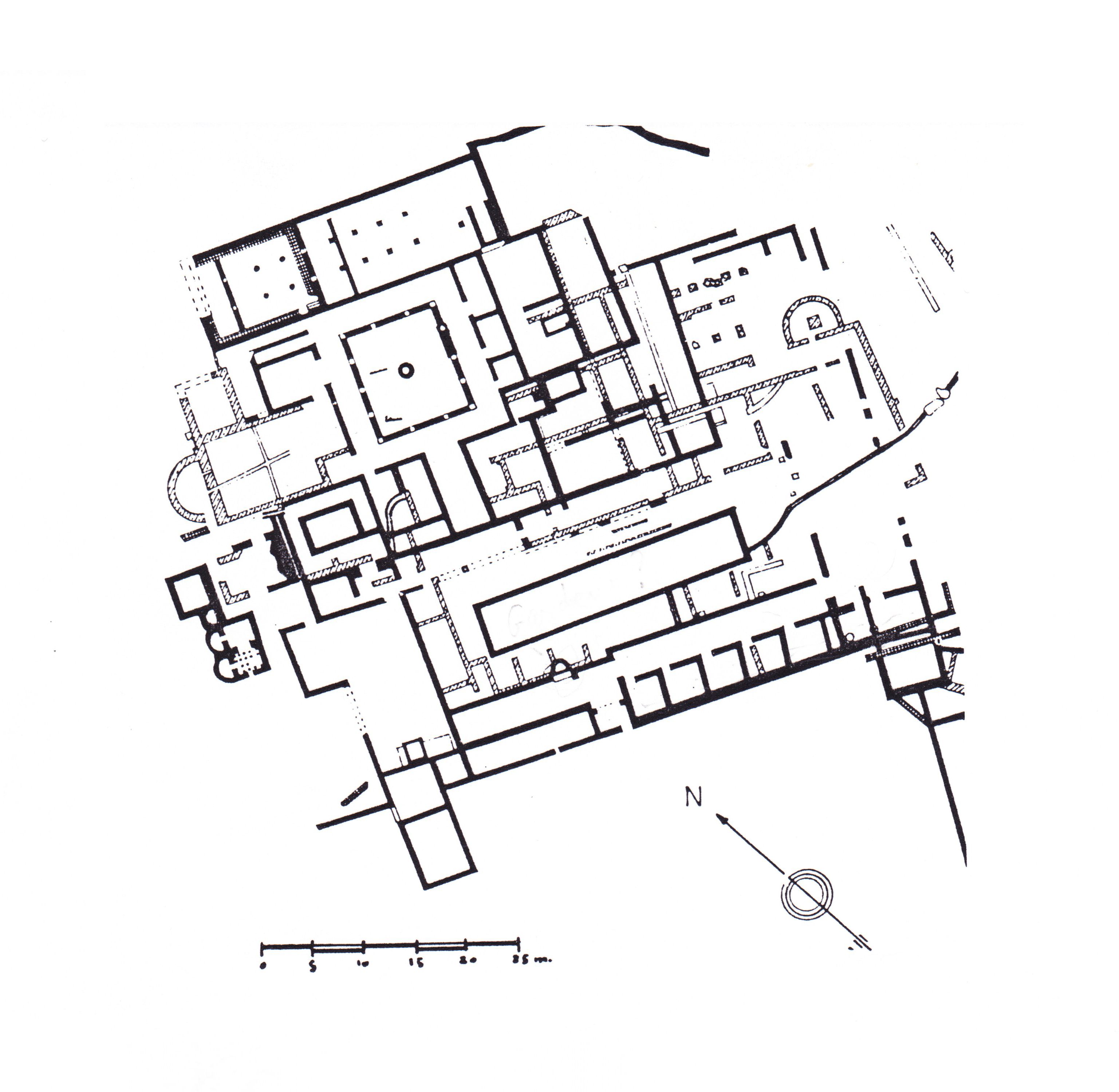
The entrance seems to have been from the south. After a short entrance came a long gallery with polychrome geometric mosaics extending along the south side of a garden with a large central pool. The pool was fed by rainwater from the roofs; an interesting spherical catch basin was found on the south edge of the garden. A drain led off to the east. A low wall ran around the garden. On the north side of the garden a wide passage led straight into the middle of the south portico of the central peristyle. All four porticoes were paved in mosaics. In 1949, Taracena offered a detailed description of the courtyard:
The peristyle is the organic center of the second residence. It measures 10.45 by 9.22 meters, and its date of construction can be determined because in the course of firming up the low wall surrounding it was found a coin of Constantine. Moreover, in exploring the subsoil at a depth of 50 centimeters, the level corresponding to the first villa, another coin of the late empire was found. Together, they seem to confirm that the peristyle was built in the 4th century, possibly in its first third. Inside the peristyle, near the wall, was found a dolium and near the wall on the south side was a line of irregular stones which perhaps formed the border of a flower bed. Even though there are no other remains of bed borders, trellis, or paths nor any trace of plantings which would help us to imagine the interior of the peristyle, we have to suppose it enlivened by some small garden, for a plain earth patio surrounded by mosaics would have been of no use for agricultural work. Moreover, we have found peristyles of these dimensions in Clunia with a strip of garden a meter wide running around the inside of the bounding wall and limited on the inside by bricks in the ground. This peristyle at Liedena, however, has only a central well whose puteal is lost. The well is 90 centimeters in diameter, lined with small-stone ashlar laid rather irregularly without mortar. At 7.2 meters, it reaches groundwater. - Blas Taracena Aguirre, 1949, p.16
The oecus or principal reception room is the room with an apse facing the southwest corner of the peristyle. It is one of the few rooms resting on foundations from the first villa. Adjacent to its south side is a rectangular area which may have had a garden in the center. Further south was a fairly large open area. Possibly it was a garden, but a palestra associated with the nearby baths seems more likely.
Plans
Bibliography
- Blas Taracena Aguirre, La villa romana de Liédena. Part 1. Excavaciones en Navarra VII P. V. nº 37, (Pamplona, 1949), pp. 353-382 (worldcat)
- Blas Taracena Aguirre, La villa romana de Liédena, Part 2. Excavaciones en Navarra VII P. V. nº 38-39, (Pamplona, 1950) pp. 9-40. (worldcat)
- A. Beltrán Martínez, "La villa romana de Liédana (Navarra)," in Archivo Español de Arqueología, XXIV. Madrid, 1951, pp. 218-220. (worldcat)
- M.ª C. Fernández Castro, Villas romanas en Hispania, Madrid, 1982, p. 70 and 178. (worldcat)
Keywords
- catch basins (AAT:300052554)
- mosaics (visual works) (AAT:300015342)
- drains (AAT:300052564)
- peristyles (Roman courtyards) (AAT:300080971)
- porticoes (AAT:300004145)
Places
- Villa at Foz de Lumbier (Pleiades:250027)
- Tarraconensis (Pleiades:981551)
- Tarraconensis (province) (TGN:6005831)