Corinthian Peristyle
Dates
31 BCE - 4 BCE
Garden Description
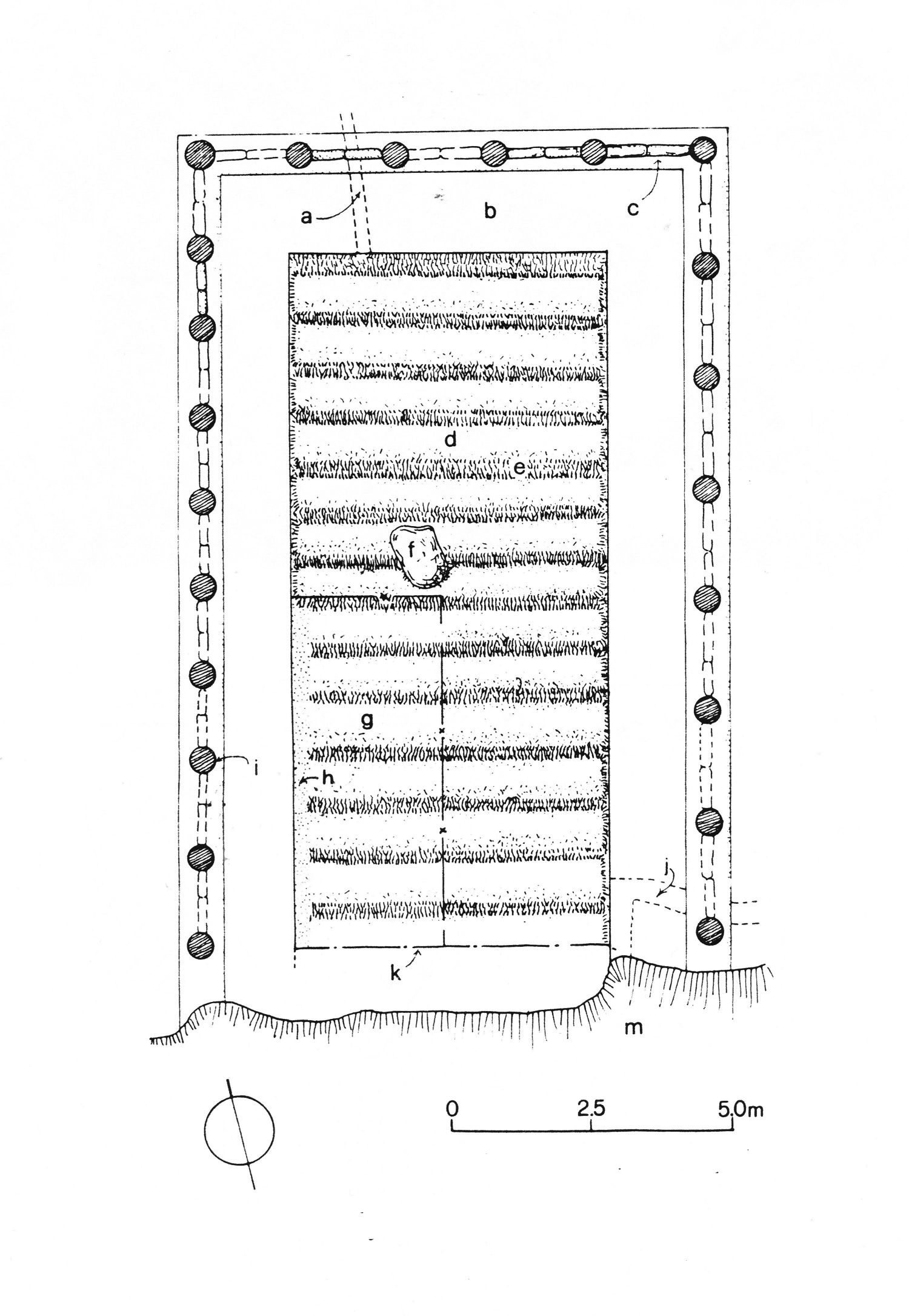
With porticoes on three sides and measuring 23 x 14.5m, this courtyard, known as area B55, is decorated with columns in the Corinthian order. (Fig. 3) The lower portions of these smooth stucco shafts alternate between red and black; above them the columns are of fluted white stucco while the Corinthian capitals are of stone. Thus far, no entablature or roof tiles have been discovered. A low stone wall, known as a pluteus, ran between the columns. Water entered the garden at the north end, under the pluteus from the aqueduct channel serving the adjacent baths. As with garden B64, an opus signinum walk runs along the exterior perimeter of the porticoes. The ridged surface of the garden lies 12cm below the surrounding walk, which is neatly finished with a curb. The ridges are of packed earth, 3 or 4cm in depth, with no trace of plaster or mortar; and whereas in garden B64 there is a covering layer of fertilized soil, in B55 the ridges are exposed. Beneath the packed surface, lies coarse gravel, perhaps equivalent to the subsoil or fill in B64. No perforated pots were found. The only evidence of ornamentation within the garden is a large boulder, centrally placed and apparently part of the garden scheme rather than fallen debris. Along the curb, layers of mineral deposit were excavated from very fine silt sand. In some respects, this courtyard has the appearance of a pool, although its surfaces are not sealed with the grey hydraulic plaster usually employed in water features elsewhere in the palace complex. The nature of this courtyard remains uncertain pending further excavation, but the mouth of a water channel on the north end and the accreted mineral deposit such either a water feature or displays of plants receiving heavy irrigation.
Plans
Bibliography
- G. Garbrecht, and E. Netzer, "Die Wasserversorgung des geschichtlichen Jericho und seiner koniglichen Anlagen," in Mitteilungen (aus dem Leichtweiss-Institut fur Wasserbau) 115, Braunschweig/Jerusalem 1991 worldcat
- K. Gleason, "Garden Excavations at the Herodian Winter Palace in Jericho, 1985-1987", Bulletin of the Anglo-Israel Archaeological Society, Vol. 7, 1987-8 Jstor
- K. Gleason, "A Garden Excavation in the Oasis Palace of Herod the Great at Jericho," Landscape Journal 12.2 (1993):156-67wordcat
- J. Kelso, James L. and Dimitri Baramki, "Excavations at New Testament Jericho and Kirbet en-Nitla," Annual of the American Schools of Oriental Research 29-30 (1949-51): 38-39
- E. Netzer, The Palaces of the Hasmoneans and Herod the Great, Jerusalem: The Israel Exploration Society, 1999: 13-64 wordcat
- Nielsen, Inge, Hellenistic Palaces,1994, 195-201 wordcat
- E. Netzer, The Hasmonean and Herodian Palaces at Jericho: Final Reports of the 1973-1987 Excavations, Vol. 1, Jerusalem: Israel Exploration Society, 2001 : 287-298 worldcat
- E. Netzer, and Garbrecht G, "Water channels and a royal estate of the late Hellenistic period in Jericho's eastern plains," in D. Amit, J. Patrich and Y.; Hirschfeld, eds, The Aqueducts of Israel. 353-365. JRA Supplement 46, R.I. 2002 worldcat
- J. Pritchard, "The Excavation at Herodian Jericho, 1951," The Annual of the American Schools of Oriental Research 32-3 (1952-4): 56-58. worldcat
- D. Langgut, and K. Gleason. "Identification of the Miniaturised Garden of King Herod The Great: The Fossil Pollen Evidence." STRATA: Bulletin of the Anglo-Israel Archaeological Society 38 (2020).
Keywords
Places
- Jericho (Pleiades:687917)
- Iudaea (province) (Pleiades:981527)
- Judean Desert (desert) (TGN:8713913)