Ionic Peristyle
Dates
31 BCE - 4 BCE
Garden Description
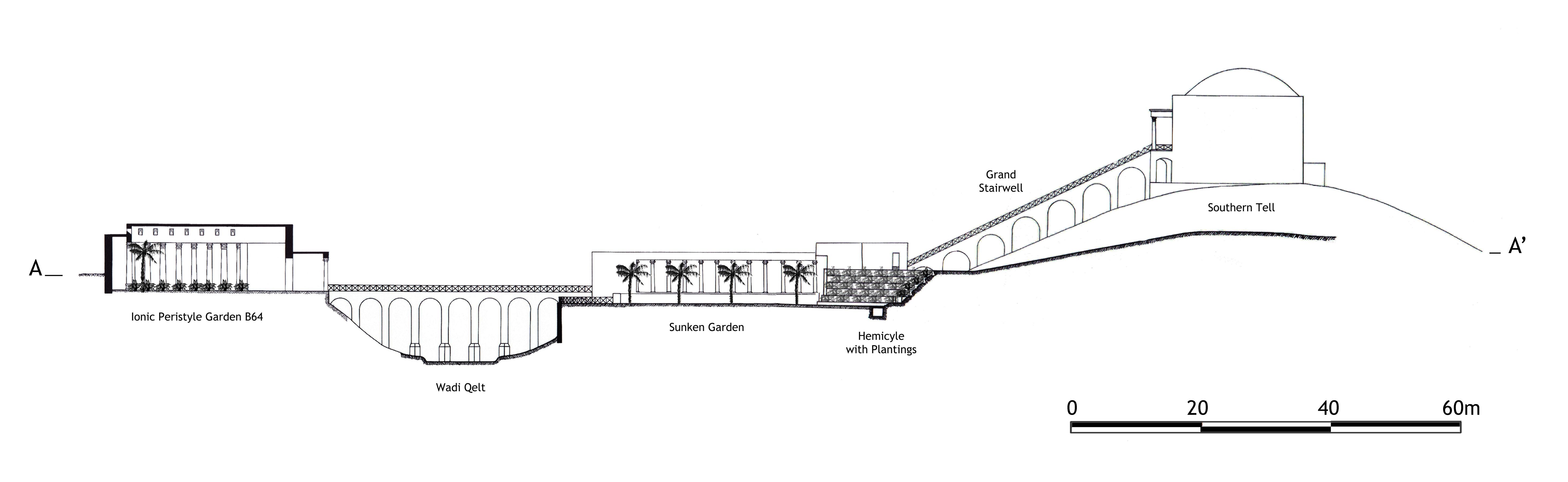
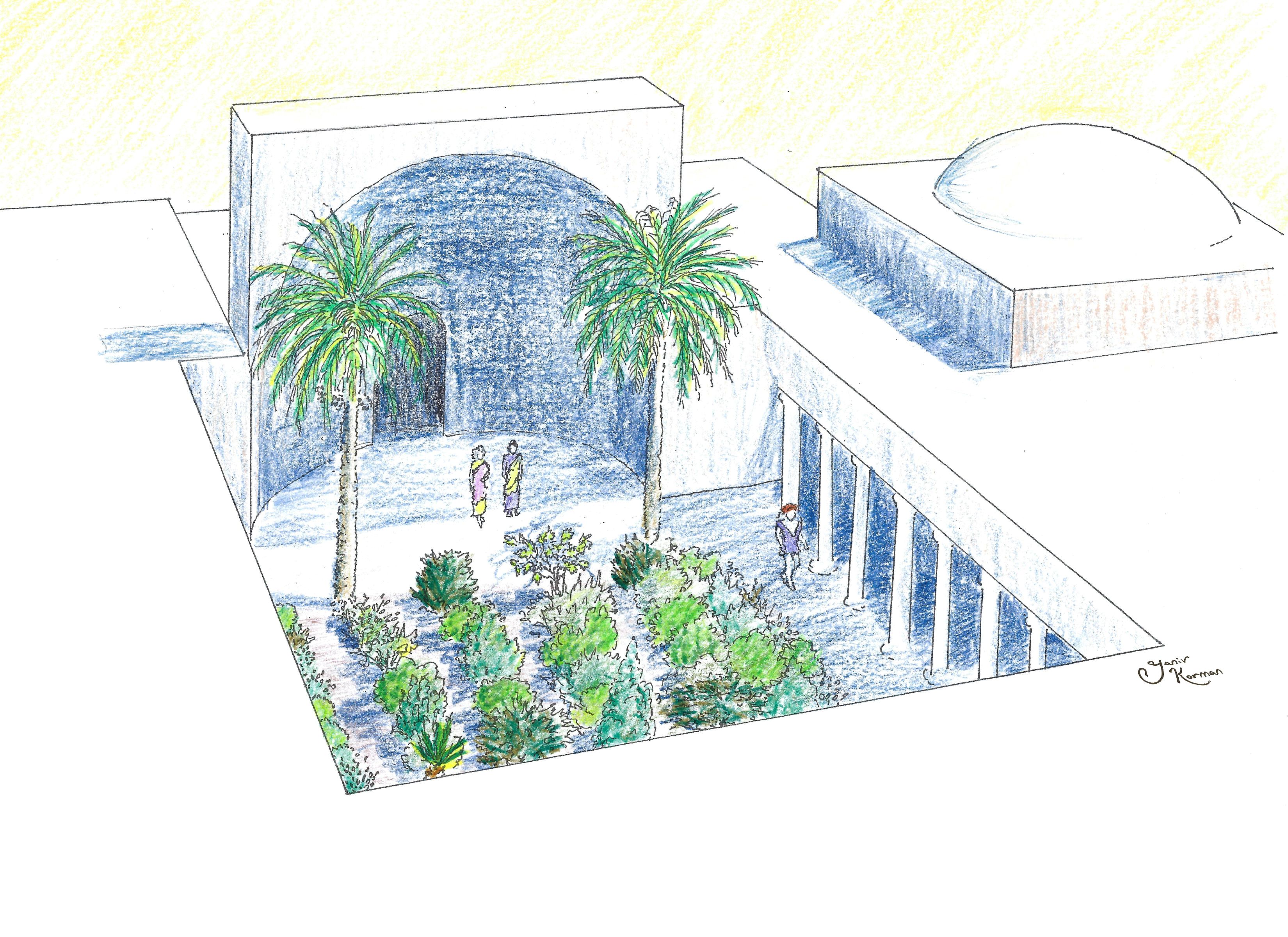
This peristyle courtyard (19.1 x 18.7) lies adjacent to the banquet hall and near Roman baths constructed in opus reticulatum. It is referred to in excavation reports as area B64. The central garden is surrounded on three sides by a colonnade of cemented stone, stuccoed in white and red. Remains of plaster Ionic capitals and other stucco decoration were found during excavation, as well as frescoes with floral motifs of unusually high quality, perhaps made by Roman craftsmen. Rozenberg claimed that this courtyard was the most richly painted space in the palace An unusual feature of the peristyles in this complex is an opus signinum walk around the inner circumference of the peristyle, outside the columns flanking the garden.
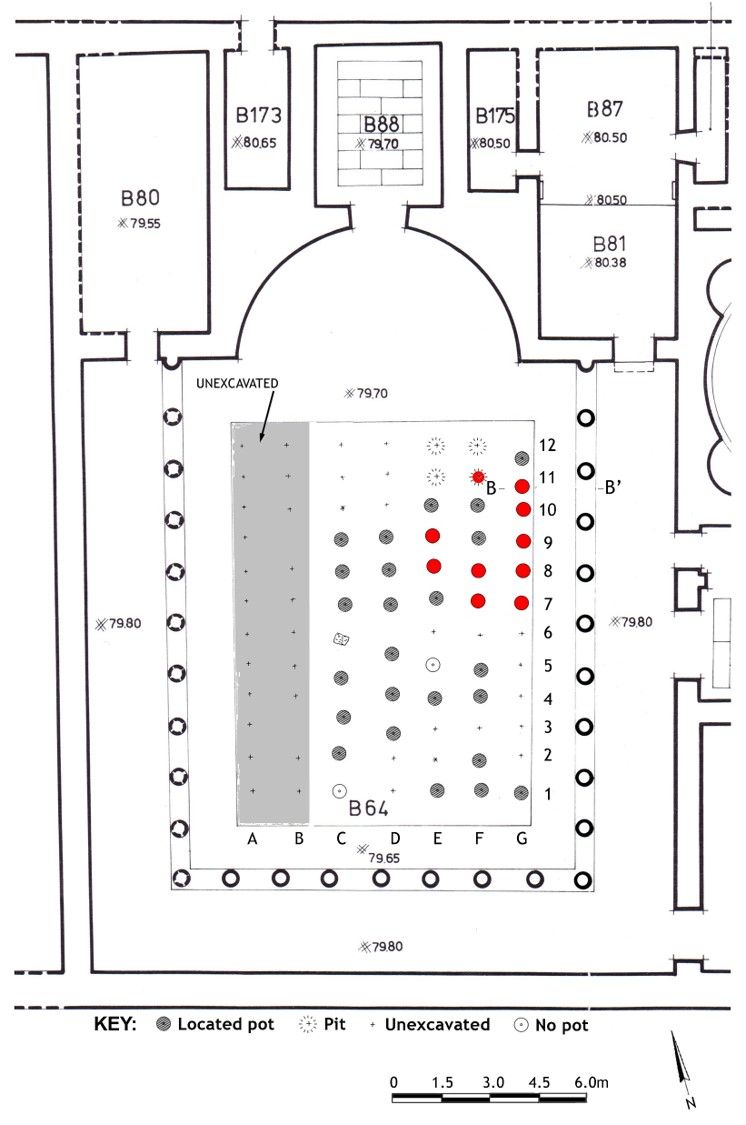
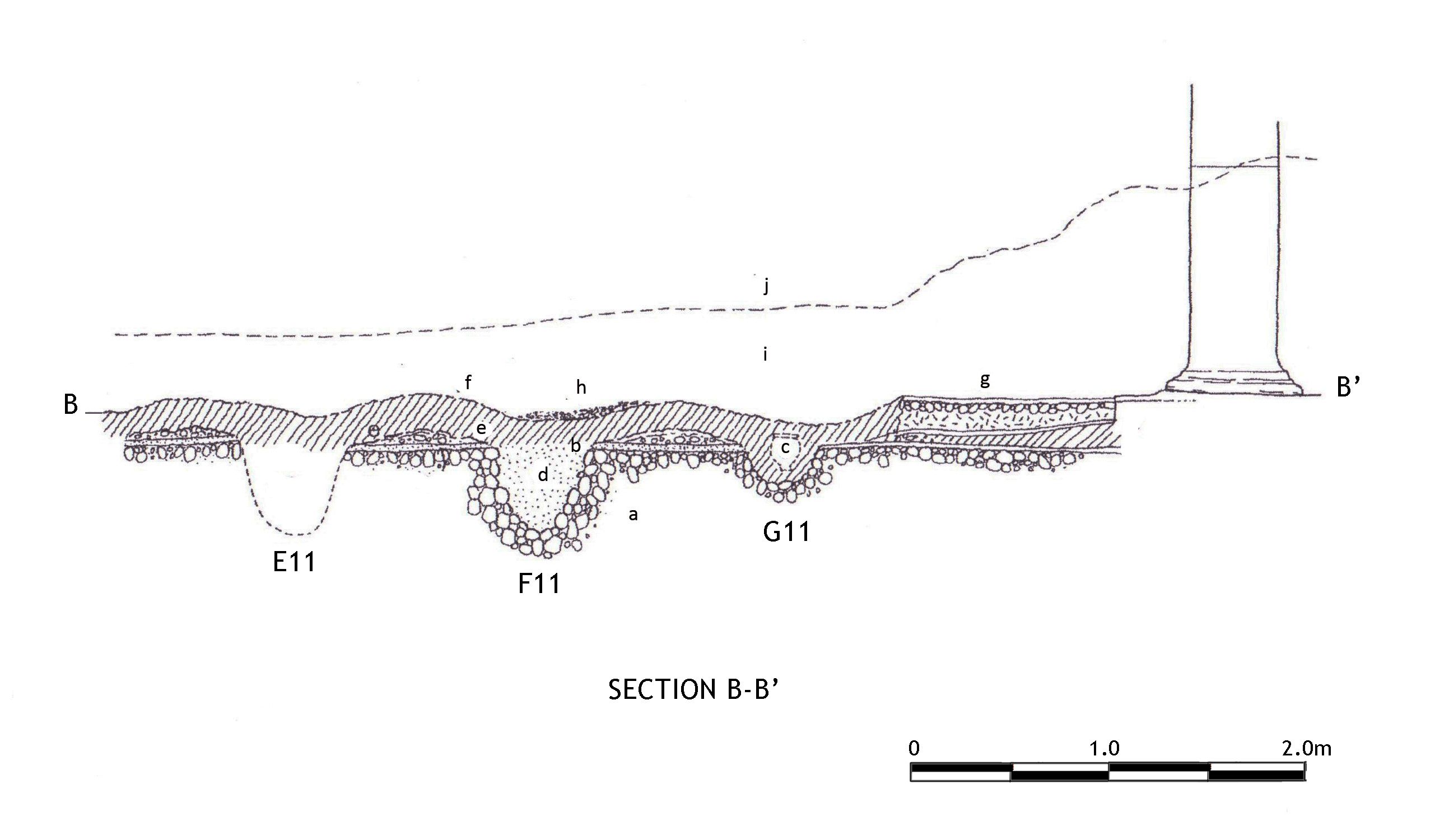
The garden was first discovered in 1976 by E. Netzer, who excavated a trench through the center of the peristyle. The garden soil was poorly preserved, but ceramic planting pots appeared at the bottom of the garden. In 1985 and 1987, K. Gleason continued the excavations and found preserved garden soil layers beneath the destruction debris at the sides of the garden. (Fig. 3 and 4) The stratigraphy is reconstructed as follows:
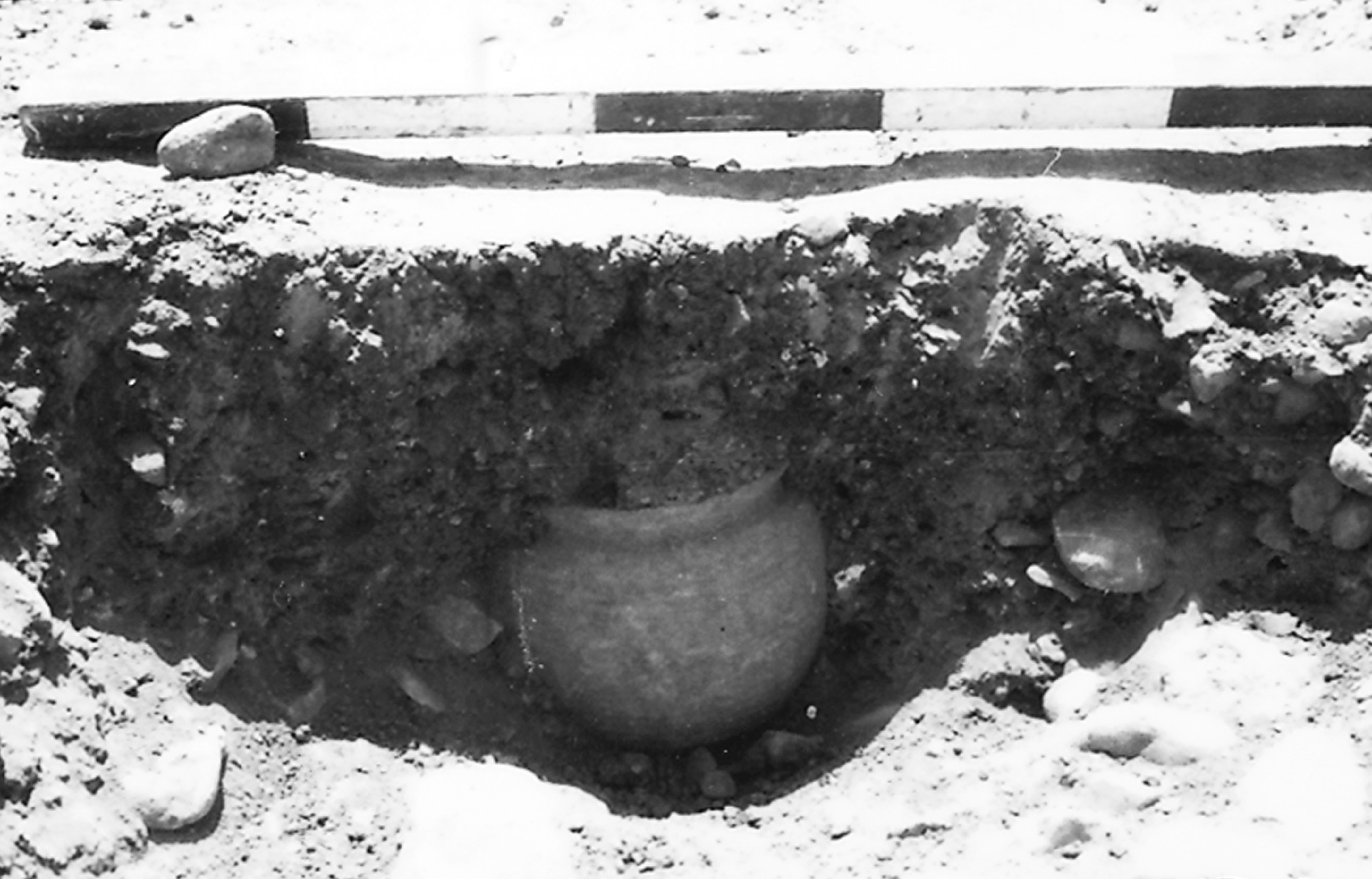
The subsoil, probably fill, is composed of coarse, poorly cemented alluvial pebbles and cobbles. Above this, a thin layer of soil, in most places, plastered over, formed a rough surface over the courtyard, except at the north end, where the plaster tapers off onto a packed earth surface. The crude quality of the plaster and varying types of mortar suggest a working surface for the construction of the peristyle. When the garden was installed, trenches extending down into the subsoil levels were cut out of the plaster surface for the pots and planting pits. (Fig. 5) The flower pots at Jericho are unusual among Roman era pots. They are well-formed of local clay with a hole in the bottom and three holes in the side of the vessel, neatly punched before firing. Their similarity to local water-wheel pots is striking, except that in the planting pot the knob-like foot is open, like a bottle top, while closed in the water wheel pots. The Mishnah suggests that perforated pots, with holes in the bottom and sides, allowed the plants inside to make contact with the ground and thus allow plants or seeds in the pot to be considered like plants in the ground in most matters of agricultural law (Mishnah 8 in Kil'ayim), purity (eg Uktzin 1.9-10), and tithing (Gitin 21b-22a). The rabbis, at least during the redaction of the Mishnah, found that flower pots posed fascinating problems for interpretation.
The plantings were aligned in rows, roughly 1.5m apart. Between the rows, ridges were formed of small cobbles crudely plastered over, apparently to direct the flow of irrigation water. At the north end the situation appears to be somewhat different. The ridges characteristic of the plastered surface end approximately 2m from the walk in front of the apse. In this area only one pot was found, but late in excavation, after light rainfall, three planting pits became evident. These were filled with a light sandy loam, and two were free of flower-pot sherds. The fertilized garden soil was then laid over the whole area, 8-10cm deep and surrounding the pots, but only on the surface of the planting pits.
The plan reveals seven rows of up to eleven pots per row, although directly in front of the apse, tree pits were observed in place of the pots. This regular ordering of rows seems peculiar in such a public location, as Roman gardens of this period could be quite ornate in their layout (Fig 7). A garden at Pompeii laid out in such straight rows would be a market garden. However, the older, Hellenistic and Persian preference is for straight rows, and it is possible that this is a display garden for miniaturized plants (Langgut and Gleason).
Plans
Images
Bibliography
- G. Garbrecht, and E. Netzer, "Die Wasserversorgung des geschichtlichen Jericho und seiner koniglichen Anlagen," in Mitteilungen (aus dem Leichtweiss-Institut fur Wasserbau) 115, Braunschweig/Jerusalem 1991 worldcat
- K. Gleason, "Garden Excavations at the Herodian Winter Palace in Jericho, 1985-1987", Bulletin of the Anglo-Israel Archaeological Society, Vol. 7, 1987-8 Jstor
- K. Gleason, "A Garden Excavation in the Oasis Palace of Herod the Great at Jericho," Landscape Journal 12.2 (1993):156-67wordcat
- J. Kelso, James L. and Dimitri Baramki, "Excavations at New Testament Jericho and Kirbet en-Nitla," Annual of the American Schools of Oriental Research 29-30 (1949-51): 38-39
- E. Netzer, The Palaces of the Hasmoneans and Herod the Great, Jerusalem: The Israel Exploration Society, 1999: 13-64 wordcat
- Nielsen, Inge, Hellenistic Palaces,1994, 195-201 wordcat
- E. Netzer, The Hasmonean and Herodian Palaces at Jericho: Final Reports of the 1973-1987 Excavations, Vol. 1, Jerusalem: Israel Exploration Society, 2001 : 287-298 worldcat
- E. Netzer, and Garbrecht G, "Water channels and a royal estate of the late Hellenistic period in Jericho's eastern plains," in D. Amit, J. Patrich and Y.; Hirschfeld, eds, The Aqueducts of Israel. 353-365. JRA Supplement 46, R.I. 2002 worldcat
- J. Pritchard, "The Excavation at Herodian Jericho, 1951," The Annual of the American Schools of Oriental Research 32-3 (1952-4): 56-58. worldcat
- Langgut D. and Gleason K. 2020. Identification of the miniaturized garden of King Herod the Great: The fossil pollen evidence, Strata.
Keywords
Places
- Jericho (Pleiades:687917)
- Iudaea (province) (Pleiades:981527)
- Judean Desert (desert) (TGN:8713913)