Asclepieia Building
Dates
unspecified
Garden Description
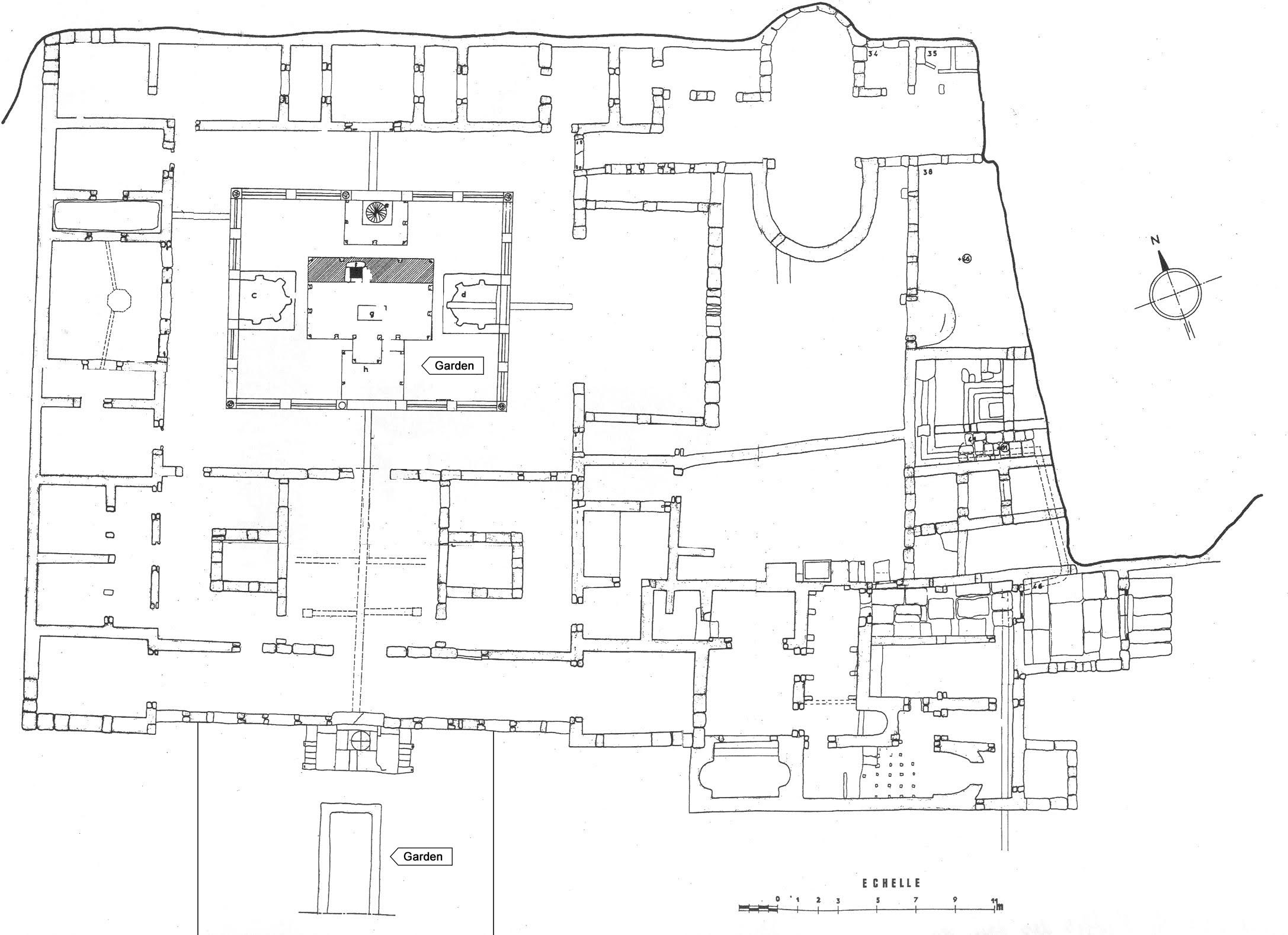
The Asklepeia monument, so-called from a mosaic inscription, is located to the northeast of the House of the Muses. (Plan view, Fig. 1)
This building is divided into three sections: the central building, the northeast sector and the private baths. The central building, probably a house, presents an architectural arrangement unusual in Africa. Strictly symmetrical in plan, the monument has a long gallery terminating at either end in two corner turrets. The facade has several windows on either side of an impressive entrance. This corridor opens onto a large square room flanked on either side by a square-shaped basin with a passageway running around it. This great vestibule views onto a peristyle garden (20.33x17.5m) equipped with a complete hydraulic system in the garden (167m2). Two large symmetrical oeci, along with their adjoining apartments, frame both sides of this peristyle. The garden gradually changed during three phases of building renovation.
During the first phase, in the beginning of the third century, the garden was bordered by twenty columns and had a well (f) and two square shaped enclosures (e, h) from which water jets came out. One jetted towards the reception room (4) located near the entrance on the south and the other jetted symmetrically towards the reception room (23) on the north.
During the second phase, in the mid third century, the garden was enclosed by a balustrade and several water features were added: two semi-circular basins (c, d) symmetrical in shape and size – with a rectangular shape on the outside and semi-circular on the inside, each facing a reception room (28, 16). A shallow round pool that had the shape of a daisy with 49 petals was placed inside the N square enclosure (h) from which water was jetting. The well was later filled with soil and not used.
During this phase, a long rectangular basin (euripus) was laid in front of the entrance of the house. The basin may have been bordered by a garden.
During the third stage dated to the beginning of the second half of the fourth century, the water features were modified and a large basin was added. Niches were added inside the semi-circular basins. In the center of the garden, a rectangular basin (g) (6.20x4.20m) that protruded onto the square basin (h) and enclosed a small rectangular basin (g) (0.15x0.15m) was added.
Plans
Bibliography
- Bullo, S., Ghedini, F., Amplissimae atque ornatissimae domus: l'edilizia residenziale nelle città della Tunisia romana, Rome: Edizioni Quasar, 2003, pp. 21-26. (worldcat)
- Ennaifer, M., La cité d'Althiburos et l'édifice des Asclepeia, Ministère des Affaires Culturelles, Tunis, 1976, pp. 71-152, plan III-IV. (worldcat)
Keywords
- villae urbanaeAAT:300005520
- domusAAT:300005506
- peristyle housesAAT:300005452
- oeciAAT:300080791
- fountainsAAT:300006179
- semicircular basin
- pools (bodies of water)AAT:300008692
- water jetsAAT:300438513
- balustradesAAT:300001989
- euripus