House of the Bassilica (Maison de la Bassilica)
Dates
4th century CE
Garden Description
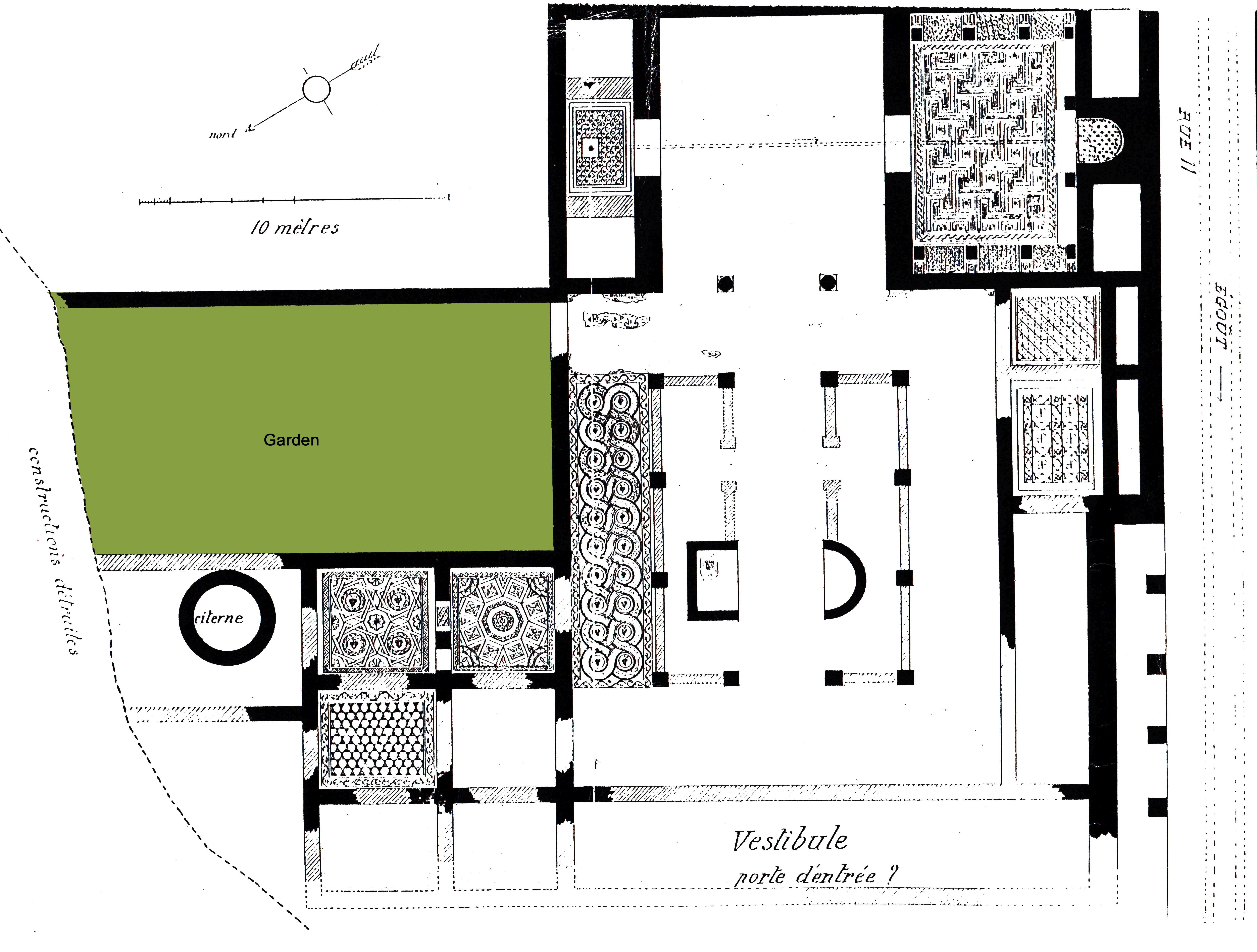
The house was located in the insula delimited by the Decumani North V-VI and the Kardines East VIII-IX and neighboring to the North West the Villa of the Aviary. Unfortunately, the house was badly preserved when Gauckler the excavator discovered it (Plan view, Fig. 1). The peristyle was bounded by four porticoes, which were supported by twelve columns. The courtyard had a central alley that was limited on its two sides by colonnaded low walls that formed a circular exedra on one side and a rectangular exedra on the opposite side facing each other. P. Gauckler mentions that the exedrae were paved with mosaic figures of seashore landscapes, as well as the West portico that welcomed the visitor just after the vestibule. Only small fragments of the mosaics have survived. The central alley of the courtyard was on axis with the oecus.
The North and the East portico lead to an open area that Gauckler identifies as a garden of at least 250m². The house dates from the IVth. c.
Plans
Bibliography
- Ben Osman, W., Catalogue des mosaïques de Carthage, Musée du Bardo, Musée des Thermes d'Antonin; quartier de Dermech, quartier de l'Odéon., Lieu de publication inconnu: Éditeur inconnu, 1980, pp. 577-587. (worldcat)
- Bullo, S., Ghedini, F., Amplissimae atque ornatissimae domus: l'edilizia residenziale nelle città della Tunisia romana, Rome: Edizioni Quasar, 2003, pp.123-124. (worldcat)
- Gauckler, P., Compte rendu de la marche du service en 1903, Tunis, 1904, pp. 16-17. (worldcat)