Richebourg (Yvelines) villa de
Location
Garden
Richebourg (Yvelines) villa de
Keywords
- porticoesAAT:300004145
- trellisesAAT:300006785
- stylobatesAAT:300000986
- amphorae (storage vessels)AAT:300148696
- pergolasAAT:300006783
- apsesAAT:300004607
- cisterns (plumbing components)AAT:300052558
- triclinia (rooms)AAT:300004359
Garden Description
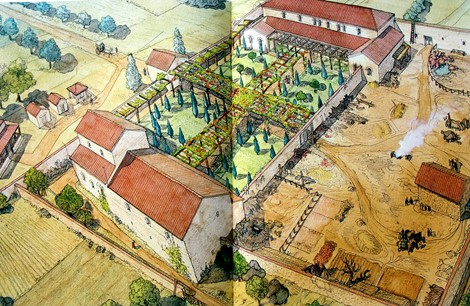
Though the site has an area of 12 or 13 hectares, only one hectare has been excavated, the residential and agricultural part. Two groups of buildings frame a large garden on a slightly trapezoidal, walled area. To the north was the residence; to the south, the utility buildings, including a silo; while to the east, within its own walls, was the farmyard also with several buildings.
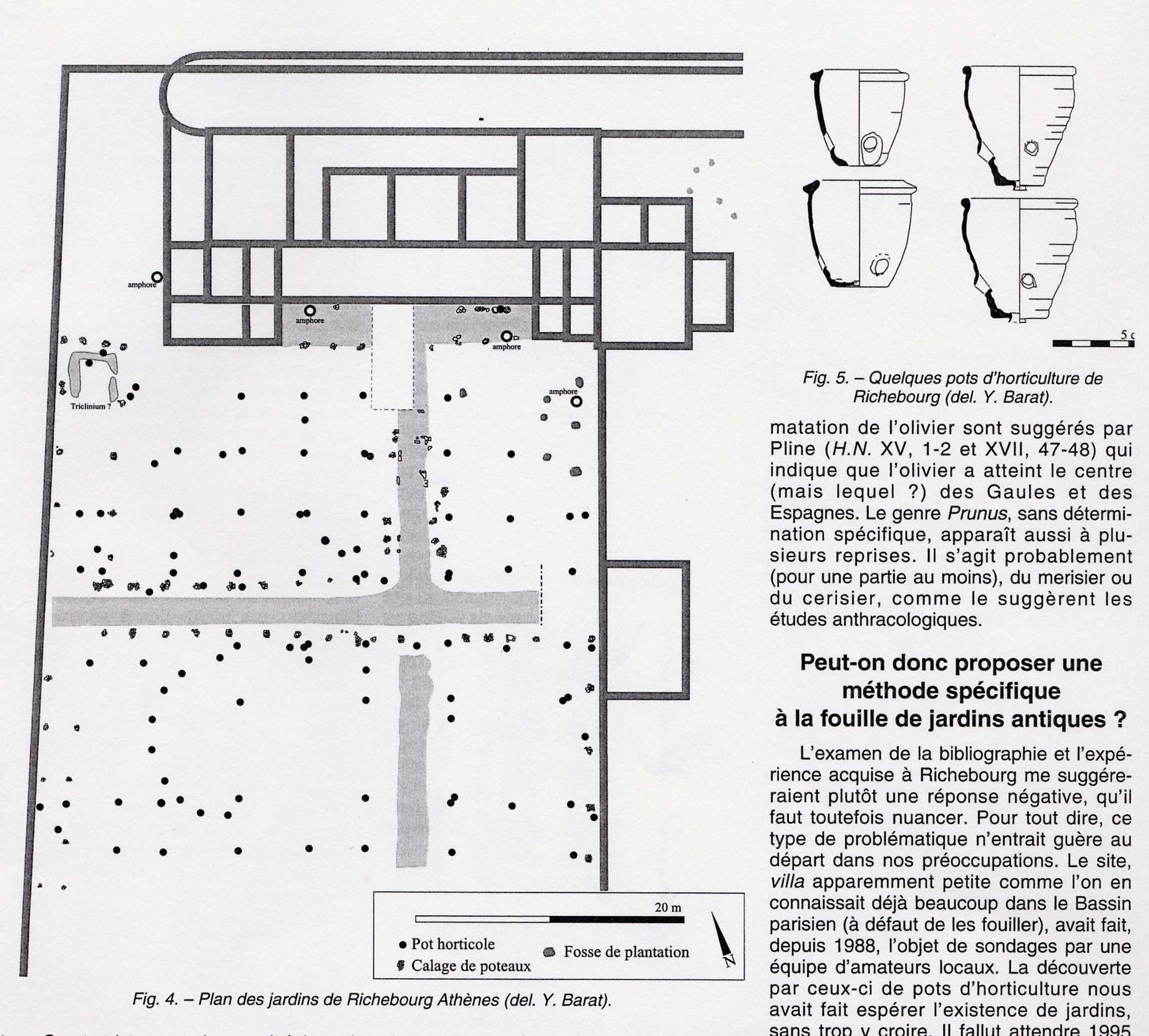
The pars urbana at the north end opened towards the south on a large space [1] developed as a garden. The southern façade was a portico stretching between rooms extending forward from either end of the main house. Along this façade [2], excavations have shown a band of gravel on a masonry base bordered by posts. Perhaps these posts supported a trellis along this façade. Against the stylobate of the portico, several bases of amphorae were discovered, doubtless as pots for plants that perhaps climbed on the trellis. A fragment of a white marble disk could be, according to Y. Barat, the only remains of an oscillum that once hung in the gallery.
The garden was divided into quadrants by two perpendicular roads, once paved with stone, though the stones were long ago carried off. The east-west road divides the garden into two equal parts; it starts in the west from a square entrance porch outside the wall not shown on the plan, then passes through a simple door pierced in the wall and framed by two vertical wooden braces. The other road [4] crosses the garden on the central axis of the residential part in the north, connecting the entry of its southern gallery to the utility building at the southern end of the garden. Symmetrically placed postholes on either side of these two roads indicate perhaps the presence of a pergola or bower. A stone basin was found at the intersection of these two roads. Along the west enclosing wall, other postholes with wedging material may indicate two other pergolas.
These roads mark off four plots of garden land. Dark brown layers indicate that they once received regular manuring and additions of wood ash, fragments of ceramic, shells of oysters and mussels, and pulverized mortar. The plan of the plots is marked out by an orthogonal network of horticultural pots, installed at intervals of 4 meters in each direction. Of the 217 of these pots found, more than 100 were in place. Aside from several bottoms of amphorae, the pots were of the classic flowerpot type, a truncated cone, and they all had a hole and in the bottom and three in the side, near the bottom. A single example had four of these lateral holes. There were five different types all with a top diameter of 8 to 12 centimeters and 9 to 13 centimeters high.
The distribution of each size pot has been carefully analyzed. Barat reports that two of the types were used in a consistent way. Type C, dated at the end of Antonine or beginning of the Severine period, was used only in the northern half of the garden. Type E, dated from the Claudian period, was found only along the post holes of the presumed pergola and would have been for climbing plants such as roses or ivy. (Only these two types could be dated with relative certainty.) In several cases, Barat felt that a grouping of two or three types of pots might simply indicate planting at different times in the same place.
On its northern side, the villa had another façade gallery [6], perhaps an ambulation, opening onto the fields. It was almost 44 meters long and has Tuscan and Corinthian columns. To the west, it was terminated by an apse; and to the east, by a cistern. Baths [7] were installed in the east wing. Next to the house, south of the baths, were several flagstones covered by a layer of garden soil, perhaps marking a flowerbed [8] over a drainage bed composed of fragments of tiles. To the south, six pits [9], 20 to 40 centimeters in diameter and 20 centimeters deep, not in the pattern of the other pots, were filled with an ochre-colored silt. Finally, north of the baths, protected by the extension of the gallery of the north façade, was found a group of five little negative casts of stumps, still with traces of the roots.
Near the southwest corner of the villa, a stone masonry slab [5] of irregular plan but generally U shaped is considered a possible open-air triclinium. It was later damaged by the erection of a building held up by posts.
Pollen analyses have yielded some results, although the pollens were damaged and oxidized by the dry environment. Samples of garden soil were both from the pots and from outside them. Several of the species identified, such as plantain, argue for a mown lawn. The tree species indicate the presence of conifers – cedars, larches and spruces (cedrus, larix, picea). An oleaceae (determined by D. Marguerie) poses problems of interpretation. Was it a lilac or an olive? In either case, it is an imported species. The lilac would come from the northeast of the Balkans; the olive, from the Mediterranean. Though the lilac might seem more probable on the basis of current plantings, it is noteworthy that Pliny reports that the olive was acclimated in central Gaul (H.N. V 1-2, XVII, 47-48). The genus Prunus appeared several times, thus confirming the results of charcoal analysis (anthracology) but without determination of the species – wild cherry or domestic cherry. Ivy is also present, perhaps to cover the pergolas.
Maps
None Available
Plans
Images
Dates
Unspecified
Bibliography
- Y. Barat, La villa gallo-romaine de Richebourg (Yvelines) in Revue Archéologique du Centre de la France, 38, 1999, p. 117-67, plans p. 122, jardin p.140. (worldcat)
- Y Barat, D. Morize, Les pots d'horticulture dans le monde antique et les jardins de la villa de Richebourg (Yvelines), in SFECAG, Actes du colloque de Fribourg, 1999, p. 213-36.
- Y. Barat, La recherche archéologique des jardins antiques in Les nouvelles de l'archéologie 83-84, 2001, p. 56-62, not. P. 58-59.
- G. Coulon, J.C. Golvin, Voyage en Gaule romaine, Actes sud Errance, Arles-Paris, 2002, p.121-3, restitution p. 122-3. (worldcat)
- Y. Barat and D. Morize, L'archéologie des jardins antiques: le cas de la pars urbana de la villa de Richebourg (Yvelines) in Actualité de la Recherche en Histoire et Archéologie agraires, Annales Littéraires de L'Université de Franche-Comté, 764, Besançon, 2003. (worldcat)