Puissalicon, villa de la Condoumine
Province
Province Description
Ancient Roman colony (founded 118 BCE) and senatorial province located in modern southern France, along the Mediterranean. This province had stronger cultural and political ties to Italy than the rest of Gaul.
Location
Sublocation
Puissalicon, villa de la Condoumine
Villa
Puissalicon, villa de la Condoumine
Keywords
- balneaAAT:300120377
- opus spicatum (process)AAT:300417912
- columns (architectural elements)AAT:300001571
- opus signinumAAT:300379969
- statuesAAT:300047600
- fountainsAAT:300006179
- reception roomsAAT:300077176
Villa Description
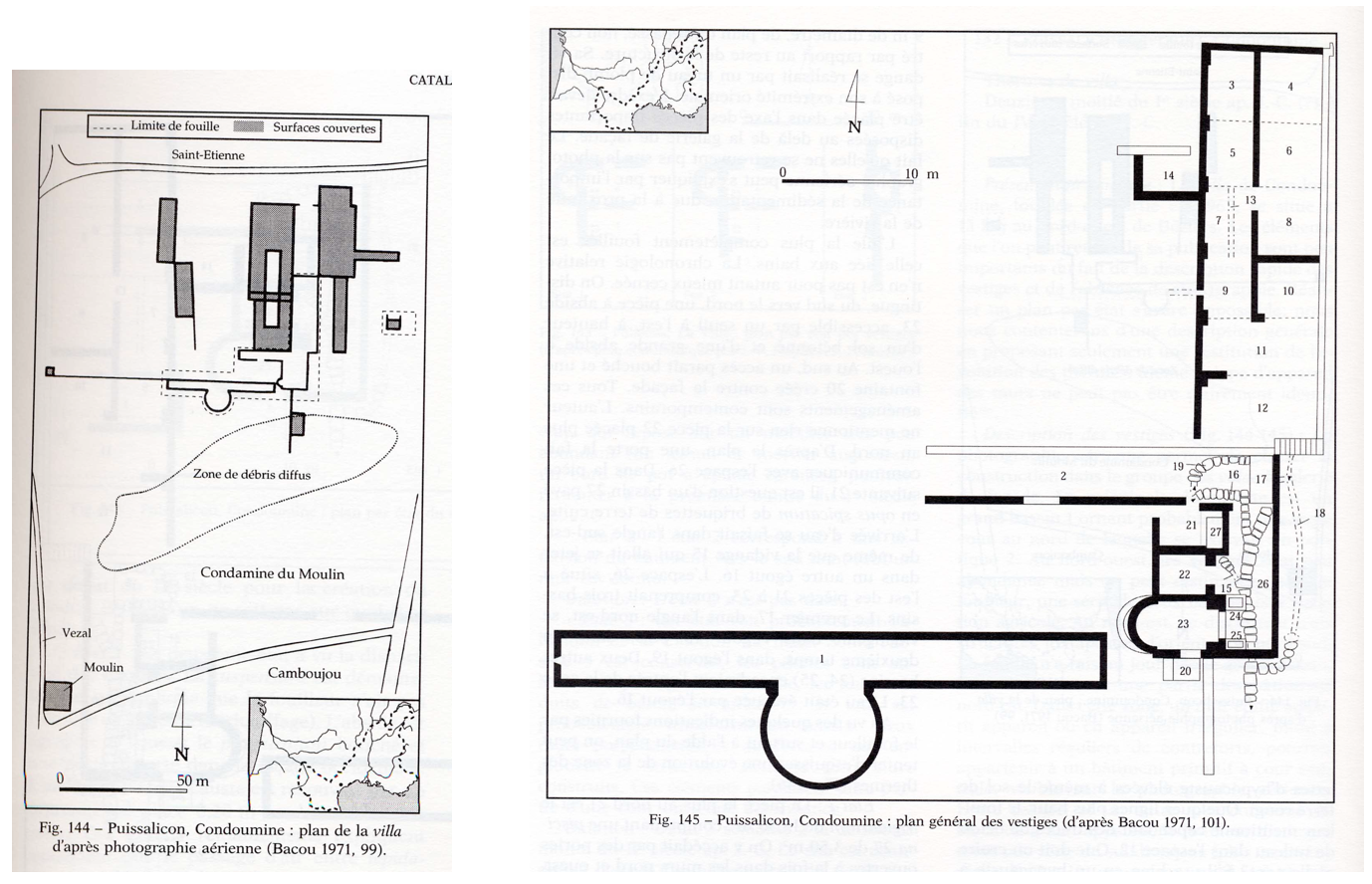
This villa in the plain of the Libron at the place called la Condoumine in the commune of Puissalicon, was first noted between 1926 and 1942 and excavated beginning in 1965. The total site extends over six hectares; the constructions of the villa must have covered some 2500 square meters but only about a quarter of the structures are known for certain. Especially well known are the baths on the south of the villa, which were complemented by a large ornamental pool.
The chronology of the villa is incompletely known. Built in the last quarter of the first century B.C., it was remodeled several times. The baths were particularly affected at the end of the first century A.D. One senses a new series of transformations in the second century and an apparent impoverishment in the third century followed by a revival in the fourth with a remodeling of the baths at the end of the fourth or beginning of the fifth century. It was abandoned in the course of the fifth and sixth centuries. A walkway [2] separated the buildings to the south from those on the north. Paved in opus spicatum, it has yielded many fragments of its pictorial décor. The precise structure of this walkway, however, is puzzling. It would make good sense for the well-constructed wall A on the south to have supported the columns of a gallery, while the frescoes were on the south side of wall B. But wall B was of very rough construction with only mud mortar between the stones, hardly the proper support for such elegant decoration. Exactly what the structure was and where the frescoes were remains uncertain. In any event, south of wall A was a vast courtyard ornamented by a large pool parallel to the walkway (44 x 3 m, 1.2 m deep) with a horseshoe-shaped apse nine meters in diameter. It may have served also as a reserve of water. The bottom was lined with pavers of opus signinum with masonry quarterround to make edges between the bottom and the sides watertight. A lead pipe mounted in a marble plaque provided drainage. The water came from the baths in a canal lined with marble and poured into the pool though a series of mouths of which one in Carrara marble was found, broken, in the pool. The north wall of the pool extended another forty-five or so meters farther to the west to a little square building three meters on a side. In the opinion of the excavator, a garden extended to the south of the pool, where several fragments of high quality statuary were unearthed. A rare find was discovered in digging out a sewer: a marble fountain head, similar to the base of a column but having inside a circular disc, also of marble, with two holes and a bottom shaped so that the water pressure would cause it to turn in its housing, letting water spurt though when one of the holes was over the inflow pipe and otherwise cutting off the flow, thus giving the water jet an intermittent, bouncing effect. The gallery led to baths [19-26]. In a second phase, they were dismantled and the heating system filled in. Two little rectangular pools belonging to fountains were created, one on either side of the door of the former caldarium [23], and another ornamental fountain was placed against the south exterior wall of the baths, blocking a former door and passage way. The apse of the room was enlarged and assumed a horseshoe shape. One may well ask, with Alain Bouet, whether in this late phase the space did not take on the function of a reception room.
Plans
Dates
A.D. 75-100 built
Bibliography
J. P. Bacou, La villa gallo-romaine de Condoumine à Puissalicon, civitas de Béziers, Revue Archéologique de Narbonnaise, 1971, 4, P. 93-149.
Bacou, J.-P. "La Villa Gallo-Romaine De Condoumine À Puissalicon (civitas De Béziers)." Revue Archéologique De Narbonnaise. 4.1 (1971): 93-149. (worldcat)
Alain Bouet, Les thermes publics et privés en Gaule Narbonnaise, vol. II, catalogue, coll. École Française de Rome 320, Rome, 2003, P. 208-11. (worldcat)
Places
- Narbonensis (province) Pleiades: 981537
- Gallia Narbonensis (province) TGN: 7030317
- Andance (inhabited place) TGN: 1031774