Suburban Villa de la Brunette
Province
Province Description
Ancient Roman colony (founded 118 BCE) and senatorial province located in modern southern France, along the Mediterranean. This province had stronger cultural and political ties to Italy than the rest of Gaul.
Location
Sublocation
House
Suburban Villa de la Brunette
Keywords
- atriums (Roman halls)AAT:300004097
- atrium housesAAT:300005451
- porticoesAAT:300004145
- gutters (building drainage components)AAT:300052565
- reception roomsAAT:300077176
- colonnadesAAT:300002613
- columns (architectural elements)AAT:300001571
- statuesAAT:300047600
House Description
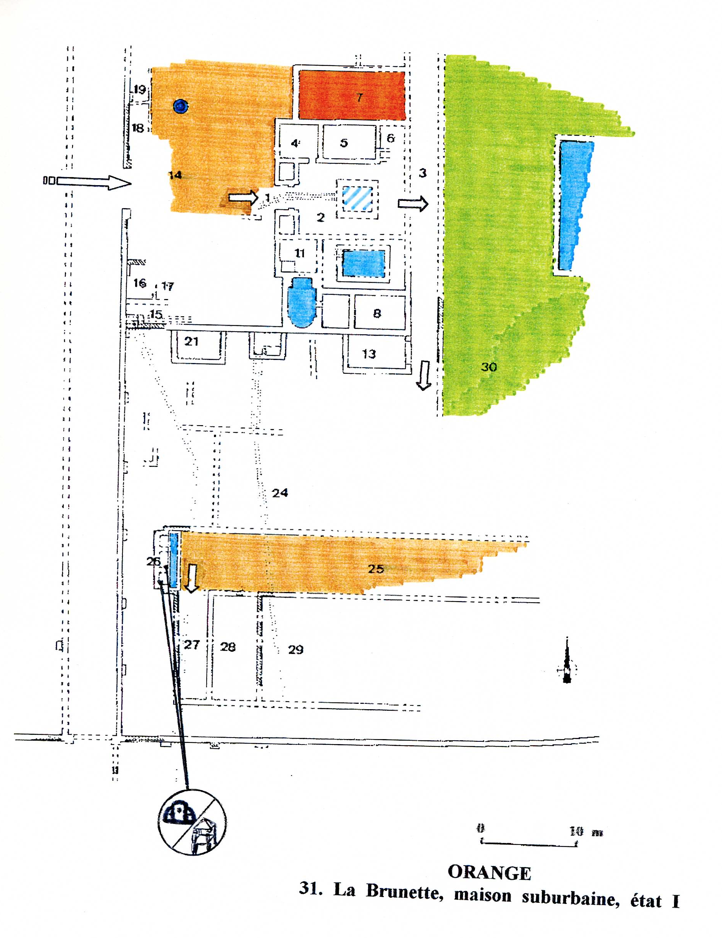
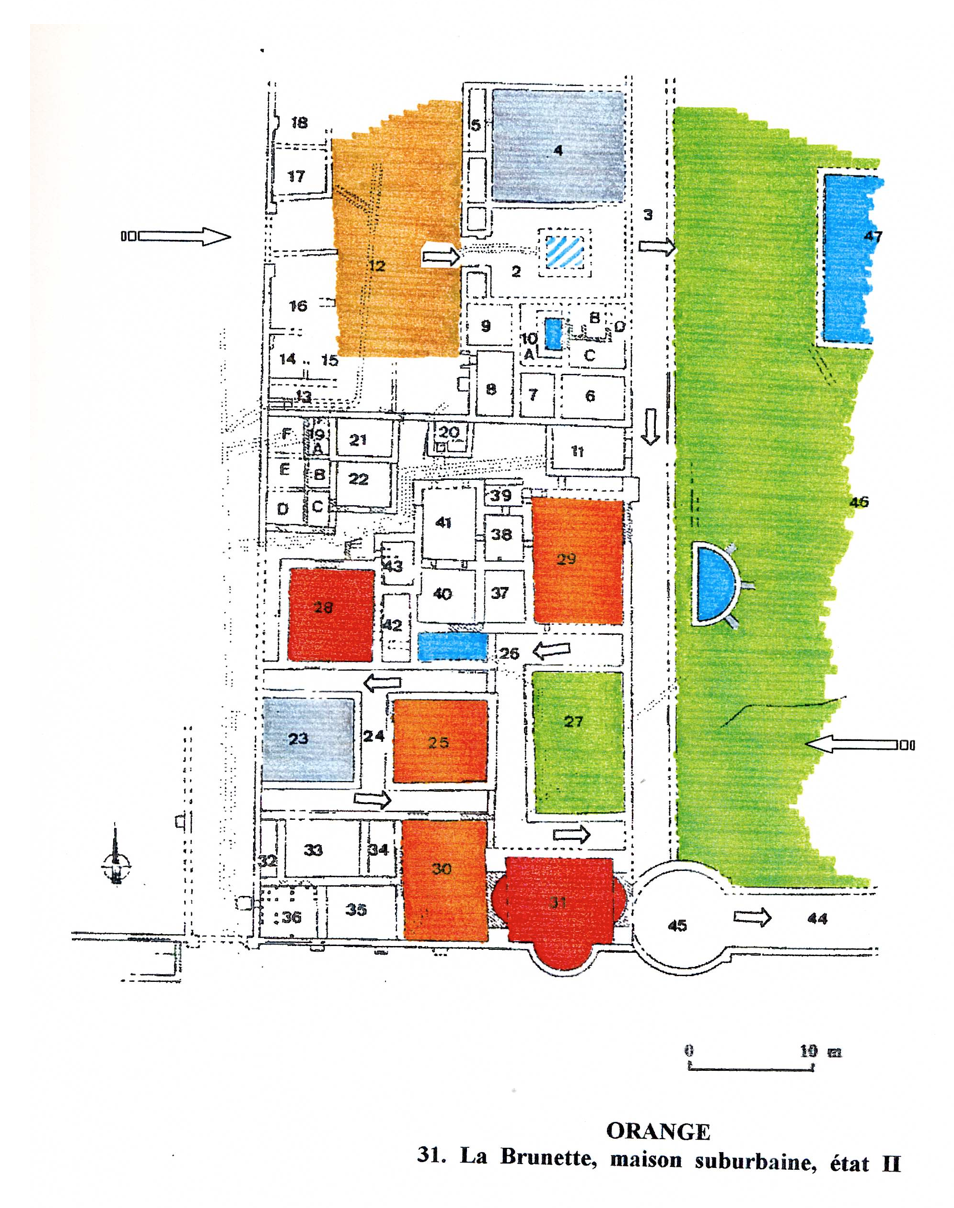
To the west of Orange, this residence is just south of the amphitheater – which was destroyed in the eighteenth century. More than 2000 square meters have been unearthed. It is bounded on the south by a fencing wall 150 meters long and on the north by road that separates the house from the amphitheater. The east and west boundaries are not known. Constructed in the first century A.D. (condition 1), the habitation was greatly remodeled and embellished towards the end of the second century (condition 2) only to be abandoned in the first half of the third century.
Garden Description
Condition 1: The central building is organized around an atrium which opens to the east on the garden through a 2.9-meter wide portico [3]. This portico extends all along the east side of the building and forms a transition between the rooms of the house and the garden. On the north, it opens onto the rooms [4] to [7]. Room [7] is the most spacious of the residential part. The garden [30] unfolds to the east of the villa. Its full surface is unknown, since its limits to the north and to the east are unknown. The form of the plantings has not been ascertained. In the garden, 15 meters from the portico [3], was a rectangular pool [31] 13.35 meters long, more than 3.5 meters wide (to the limit of the excavation) and more than a meter deep. It is covered with a layer of tile with waterproofing strips in the corners. Around the pool, the ground was covered with pebbles.
Condition 2: Towards the end of the second century, new constructions radically transformed the suburban villa. It was enlarged to the south, and was henceforth organized around an east-west axis of symmetry, that is to say, determined by the two courtyards with portico's [23] and [27]. The first room, [23], is square (7 by 7 meters). Situated at the west of the building, it leads into several large rooms; the central part {of what?} doubtless had a stone floor. The large room [27] is between one courtyard [23] and the second courtyard [7], (7.20 by 11.50 meters), separated from the garden [46] by the portico [3]. This courtyard {first or second?} was certainly planted, for the soil is arable earth. It is surrounded by a U-shaped gallery with columns 2.50 meters apart and crowned with Corinthian capitals. A gutter at the foot of the portico collected rainwater. There was no passage towards the center. {What center???} Outside the axial room [25], two other reception rooms opened directly onto the courtyard: the rectangular room [29] and the room with the trilobe plan [31]. A fourth reception room [30], further back, opened into the southwest corner of the gallery.
In comparison to the previous phase, the garden [46] has been considerably enlarged; its southern limit has been pushed back about 40 meters. The portico which ran along the west side [3] has been lengthened up to the wall delimiting the villa on the south. It returns towards the east by a wider gallery [44]. The two galleries meet in a circular room 8 meters in diameter [45] of which only the foundations remain. The elevation could have been a curved wall pierced with bays or a colonnade.
At the heart of the garden, the rectangular pool [47] of the first condition was kept. Along the gallery [3], a semi-circular pool [48] with an internal diameter of six meters was added. It is separated from the gallery by an elongated.
Plans
Dates
A.D. 1-100 constructed
Bibliography
- J.-M. Mignon, I. Doray, V. Faure, A. Bouet, La Brunette à Orange premier établissement antique périurbain (Vaucluse), in R.A.N., 30, 1997, P.173-202.
Places
- Narbonensis (province) Pleiades: 981537
- Gallia Narbonensis (province) TGN: 7030317
- Vaucluse (inhabited place) TGN: 7599818