Villa de Saint-Symphorien
Province
Province Description
Ancient Roman colony (founded 118 BCE) and senatorial province located in modern southern France, along the Mediterranean. This province had stronger cultural and political ties to Italy than the rest of Gaul.
Location
Sublocation
Sublocation Description
Halfway between Avignon and Cavaillon, this villa is west of the present village of Caumont-sur-Durance where the road forks with one branch going to Bonpas and the other to Avignon. It sat upon a little mound overlooking the Durance. Known since its fortuitous discovery in the middle of the nineteenth century, the site is the source of the famous, acephalous Venus of Caumont, a beautiful marble statue now in the Calvet museum.
Villa
Villa de Muscapeu
Keywords
- peristyles (Roman courtyards)AAT:300080971
- mosaics (visual works)AAT:300015342
- porticoesAAT:300004145
- hypocaustsAAT:300004277
- orchardsAAT:300008890
Villa Description
The site of the villa is practically completely covered by modern houses. The villa, of vast proportions, was built on successive terraces whose form survives in the present layout of lots. The part already excavated have revealed a sigma-shaped portico and at least two groups of rooms connected with baths. The construction was luxurious as attested by fragments of opus sectile, mosaics and wall paintings of quality, and especially by beautifully made architectural tiles called Campana plaques, with low-relief volutes and images of porticos, winged victories sacrificing bulls .
In the course of test probes for the construction of a subdivision, a large ornamental pool was found on the terrace below the villa. In 2001, a program of archeological research was begun on this vast terrain which was once a huge garden, 140.6 by 83.5 meters for a total surface of 1.2 hectares. To create a level surface, the lower parts to the south and east had been filled with earth moved from the upper parts. A wall around the outside 60 centimeters thick completely enclosed the terrace; sections fallen in place show that it was 2.9 meters high. It is still standing on south and east sides, where it continues to function as a retaining wall. On the west side, below the villa, it both served as a buttress and gave an esthetically pleasing, monumental façade to the terrace. In this part of the wall, semicircular niches, 3.32 meters in diameter extended out, away from the garden at regular, 18.75 meter intervals; open on the garden side, they may have served to accent sculptures. These niches alternated with semicircular buttresses, also protruding outside the garden but walled up on the line of the wall. The were constructed on top of the embankment and were thus anchored at a higher level.. The inside of the wall was covered by carefully executed opus reticulatum, a technique common in Italy but rare in Gaul. This fact has given rise to the hypothesis that the proprietor brought workmen from Italy. On the basis of the construction and the general context, a dating in Augustan times, in the last third of the first century B.C. has been proposed. Despite the internal buttresses, the wall was not sufficiently well founded against the embankment on the west side, and soon fell over.
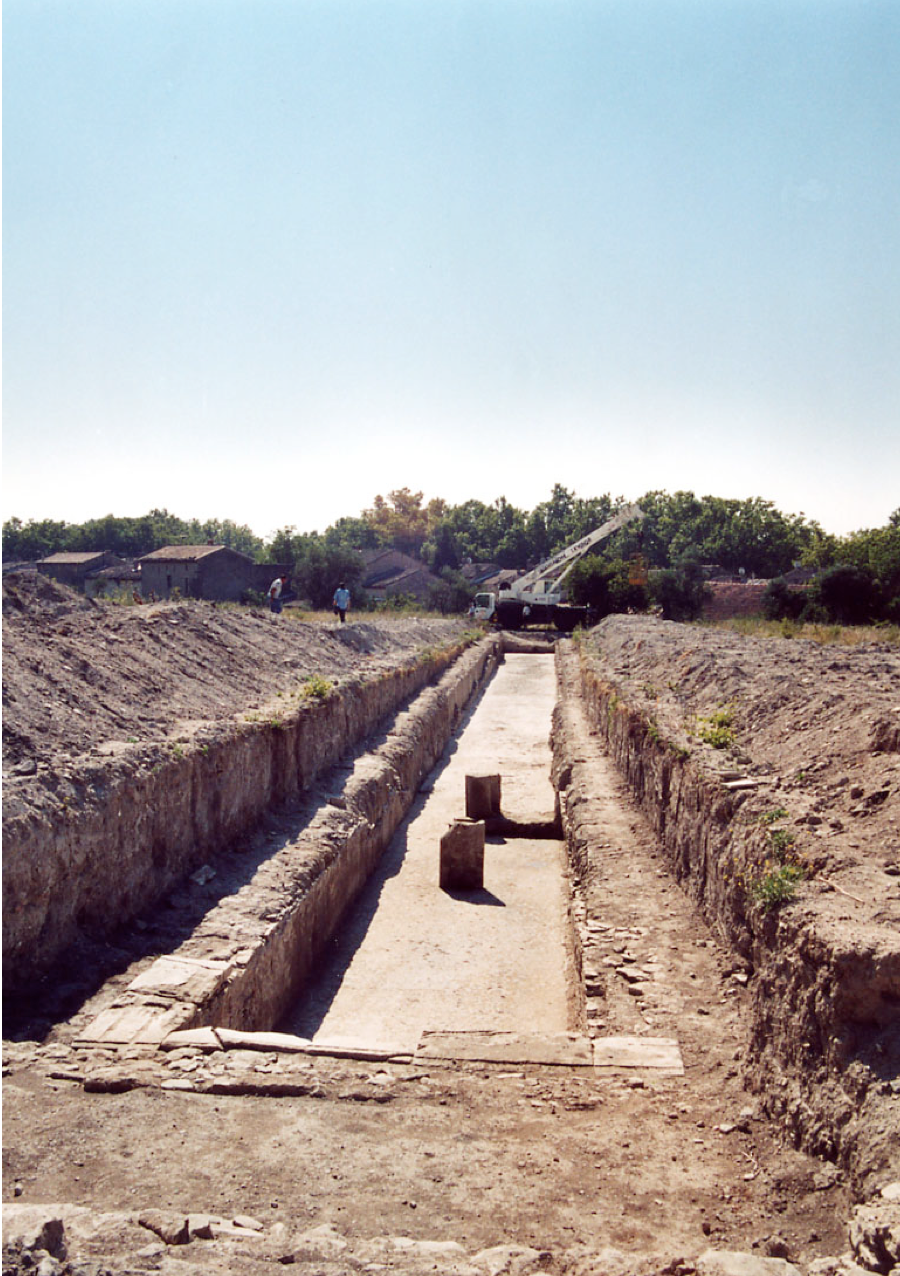
Doubtless also from the Augustan period is the monumental, elongated rectangular pool (66.05 by 4.58 meters), 1.2 meters deep, which cuts across almost the entire width of the garden approximately in its center. It seems impossible to date its creation later than the year 1. The inside was covered with a thick layer of smooth opus signinum painted red. A rim of limestone flagstones terminated its border. The ground was covered with a careful opus spicatum extending over some 202 square meters with a blend of bricks of colors differing according to differences in firing. A flight of five limestone steps in one corner allowed easy descent into the pool.
The water supply system for the pool is not known. A nearby spring may have contributed to filling this 280 cubic meter pool, without, however having a sufficient output to fill the pool completely. One can also imagine pumping from an inlet cut in the bank of the nearby river, and the contribution of captured rain water is not to be forgotten. At the eastern end, a horizontal plughole permitted emptying the pool into a sewer. Outside the pool, running underground along its north side was a drain designed to lower the ground water level, keep the subsoil healthy, and avoid uplift under the pool when it was emptied. It is possible that, besides its ornamental function, the pool served for raising fish, though no chambers for egg laying were built into its walls and no submerged container for hatching was found, and carpological samples have given no positive results.
The first stage, described so far, was followed by a second in which an important restauration took place. The west wall, which had shown signs of weakness, was rebuilt along nearly 40 meters, this time with regular blocks of limestone bound together with lime. Rectangular pillars, encroaching on the garden, marked off rhythmical intervals of the wall. At the same time, fill added to the north west corner raised its level nearly a meter. Excavation of this fill yielded numerous fragments of furniture and of construction material, including nearly 50 fragments of Campana plaques. These fragments permit the dating of this whole operation to the beginning of the second century.
A third stage corresponds to the late use of the garden. In the southwest was installed the shop of a tile maker. North of the west end of the pool, near one of the niches, stuck against two buttresses of the wall were built small baths. They had a warm room with the pool in a little apse and a tepid room on little piles. Heating was provided by an exterior fireplace in a court. Since the pool was still filled with water, to connect to two halves of the area without a long detour around an end, a bridge was built over the pool. It rested on monolithic piles made from re-used columns. Some fifty coins and a purse lost at the bottom of the pool date this transformation to the second quarter of the fourth century.
The abandonment of the garden marked its fourth and final stage. Gradually, the pool filled in and the baths crumbled. At the end of the fourth or beginning of the fifth century, several burials were made in the area, notably in hypocaust under the collapsed baths, in tombs covered with tiles placed to form a little gabled roof or in African amphora.
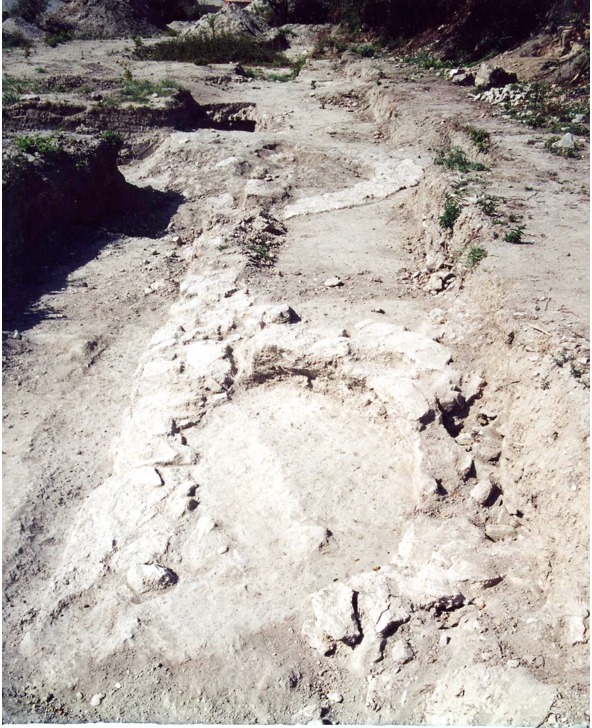
In an effort to determine whether the garden was ornamental or productive, Philippe Boissinot, undertook a study of traces of planting in a area that was sealed in antiquity by the collapse of the enclosing wall. A series of pits could be clearly excavated (Fig. 1&2) Rectangular holes in lines corresponding to grape cultivation were associated with bigger pits, without doubt those of the trees that supported the vines. This method of viticulture, widespread in antiquity but rarely identified in the south of France, may well be suggested. The second zone investigated, against the southeast wall, was without doubt an orchard.
Images
Bibliography
D. CARRU, D. LAVERGNE, J. MOURARET, Caumont-sur-Durance, Saint-Symphorien, in Bilan scientifique de la région Provence Alpes-Côte d'Azur, S.R.A, D.R.A.C, Marseille, 2002, P. 181-183.
D.CARRU, Caumont sur Durance – Saint Symphorien, in Archéologie en Vaucluse, Journal d'information du service archéologique départemental de Vaucluse, 37, déc. 2002, P. 5.