House B, Les Villégiales, quarter of the Benedictines
Province
Province Description
Ancient Roman colony (founded 118 BCE) and senatorial province located in modern southern France, along the Mediterranean. This province had stronger cultural and political ties to Italy than the rest of Gaul.
Location
Sublocation
House B, Les Villégiales, quarter of the Benedictines
House
House B, Les Villégiales, quarter of the Benedictines
Keywords
House Description
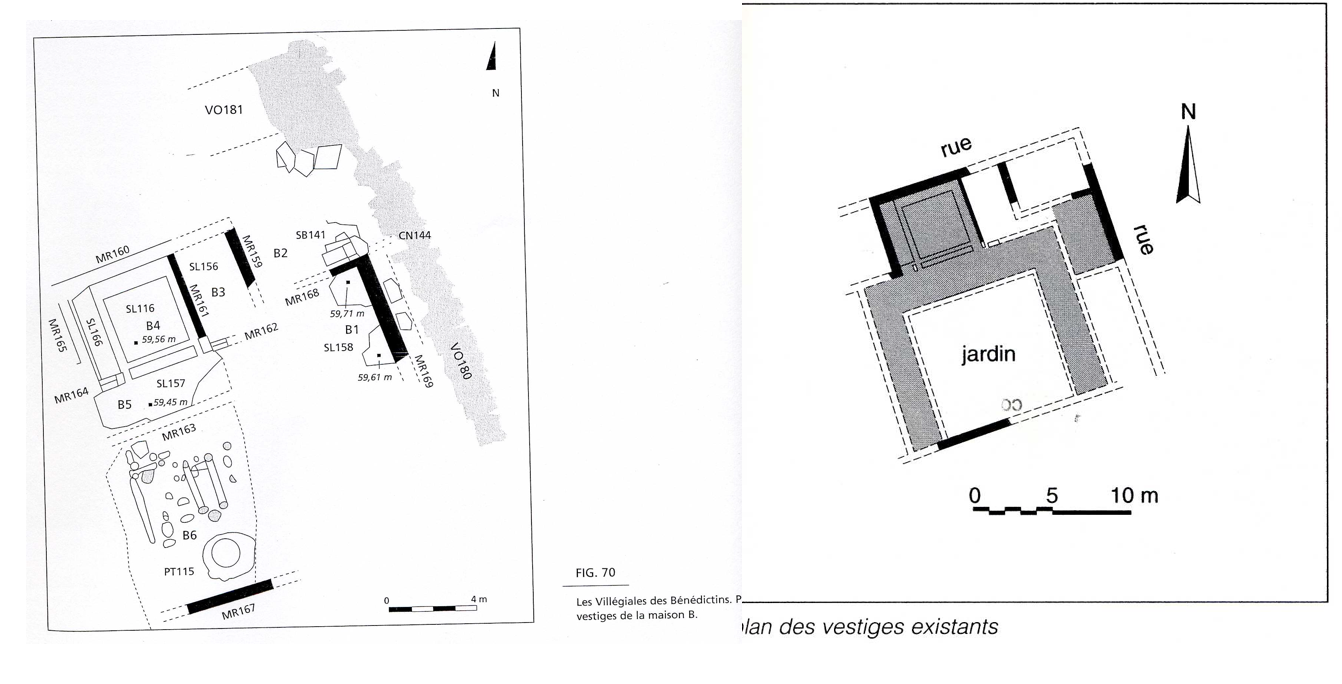
This site is 300 meters east of the big spring de la Fontaine at the foot of Mt. Cavalier. The house, discovered during an emergency dig in 1991-92, is not well preserved. Built in the middle of the first century, it seems to have existed until the middle of the second century. Though not very luxurious, it had however some opus signinum with geometric patterns of tessera. It is noteworthy, however, that in contrast to other houses in Nîmes of the same period, it seems to have had running water supplied by lead-lined canals in a utility tunnel in direct connection to the town water house. Covering a little more than 170 square meters, the dwelling is organized around a garden, which has been explored in an area of 8 by 6 meters, but which must have been somewhat longer and probably had an area of about 72 square meters. Along the east, west, and north sides ran galleries paved in opus signinum with inlays. On the north side, slightly off-center toward the west, there was a small reception room in the form of an exedra (4.8 by 3.8 m).
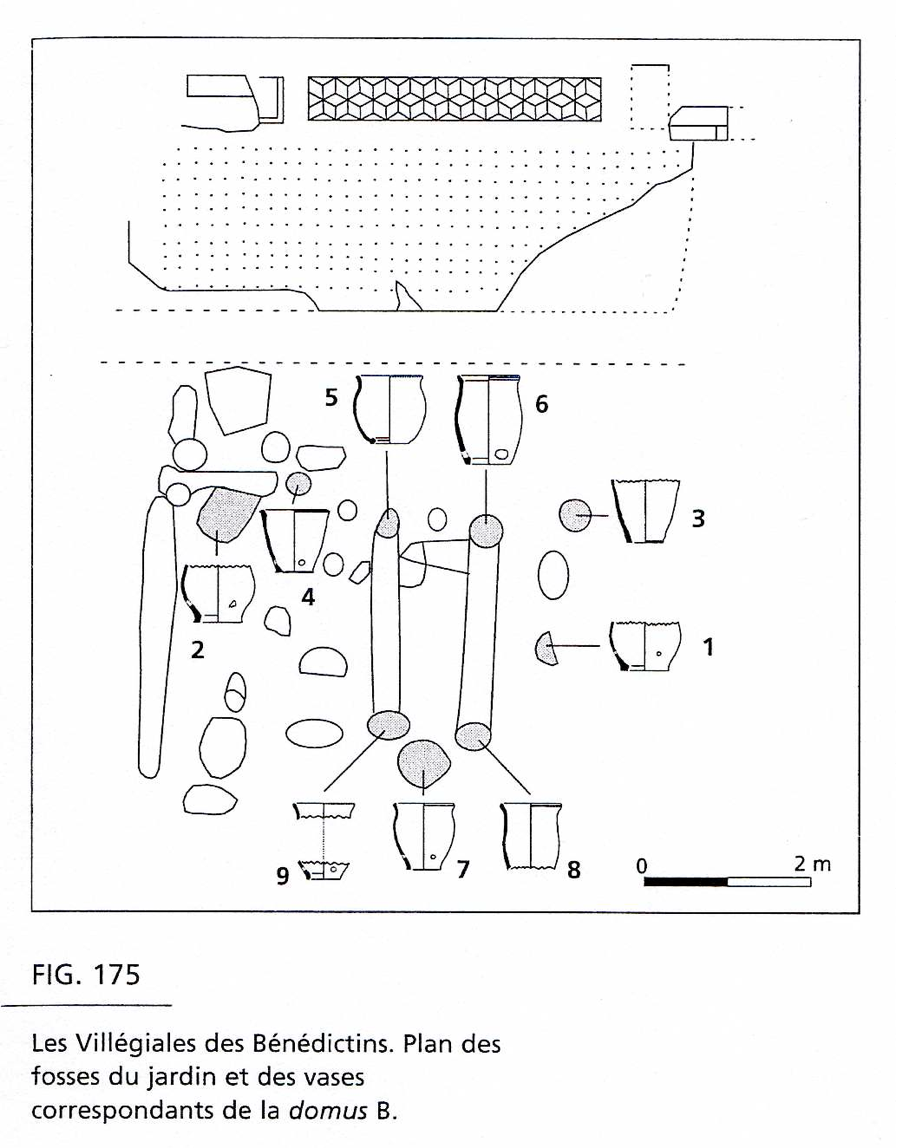
Planting in the garden is well attested by the discovery of nine horticultural pots of globular, ovoid, or truncated conical form made of a pale clay with three fairly large holes on the base of the pot. In all cases where the bottom was present, it had been scooped out before firing. {Does "scooped out" make sense?} They were found in place in circular ditches or at the extremities of long, parallel trenches which may have played a role in the irrigation of the plants. There seems to have been a certain symmetry in the placement of the pots relative to the two straight ditches.
The site had not been disturbed, whence the good state of preservation of the pots, but palynological analysis has not been able to establish the species of the plants on the basis of pollens. Post holes near the trenches, of which three have been identified thanks to wedging stones still in place, may indicate the presence of stakes to support climbing plants.
At the south of the garden there is a well which may have supplied the house before the connection to city water was installed; it could also have been used to water the garden. The absence of ceramic material in the ditches makes precise dating of them impossible, but the general context suggests a date in the first century A.D. for the establishment of the garden. A dump dug in the garden allows dating of one of the principal phases of occupation of the building to A.D. 60 to 90.
Plans
Dates
A.D. 1-100 Built A.D. 60-90 One of the principal phases of occupation
Bibliography
J.L. Fiches, A. Veyrac, Nîmes, CAG, 30/1, 1996.
P.Gros, J. Guyon, Ph. Leveau, dir.,La maison urbaine d'époque romaine, Atlas des maisons de la Gaule narbonnaise, t. II, Doc. d'Archéol. Vaucl, 6, 1996, Nîmes, fiche n°6 P. 200-201.(worldcat)
M. Monteil, Nîmes antique et sa proche campagne, Monographie d'Archéologie Méditerranéenne, 3, 1999, P. 130-135.(worldcat)
Garmy, Pierre, and Martial Monteil. Le Quartier Antique Des Bénédictins À Nîmes (gard): Découvertes Anciennes Et Fouilles, 1966-1992. Paris: Editions de la Maison des sciences de l'homme, 2000, P. 74-90, P 173-181.(worldcat)
Places
- Narbonensis (province) Pleiades: 981537
- Gallia Narbonensis (province) TGN: 7030317
- Nîmes (inhabited place) TGN: 7008371