Villa des Baumelles
Province
Province Description
Ancient Roman colony (founded 118 BCE) and senatorial province located in modern southern France, along the Mediterranean. This province had stronger cultural and political ties to Italy than the rest of Gaul.
Location
Sublocation
Villa
Villa des Baumelles
Keywords
- aqueductsAAT:300006165
- opus signinumAAT:300379969
- colonnadesAAT:300002613
- stairs (series of steps)AAT:300003228
- porticoesAAT:300004145
- mosaics (visual works)AAT:300015342
- reception roomsAAT:300077176
- peristyles (Roman courtyards)AAT:300080971
- triclinia (rooms)AAT:300004359
Villa Description
On a cliff overlooking the sea stood a elegant maritime villa in what is now the quarter of the Baumelles. Excavations go back to the eighteenth century, but new researches were carried out between 1969 and 1973. The first building, dating from the times of Augustus or Tiberius was replaced during the last quarter of the first century by a grand residential villa which existed until the end of the fourth century, though there are traces, such as coins, of very late occupancy even into the fifth century. The luxurious pars urbana covered 1.4 hectares, while the pars agrarian spread out to the south. The villa was supplied with drinkable water by an aqueduct.
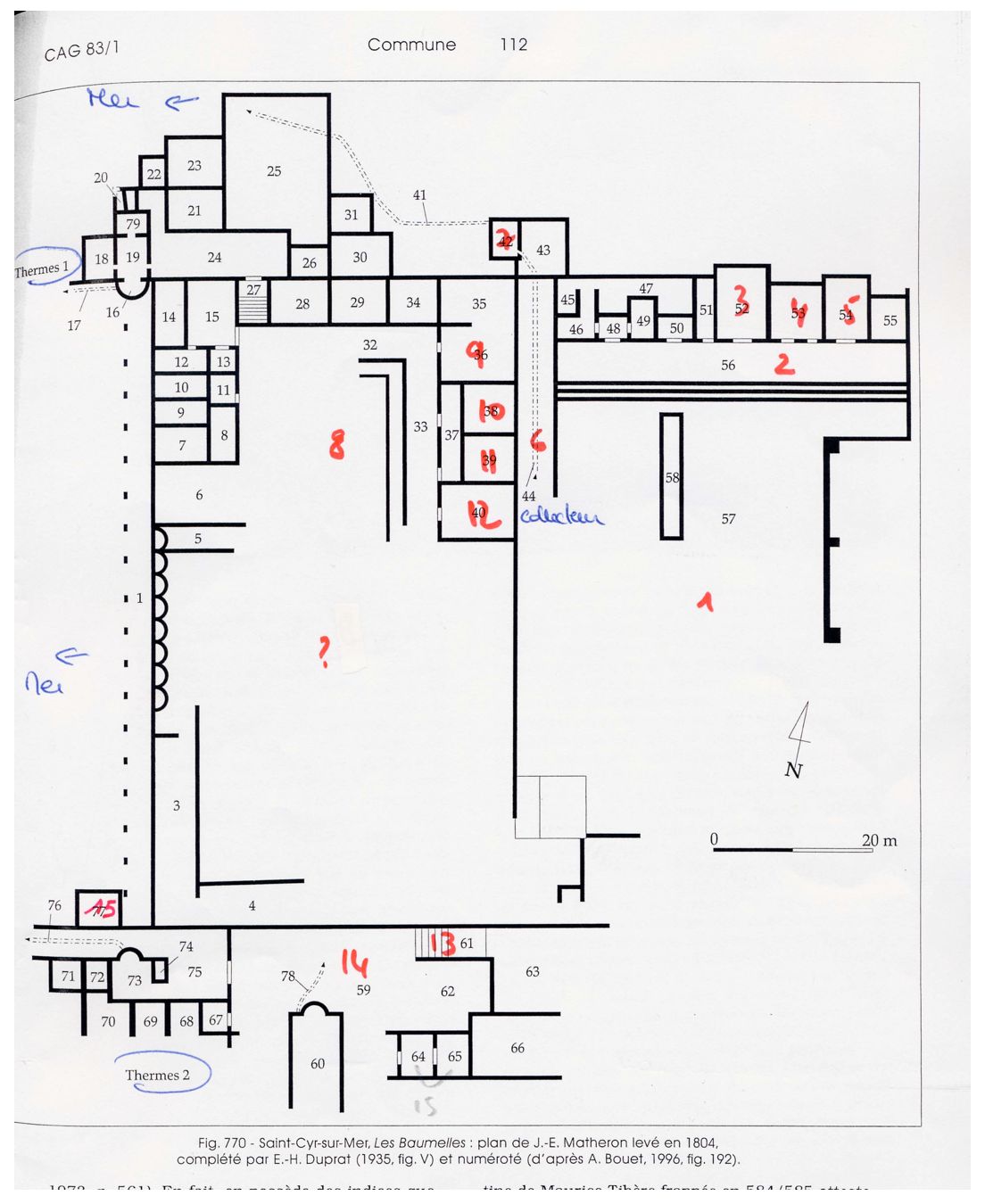
The villa descends, level by level, over several terraces that go down to the southwest towards the sea. The top terrace, in the northeast, opens to the southwest onto an interior garden [1] 32 meters wide with a rectangular pool (2.4 by 14.5 meters) coated with opus signinum. To the northeast, a colonnade (4.8 meters deep and 43 meters long) formed the façade in front of a residential wing, probably accessed by stairs. From the portico behind the colonnade, paved with a white mosaic and with walls covered in marble, opened three reception rooms [ 3, 4 and 5]. The garden was bordered by a buttressed wall which marks its limit. Along the southwest side ran a gallery in which a collector caught the rain water and drained it towards the pool [7] which could overflow into a channel leading to the sea. This sector was not all built at the same time.
To the southwest, a second residential complex, closer to the sea, was developed around a vast garden [8] surrounded by a peristyle with brick columns. The mosaics of the rooms of the northeast wing have been destroyed while the rooms of the southeast wing still have their marble plates and their mosaics in place. This wing is enriched by a series of beautiful reception rooms [9 to 12], of which [12], opening onto the portico, is considered a triclinium. The western and southern limits of the peristyle are poorly known.
An 80-meter gallery running the full length of the villa served as the southwest façade beside the sea. Its stone columns rested on cubical bases. To the south rose a tower, doubtless a belvedere [16], which was perhaps balanced by a symmetric one at the other end of the gallery.
To the south, a charming apartment overlooked the cove of the Madrague and may have been winter living quarters. Below, on the lowest level, another court [14] reached by stairs [13], was embellished by a large rectangular pool (9.92 by 6.15 meters) with an apse at either end. The pool was lined with opus signinum with quarter-round molding for waterproofing in the corners. Steps descended into this pool, and at the foot of the steps a lead pipe was found. The villa also had two facilities for heated baths, one at each end of the façade towards the sea.
Garden Description
Plans
Bibliography
Brun, Jean-Pierre. Carte Archéologique De La Gaule: 83, Le Var 1. Paris, 1999, vol.2, P. 639-649, plan P. 641. (worldcat)
Bouet, Alain, and Philippe Leveau. Les Thermes Prives Et Publics En Gaule Narbonnaise. S.l.: s.n., 1996, P. 293-294. (worldcat)