House in Insula 13 in Aventicum
Location
Location Description
The town was established in the Augustan period as the civitas capital of the Helvetii. At this time the orthogonal street grid was laid out. Most probably in AD 71, it became Colonia Pia Flavia Constans Emerita Helvetiorum Foederata. The town was destroyed or badly damaged around AD 260, and it was progressively abandoned thereafter.
Garden
House in Insula 13 in Aventicum
Keywords
- balneaAAT:300120377
- corridorsAAT:300004294
- fountainsAAT:300006179
- garden pavilionsAAT:300006819
- gutters (building drainage components)AAT:300052565
- insulae (apartments)AAT:300000325
- peristyles (Roman courtyards)AAT:300080971
- piscinae (pools)AAT:300375619
- reception roomsAAT:300077176
Garden Description
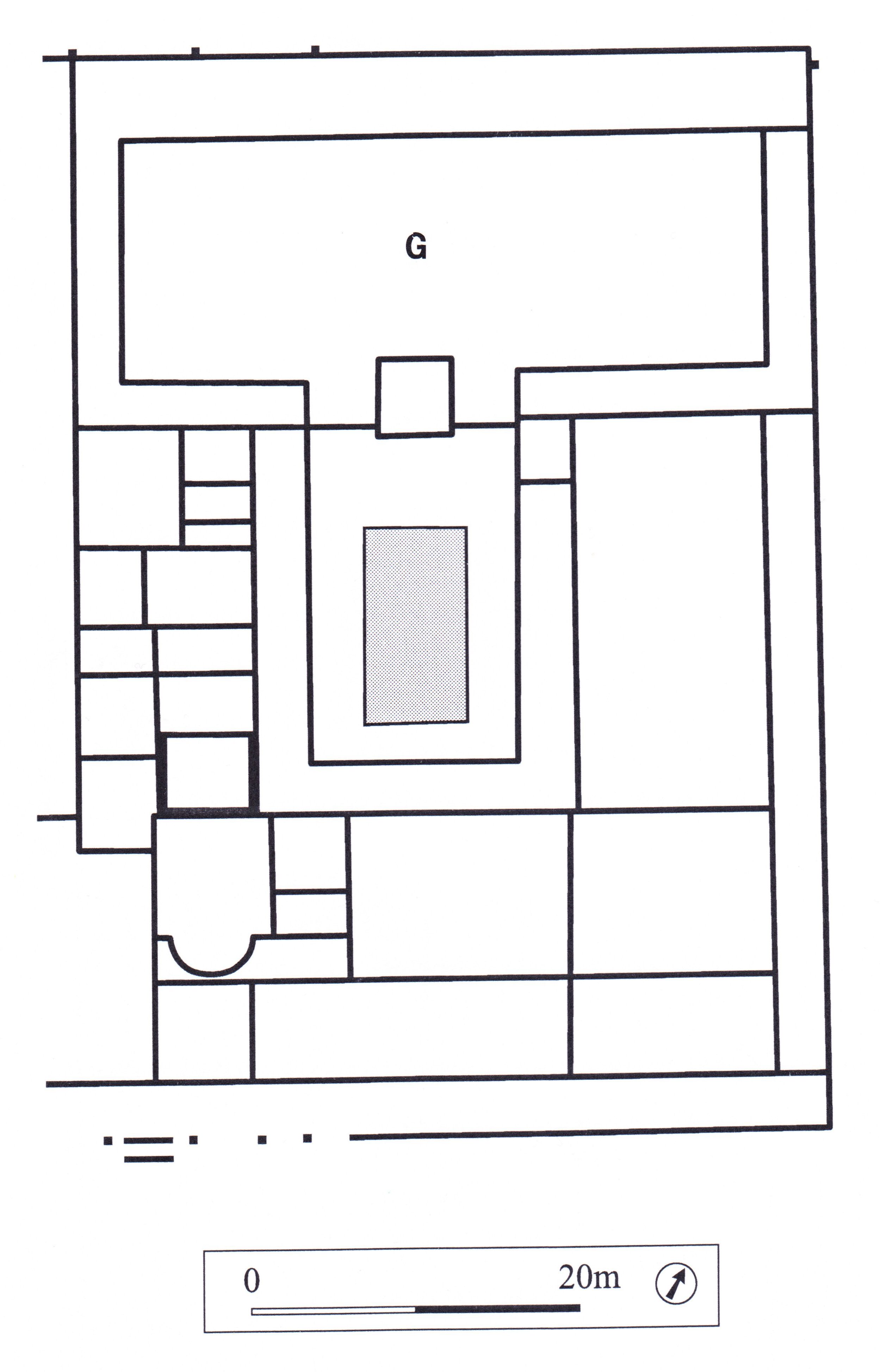
Recent excavations in Insula 13 on the northwestern edge of the town have uncovered the remains of two large and luxurious houses separated from each other by a narrow corridor. They date to the late 1st century and were occupied until the middle of the 3rd century. Both buildings had a length of 60 meters, spanning the length of the insula. The eastern house included a private bath suite and an apsed reception room on the southwest.
The most remarkable feature of the building was a T-shaped garden courtyard (G in Fig. 1) surrounded by a peristyle on all sides (Fig. 1). A ground line gutter ran around the edge of the courtyard. In the southern part of the garden was a large pool paved with limestone slabs and measuring 6 x 12 meters On the northern edge of the pool was a rectangular fountain. To the north of this was a square structure measuring 5.40 x 5.40 meters which may have been a garden pavilion.
Plans
Dates
Houses: Late 1st century - Middle of 3rd century
Bibliography
- J. Morel, "Chronique archéologique 1993," Bull. de l'Association Pro Aventico 35, 1993: 19-21, figs. 8, 11.
- J. Morel, "L'habitat," in : A. Hochuli-Gysel, ed., Avenches, capitale des Helvètes, Archéologie Suisse 24.1, 2001: 45-46, figs. 58, 60. (worldcat)
- M. Carroll, Romans, Celts and Germans. The German Provinces of Rome, Stroud, 2001, p. 55, fig. 20. (worldcat)