Villa el Ruedo
Location
Garden
Villa el Ruedo
Keywords
- basins (vessels)AAT:300045614
- courtyards (uncovered spaces)AAT:300004095
- mosaics (visual works)AAT:300015342
- orchardsAAT:300008890
- peristyles (Roman courtyards)AAT:300080971
- reservoirs (water distribution structures)AAT:300006191
- triclinia (rooms)AAT:300004359
- nymphaea (garden structures)AAT:300006809
- kilnsAAT:300022798
Garden Description
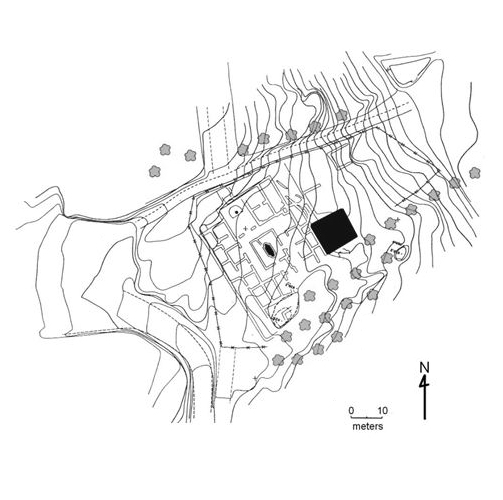
The location of this villa was excavated in 1989, when, owing to a lack of coordination between the Consejeria de Cultura and the Conseqeria de Obras Publicas, a major intersection for A-339 was planned exactly over the villa. An unusual aspect of this site is that the planting pits for trees shading the villa were found clearly defined in the hard earth and rock around it. Each is about one meter in diameter and a meter deep. They are indicated by the green symbols in Figure 1. There was also a large water reservoir that caught the water which had been used for aesthetic effect in the central part of the house and saved it to be used to irrigate the gardens and orchards which presumably extended down the hill to the northeast of the house and between the two rows of trees. The archaeologists working on the site regretted that time and resources were lacking to explore this area with the techniques of garden archaeology.
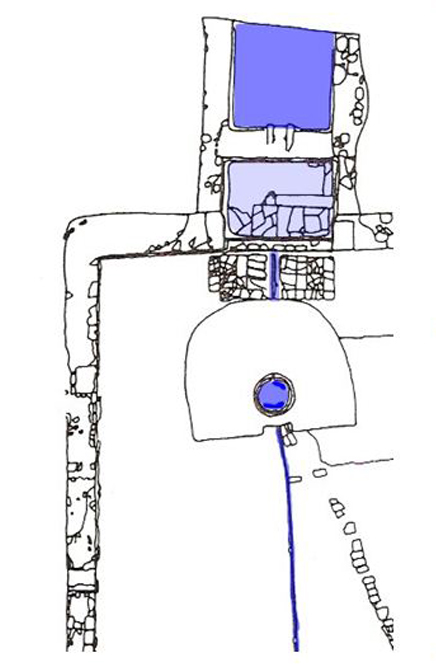
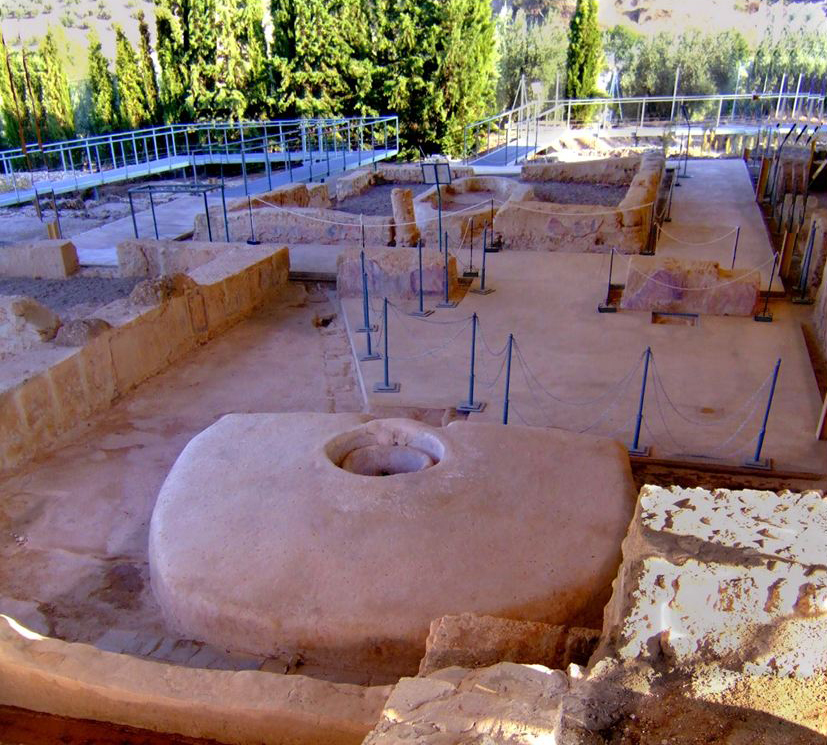
The villa maintained a decidedly agricultural character through four phases. The most highly developed was the third phase, which is the one now represented in the ruins. The striking feature of this third phase is the dramatic entry and use of water. There are numerous springs in the karst formations higher on the hill, and from them the water was gathered into a rectangular tank, visible at the top of Figure 4 and shaded dark blue in Figure 3. At the forward edge of the tank was a small structure with a column of local marble on either side. From the tank, the water rushed down over an inclined surface lined with white marble tiles. At the base of the incline, the water was caught in a trough and guided to the center, where a lead pipe took it down, under the floor of the room below, under a somewhat more than semicircular stibadium and up into a circular basin in the center of front of the stibadium. This basin was, in fact, double, like a circular pan sitting in a larger circular sink. The overflow from the inner basin was caught in the outer basin and led, in part, by a lead pipe to the pool (space X in Figure 2) in the middle of the peristyle courtyard (space XI). A larger part of the water from the basin in the stibadium went to the reservoir (space XV), which then supplied irrigated the presumed gardens on the slope below. The pressure from the water in the trough at the base of the incline kept the water bubbling into the basin in the stibadium. In this villa, the stibadium replaced the triclinium, and the diners reclined with their heads towards the center. This particular stibadium was made of bricks covered in opus signinum. The rest of the room XVII must have been occupied by sculpture, including a copy of a Hermaphrodite statue, and possibly potted plants.
The exterior of the low walls between the eight columns of the peristyle were painted with floral designs. By this third phase of the villa, the center of the peristyle was covered in mosaic. The excavators, however, described the peristyle court as an area where vegetation must have been abundant. The attention to water and to nature in the decoration calls for plants; and the use of planters could have made the center of the peristyle seem like a garden, though no planters were found.
The chronology of the house is quite tentative. A first phase, probably to be placed in Flavian times, was an agricultural establishment with a central courtyard. The second phase added a peristyle to this courtyard and paved its center with mosaics. There may have been a pool in the peristyle. This phase probably lasted through most of the 2nd and perhaps well into the 3rd century. The elaborate nymphaeum and stibadium described above were then created either in the late 3rd or more probably early 4th century. It met a violent end with intentional destruction of the statues early in the 5th century. Later in that century, some industrial structures, including a kiln for structural ceramics, were built on the site.
Maps
Images
Dates
unspecified
Bibliography
- D. Vaquerizo Gil and J. R. Carrillo Diaz-Pines,'The Roman Villa of El Ruedo' (Almedinilla, Córdoba),Journal of Roman Archaeology 8, (Ann Arbor 1995), 121-154. (worldcat)
- D. Vaquerizo and J. M. Noguera,La villa romana de El Ruedo (Almedinilla, Córdoba): Decoración escultórica e interpretación, Diputación Provincial de Córdoba-Universidad de Córdoba-Universidad de Murcia (Murcia 1997). (worldcat)