House No. 1 or West House
Location
Location Description
Baelo Claudia began in the late second century BC as a center for trade with North Africa through Tangier and for salting fish and production of garum, or fish sauces. Baelo's high point was reached about the time of Claudius, when it was made a municipium. An earthquake in the second century AD hastened its decline, though there was some revival in the third century, until it was totally abandoned by the seventh century AD. Nowhere else in the Iberian peninsula is it possible to find all the elements of Roman urbanism in such good condition: forum, temples of the capitol to the traditional gods of the Romans, a temple to an oriental divinity (in this case, Isis), curia, administrative buildings, market, theater, baths, aqueducts, private houses, an industrial zone, and a complete city wall. Only an arena seems missing.
The two private houses where there may have been gardens are near the port and are right next to the fish processing establishments – but upwind of them. They were excavated and documented in the early 1920's by P. Paris and each occupy some 500 square meters. They faced each other with a street with porticoes on both sides between them. Both were two-story houses organized around a central peristyle courtyard. In the first, House 1 or West house, it seems highly probable that there was a garden. In the second, the House of the Sundial, one source may be read to imply that the center of the peristyle was paved in opus signinum and thus could not be a garden. Another reading of the same passage, however, puts the opus signinum only on the gutters around the perimeter of the courtyard.
Garden
House No. 1 or West House
Keywords
- colonnadesAAT:300002613
- courtyards (uncovered spaces)AAT:300004095
- peristyles (Roman courtyards)AAT:300080971
- triclinia (rooms)AAT:300004359
- Doric orderAAT:300067406
Garden Description
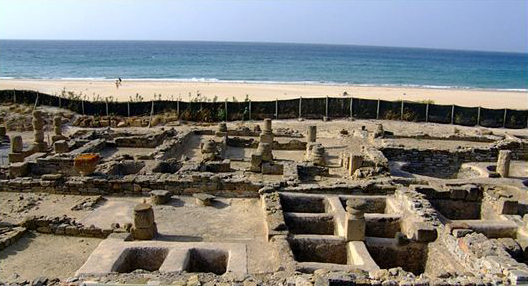
The entrance [Fig. 1, 2] to this house was on the west side of the colonnaded street. Just to the north was a shop [23] selling fish and garum; its tanks are still in place. The entrance hall leads into the west gallery of the peristyle courtyard [25]. There are three columns on each side of the courtyard. Each column's base featured an ornamental double torus. Three capitals have been preserved; they were of the Doric order but were only rough-hewn as they, like all columns in Baelo, were covered with plaster. A garden most likely surrounded the well in the center. Rooms [32] and [33] were probably the reception room and the triclinium respectively. The reception room had a good view of the garden though not central. The northwest corner of the house belonged instead to the garum factory [VI].
Maps
Images
Dates
unspecified
Bibliography
- A. Balil Iliana, 'Casa y urbanismo en la España antigua. Casa familiar y vivienda colectiva en la España romana,' Boletín del Seminario de Estudios de Arte y Arqueología, XXXIX, Universidad de Valladolid (Valladolid 1973), 138-140.(worldcat)
- P. Sillières, M. Fincker, J.M. Labarthe,Baelo Claudia: une cité romaine de Bètique, Collection de la Casa de Velázquez 51 (Madrid 1995), 165-170.(worldcat)
Places
- [House of the West at Baelo]/test-drafts/place/hispania_baetica/baelo_claudia/)
- House of the West at Baelo Pleiades: 574194294
- Baelo Claudia (deserted settlement) TGN: 8712326