House of the Rhodian Peristyle
Location
Location Description
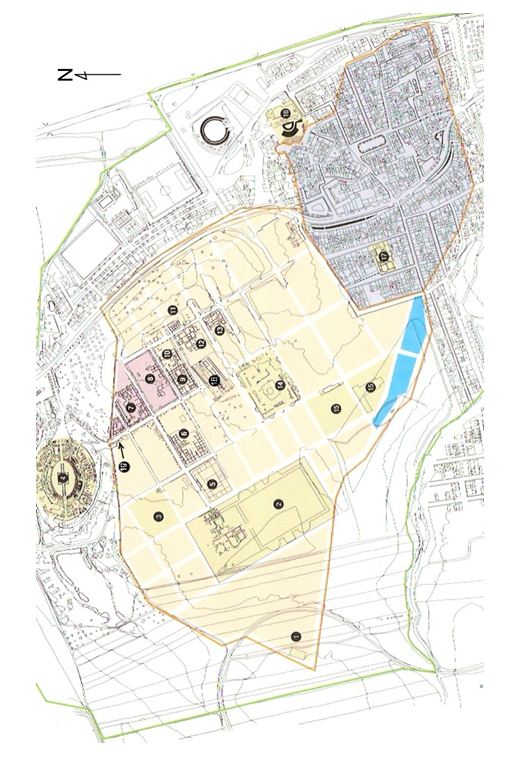
In 206 BC Publius Cornelius Scipio settled wounded veterans of the battle of Ilipa in an existing Turdentanian town which he renamed Italica to remind the settlers and their descendants of their origins. Three centuries later, it was still a town of some 14 hectares, less than a fourth the size of Pompeii and much smaller than neighboring Hispalis (Sevilla) or Corduba. Little is known of this town archaeologically because it lies under modern Santiponce.
Italica underwent a major expansion during the reign of the emperor Hadrian, a native of the town. A new area of 30 hectares to the northwest of the old city was enclosed with walls, laid out in an orthogonal plan, and provided with aqueduct water and a well-designed sewer system. Imperial-style baths were built, and a vast and innovative monument to Hadrian's adopted father Trajan, the Traianeum, was erected. Just north of the new walls an amphitheater accommodating 25,000 spectators was constructed. Dio Cassius says (69.10.1) says that Hadrian showed his patria great honor and bestowed on it many splendid gifts. Style and construction techniques point to imperial and even eastern influence in the layout, the baths, and the Traianeum. Mileposts on a new road leading north proclaim his patronage, the aqueduct is almost surely his work, and his initials are found on some lead pipes.
Garden
House of the Rhodian Peristyle
Keywords
- courtyards (uncovered spaces)AAT:300004095
- mosaics (visual works)AAT:300015342
- peristyles (Roman courtyards)AAT:300080971
- triclinia (rooms)AAT:300004359
Garden Description
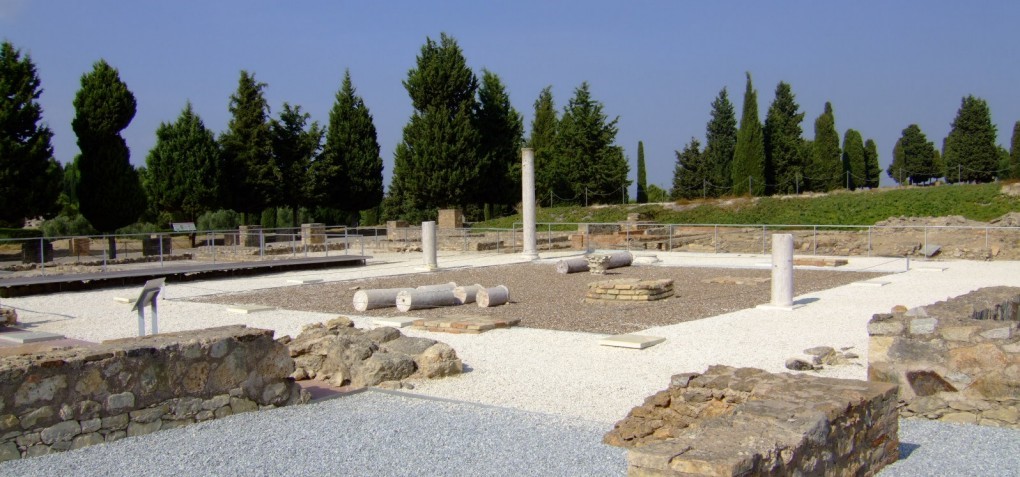
This house is on the top of a hill and has thus been exposed to more erosion and pillage of stone than most. The entrance was on the east side and led into the peristyle. One of its galleries was higher than the other three. Vitruvius 6.7.3 used the term "Rhodian" to describe such peristyles, and this feature gave the house its modern name (reference). Only two rooms around the courtyard are in good enough condition to be interpreted. One is marked as a triclinium by the shape of its checker-board mosaic. The other had rolls of foliage. In the absence of evidence to the contrary, we may guess that the central courtyard was a garden.
Maps
Images
Dates
unspecified
Bibliography
- Antonio Garcia y Bellido,Colonia aelia augusta Italica, Instituto Español de Arqueologia, (Madrid 1960). (worldcat)
- A. Caballos and P. León,ITALICA MMCC: Actas de las Jornadas del 2.200 Aniversario de la Fundación de Itálica, Sevilla, Consejeria de Cultura, (Sevilla 1997).(worldcat)
- A. Caballos, J. Marín and J. M. Rodríguez Hielgo, Itálica Arqueológica, Universidad de Sevilla, (Sevilla 1999). 82 (worldcat)
Places
- [House of the Rhodian Peristyle at Italica]/test-drafts/place/hispania_baetica/italica/)
- House of the Rhodian Peristyle at Italica Pleiades: 932178530
- Itálica (deserted settlement) TGN: 7007822