La Olmeda
Province
Location
Location Description
The size, quality, and excellent state of preservation of the mosaics of this villa make it an arehaeological jewel. In an area known since the Middle Ages as La Olmeda (the Elm Grove), it was discovered in 1968 by Javier Cortes, the owner of the land, as he was about to level the area for an irrigation project. He immediately recognized its value and involved Pedro de Paloa, a professional archaeologist. Its scientific exploration was financed by Cortes until the site was given to the provincial government in 1980. Excavation continued to 1986. Great care has been taken to preserve the mosaics and lower parts of the villa walls in their original place. In 2005, construction began on a new, 6.2 million euro protective shell and facility to accommodate some 40,000 visitors a year. The Museo Monográfico de la Villa de Pedrosa de la Vega has been created in the old chuch of San Pedro in Saldaña to display the many tools, coins, ceramics, glass and other daily objects from the villa and the extensive nearby cemeteries. The villa is best reached by a well-marked road turning to the west from CL-615 in Gañinas de la Vega, 3.6 km south of the intersection of CL-615 with CL-624 just south of Saldaña. (CL-615 is the road from Palencia to Saldaña.)
Garden
La Olmeda
Keywords
Garden Description
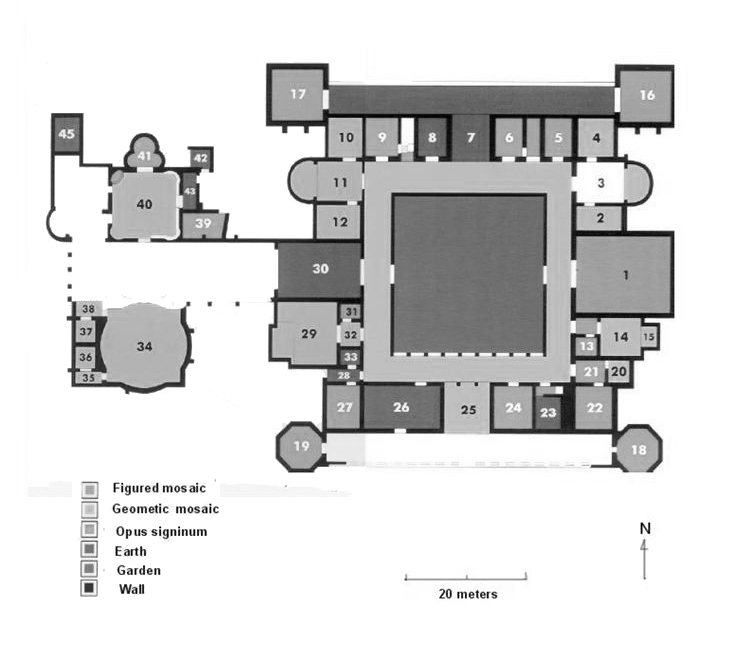
The major building period dated to the beginning of the 4th century, supplanting an earlier late 1st century phase.. The peristyle garden belonged to the later phase. The house is laid out around its central garden with approximate symmetry relative its north-south axis. The front of the house, the side from which guests entered, was clearly the south where the entry way [25] had a geometric mosaic floor whereas the north entrance way [7] had an earthen floor. Immediately on entry, the guest would have seen the garden through an arcade on its south side. These nine semicircular arches formed a sort of interior façade. This arcade had fallen over – or been pushed pulled over – in the destruction of the house, so it has been possible to reconstruct it in elevation, and it has been rebuilt. The Romans made extensive use of the round arch for practical purposes; this is an interesting example of its use for purely esthetic purposes, since a simple colonnade would have served just as well structurally.
In the center of the nearly square garden was a small fountain which has disappeared. It was surrounded by a small mosaic which survived only as scattered tessera. Crossing the garden in an east-west direction was a pergola. A low wall under the arches prevented guests from entering directly into the garden. Rather, a walk with impressive geometric mosaics led to the main reception room [1] with a vast polychrome mosaic depicting Achilles discovered by Odyssesus among the women of the household of Lycomedes. This mosaic is believed to be one of the largest known figured polychrome mosaic of the Roman world. From the reception room one entered the garden, through the pérgola to the bath complex. The walks around the garden in the porticoes were completely covered with geometric mosaics. A variety of rooms opened off the garden peristyle, offering a variety of spaces for entertaining and activities of daily life. Many did not open directly on the garden but may have had window through which to view the garden. Javier Cortes noted that hardware was found around the edges of the garden suitable for wood vanes which may have closed the spaces between the columns in cold weather. Asked about the quality of the soil in the garden, he replied that it was rich but so was all the soil in this river bottom area. The large number of objects of daily life found in the ruins, some under toppled walls, makes it clear that the villa was violently destroyed, probably in the second half of the fifth century, though the date is uncertain.
Plans
Images
Bibliography
- Pedro de Palol, Javier Cortes , La villa romana de La Olmeda de Pedrosa de la Vega (Palencia). Guía de las excavaciones. Palencia, 1986. (worldcat)
- Excavaciones de 1969 y 1970", vol. I, in Acta Arqueológica Hispánica, VII. Madrid, 1974. (worldcat)