The garden on the back
Location
Sublocation
laurentinum
Sublocation Description
The discovery of the Laurentinum
The Laurentinum was a villa belonging to Pliny the Younger (PLIN. epist. 2.17). It was described in a letter directed to one of his friends, a certain Gallo, whom he invited there to spend some time together. In this letter Pliny described accurately his Laurentine maritime residence. Throughout the centuries, having read this letter, many architects and scholars tried their hand at reconstructing its plan. I did one myself, which - as I discovered later on - was not exactly right, but at least it proved to be as good an approximation as it could be expected.
Knowing of this reconstruction, Prof. Antonio Maria Colini, who in 1935 had excavated the so-called Pliny's Villa of Castel Fusano (COLINI 1985), asked me if it was possible to confront it with the plan of the Castel Fusano excavation. He wanted to check if there was any chance that, also if greatly modified during the centuries, this one could be the real Laurentinum. Lanciani, at least, had so declared and, after his statement, the fact was not discussed any more.
It did not take too long to decide that the Castel Fusano Villa had nothing in common with the Laurentinum and that no transformation brought to it throughout the centuries could ever have made it look as it looked.
At this moment to locate the real Laurentinum was a challenge one couldn't resist. With all that had been discovered and all the elements that were now at hand, finding it couldn't really pose great problems. In fact Pliny gave its topographical localization quite clearly. First of all he told his friend that his residence was situated 17 miles from Rome and that it could be reached by two roads: the Laurentina and the Ostiensis. After 11 mile one had to leave the Ostiensis and take a dirt track; as for the Laurentina, after 14 mile one would find another dirt track leading to Pliny's villa.
This meant two things: first of all that the trip would have had the same length through the two itineraries, and second that the villa was placed on the stretch of coast which was limited by the two roads. Only in this case one could have used both for getting there. Pliny told also something else that was very important: he told his friend that his villa was the second one starting from a village which was in this area, but he didn't say if it was towards Ostia or towards Antium.
At the end of the XIX century the village was found. As the Municipality of Rome had bought the property of the Chigi family at Castel Fusano, where a villa - the second one towards Ostia starting from the village - had been found, it was decided to excavate it. As we have just seen it proved not to be Pliny's one. So I concluded that the Laurentinum had to be the second one toward Antium, the so-called Villa Magna (SALZA PRINA RICOTTI 1984; SALZA PRINA RICOTTI 1987, pp. 182-184, figs. 35-37).
Proofs of this were gathered. First of all topographical ones. We knew the layout of the ancient Ostiensis and Laurentina roads. Thus one could easily mark on a map the place where these roads had to be left. It is evident that these places could be considered two points of a triangulation. At this moment one had only to take a compass, point it on the spots where to leave the Ostiensis and take an opening corresponding to six mile. After this do the same for the Laurentina with an opening of three miles and trace the two arches. They would cross on the spot were Pliny's Villa had been. When I did it the arches crossed just on the Villa Magna.
A survey proved that everything Pliny had depicted in his letter tallied with the remains of the villa, and also the description of his gardens (SALZA PRINA RICOTTI 1985; SALZA PRINA RICOTTI 1987a).
Garden
The garden on the back
Keywords
Garden Description
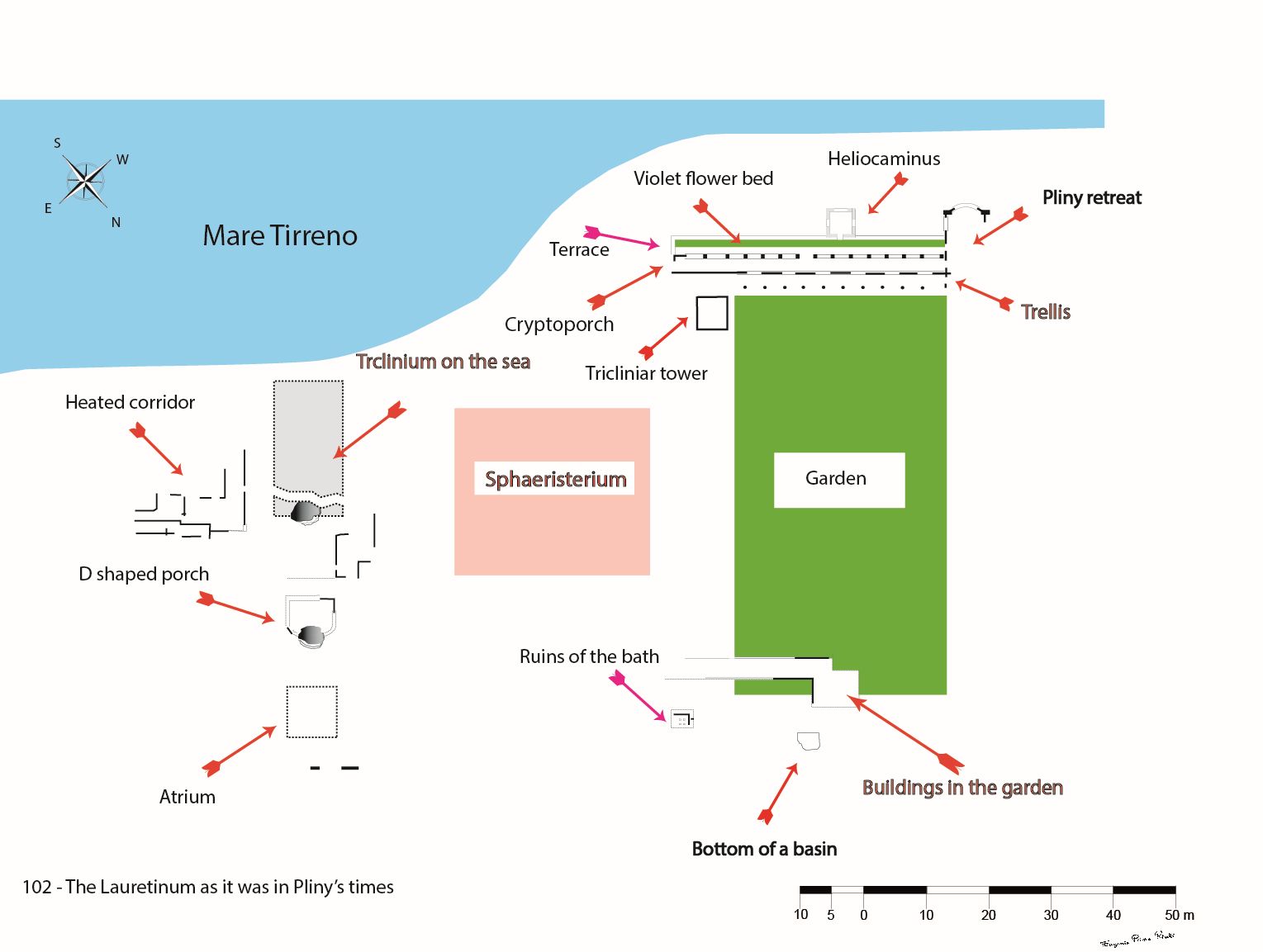
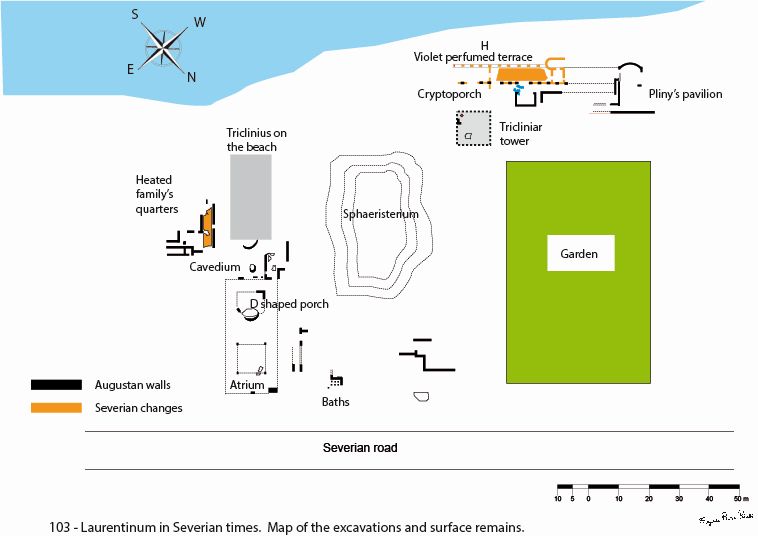
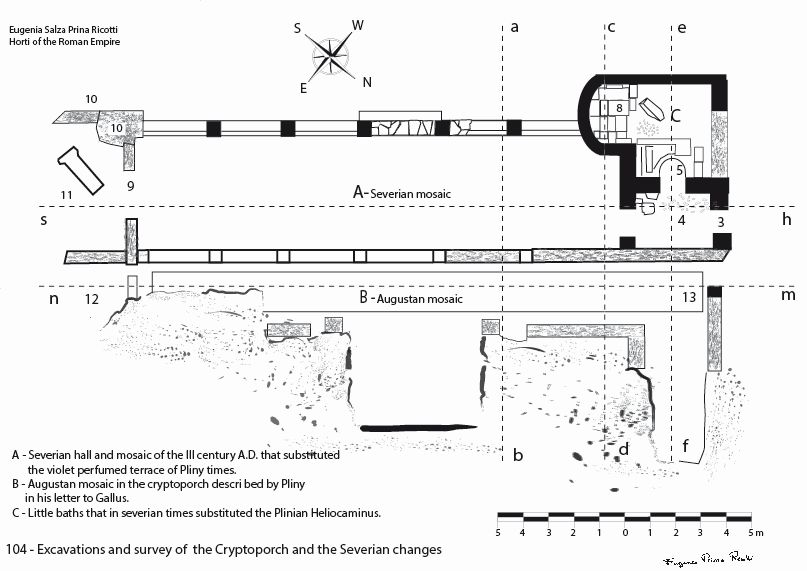
Excavating the garden of the Laurentinum would have been very interesting, but there was not the time, nor the money. However we found where it was: a rectangular area free from masonry set, as the letter said, on the back of the famous cryptoporticus, one of the principal highlights of the Laurentine. Pliny told us that a long vine trellis ran along this building and that mulberry trees and figs grew in the garden. Thus the place, with its fruit trees, must have been pleasingly rustic. There was also a long hedge of box trees. Rosemary took the place of buxum every time the bushes had to be exposed to the sea winds. As Pliny explained, buxum couldn't stand the salt and, when exposed to it, it quickly dried up and died, while rosemary thrived on the coast. This description we just reported was the one that Pliny gave us. From what we see now, it appears that, after Pliny's death and the selling of his maritime residence, the new owners brought many changes to it. Today high heaps of soil surround the garden's area and, even though this part has not been excavated, it is evident that some masonry structure must be buried under it. It is highly probable that the vine trellises, and the rustic enclosures of Pliny's times, were substituted by a marble portico which transformed the simple garden in a more elegant peristyle one. Evidently at this moment mulberry trees and figs must have been quickly replaced by less useful but more decorative plants.
Plans
Dates
Unspecified
Bibliography
COLINI 1985 = A. M. COLINI., Tra Castel Fusano e Capocotta: il vicus Augustanus e le ville di Ortensio e di Plinio il Giovane, Sin AA. VV., Capocotta ultima spiaggia. Proposta per il parco naturalistico-archeologico del litorale romano, Roma 1985, pp. 79-87. worldcat
SALZA PRINA RICOTTI 1984 = E. SALZA PRINA RICOTTI, , La c.d. Villa Magna: il Laurentinum di Plinio il Giovane, RendLinc 39 (1984), pp. 339-358 worldcat
SALZA PRINA RICOTTI 1985 = E. SALZA PRINA RICOTTI, , La Villa Magna a Grotte di Piastra, in Castelporziano I. Iª Campagna di scavo e di restauro 1984, Roma 1985, pp. 53-66 worldcat
SALZA PRINA RICOTTI 1987 = E. SALZA PRINA RICOTTI, , The Importance of Water in Roman Garden Triclinia,in Ancient Roman Villa Gardens (Dumbarton Oaks Research Library and Collection), Dumbarton Oaks 1987, pp. 137-184 worldcat
SALZA PRINA RICOTTI 1987a = rrE. SALZA PRINA RICOTTI, , La Villa Magna a Grotte di Piastra,in Castelporziano II. Campagna di scavo e di restauro 1985-1986, Roma 1987, pp. 45-66 worldcat