V.iv.c.
Province
Province Description
The Italian peninsula extending northward to the Alps as recognized by the Romans.
Location
Location Description
An ancient city of Campania destroyed by the volcanic eruption of Mt. Vesuvius in A.D. 79, Pompeii was named as a UNESCO World Heritage Site in 1997.
Sublocation
Region V
Insula
Insula iv
House
House c
Garden
V.iv.c.
Keywords
- viridarium
- cisterns (plumbing components)AAT:300052558
- mural paintings (visual works)AAT:300033644
- tablinaAAT:300004180
- trellisesAAT:300006785
- larariaAAT:300400600
Garden Description
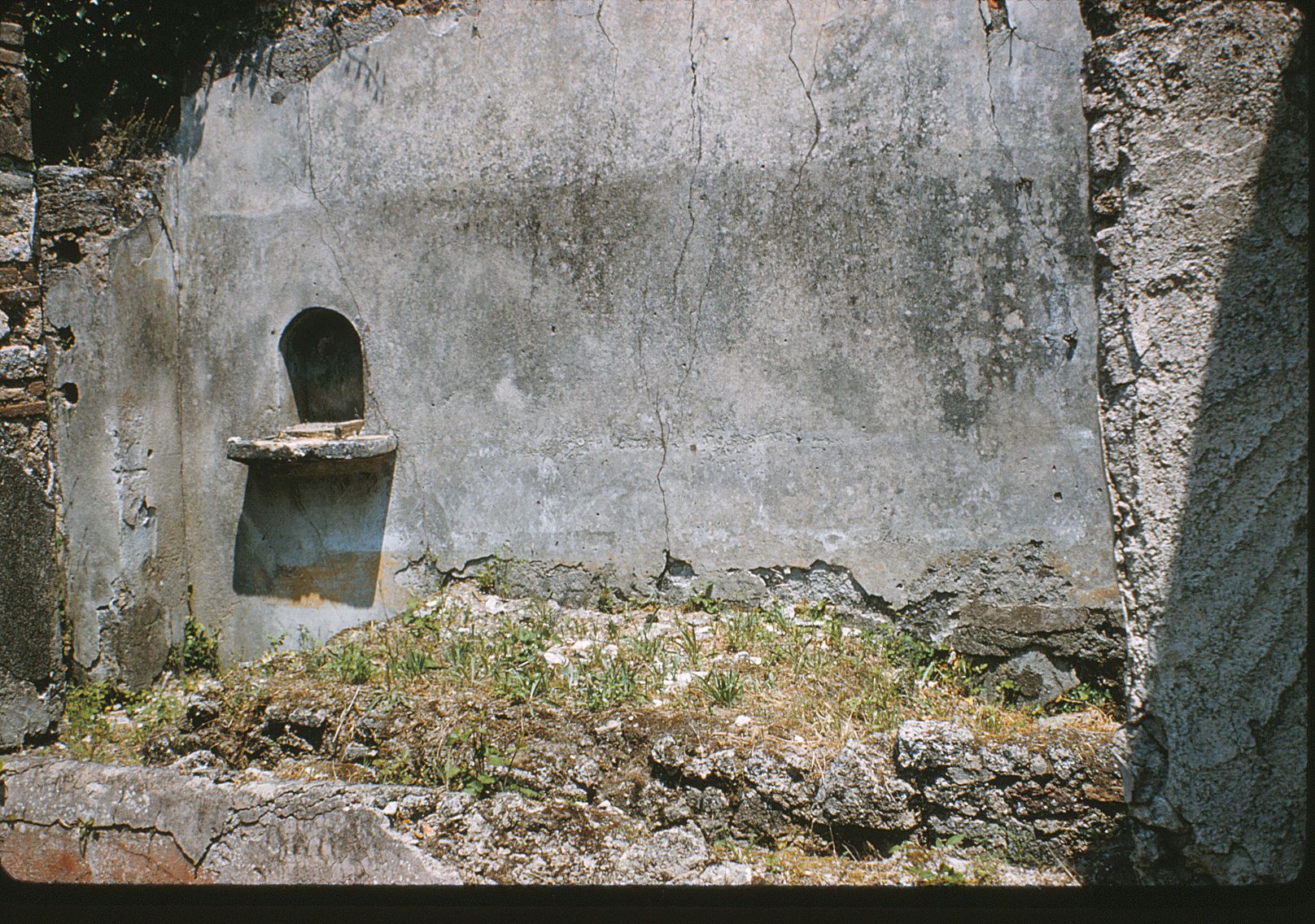
Wooden steps at the rear of this house excavated in 1902 led up to a viridarium (a) confined by a low masonry wall. A cistern had been walled up and the garden was built over the cistern mouth and a paved courtyard. Water from the neighbor's roof (no.13) supplied the cistern. The east and south walls once had garden paintings, and from the entrance the garden could be viewed through a window in the tablinium. The painting on the east wall was visible from the entrance and continued not only on the south wall but additionally on the pillar to the northeast. According to the excavator's reports the painting had a lattice fence at the base with a variety of tall, bushy plants and birds throughout. There was a marble basin with a bearded sphinx above, reposing with the profile turned to the left. At the extreme left of the east wall was a niche that most likely had been a lararium (Fig.25, 48.1.61).
Images
Dates
79 CE
Excavation Dates
1902 CE
Bibliography
- Boyce, p. 39, no. 117. (worldcat)
- Jashemski, Gardens, vol.II, pp. 116, 336. (worldcat)
- Mau, RM (1901), pp. 313-314. (worldcat)
- Schefold, WändP, p. 83. (worldcat)
- Sogliano, NSc (1901), p.256 and fig. 1 (plan). (worldcat)