The Gardens of Sperlonga. The peristyle garden
Location
Sublocation
Sperlonga
Sublocation Description
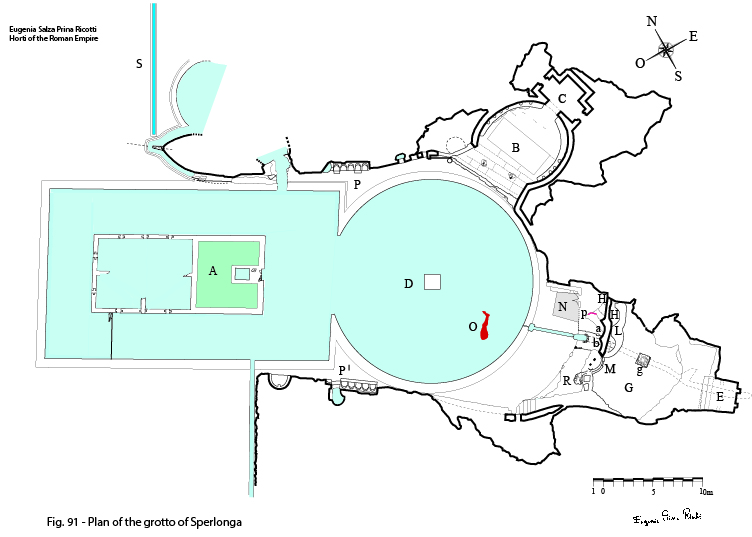
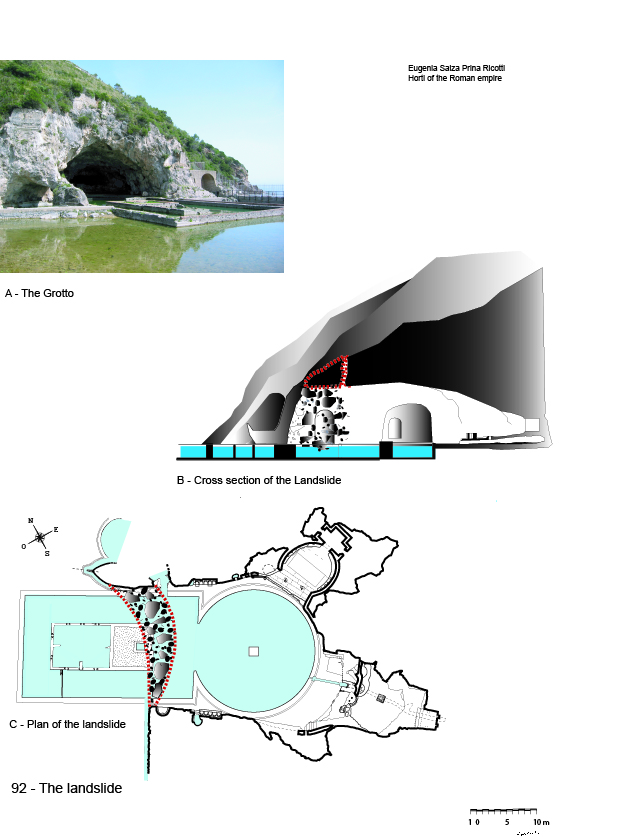
Sperlonga is a maritime villa built at the end of the Roman Republic. It probably belonged to some very rich piscinarius, one of those extremely wealthy Roman patricians who took delight in creating their own fish ponds. The purpose might have been to always find fresh fish at their disposal, or, at least, so they said. Actually those Tritones piscinarum, as Cicero called them (CIC. Att. 2.1.6; 2.9.1), considered their piscinae more a status symbol than an industrial operation, and cherished their fishes more as pets than as tasty tidbits (VARR. r. r. 3.17.3). Sperlonga, with its lavish decoration and its luxurious setting, was built by one of these tycoons. Built, yes, but by whom? When, in the middle of the last century, this villa was discovered, some scholars decided that it must have been Tiberius. Actually the only connection we could establish between the ancient emperor and this place is the fact that he nearly died while dining in the villa's colossal nymphaeum. At this time he was traveling from Capri to Rome and stopped at Sperlonga to rest. We read that he was there, on a small island set at the center of the fishpond, laying with his friends on mattresses placed around an elegant water triclinium (Fig. 91, A) set on a small island at the center of the fishpond. They were drinking, chatting and enjoying the splendid view of the statuary groups displayed in the nymphaeum when the entrance of the grotto crashed down in a historical landslide reported by both Suetonius (Tib. 39) and Tacitus (ann. 4.59) (Fig. 92). I can't imagine how this unfortunate dinner could place Tiberius as the owner and the creator of the spectacular grotto. However this is what some scholars assert and they still believe it. I can't agree. For one thing we know that Tiberius disapproved of luxury. In Tacitus (TACITUS) we find the transcription of some of his speeches to the senate and we notice how harshly he attacked all the people who built luxurious villas and bought expensive statues to put in them. How could Tiberius censor his fellows countrymen for purchasing some marble copies of goddesses and heroes, while he himself was importing from Greece those monumental Hellenistic groups, and setting them in the seaside grotto of a more than sumptuous maritime residence? It was not logical, and for this reason we feel quite certain that Tiberius had no part in creating the Sperlongan art display. However, are we sure that the villa didn't belong to the imperial praedia? No, we can't even deny this: Sperlonga could have entered Augustus' estate through a legacy. As a matter of fact we know that, on their death, many rich men used to leave their property to the emperor. Some of these tycoons and also some relatives of the Julio-Claudian family could easily have done this. We can't even forget that - as reported by Cicero (CIC. I cent. B.C.) - Philip, Augustus' stepfather, was one of the most important and rich piscinarii of the I cent B.C. Apart from this we can't say anything more.
Garden
The villa has three gardens: one peristyle garden, one cryptoporticus and the terrace on the sea, one nymphaeum.
Keywords
- insulae (apartments)AAT:300000325
- courtyards (uncovered spaces)AAT:300004095
- peristyles (Roman courtyards)AAT:300080971
Garden Description
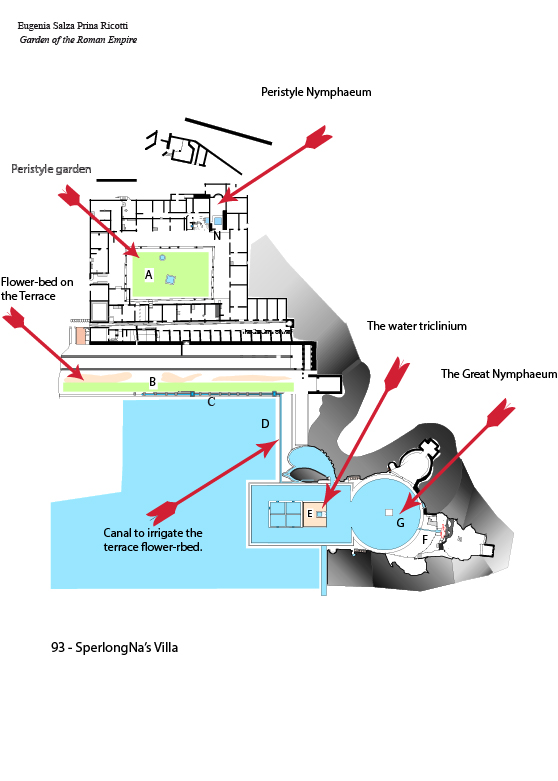
In the villa there are three different garden arrangements (SALZA PRINA RICOTTI 1990). Unluckily (Fig. 93) all its quarters have been badly damaged by a colony of monks who, probably toward 800 A.D., established themselves and their peasants there. All this people excavated a well in the peristyle, created a tank to wash their linens, moved and demolished many of the portico's columns, and set mangers for the animals in the elegant rooms of the villa. Moreover the family of peasants who tilled the monastery's fields divided this lordly mansion in 8 lodgings. Due to these transformations, today it is nearly impossible to find how the original peristyle looked at its heydays. We can only see the bases of the portico's columns and the remains of what probably was a nice nymphaeum, which, set on the north-eastern part of the courtyard (Fig. 93, N), occupied a large hall, 9 m long and 4.5 m wide, with a semicircular absid at the end. A square basin, 2 x 2 m, stood near the entrance. Apart from this there is nothing else left.
Plans
Images
Dates
Unspecified
Bibliography
-B. ANDREAE, A. CONTICELLO, H. SCHROTELER, D. WUNDERLICH, Abformung der Polyphemgruppe von Sperlonga, in GfK nach einem neuen Verfahren, Der Präparaator 16, 1-2 (1970), pp. 1-000 worldcat
-F. COARELLI, Sperlonga e Tiberio, DArch 7 (1973), pp. 97-122 worldcat
-A. CONTICELLO, B. ANDREAE, Die Skulpturen von Sperlonga, Antike Plastik 14, Berlin 1974, pp. 000-000 worldcat
-G. JACOPI, L'antro di Tiberio a Sperlonga (Istituto di Studi Romani), Roma 1963 worldcat
-SALZA PRINA RICOTTI, Il gruppo di Polifemo a Sperlonga - Problemi di sistemazione, RendPontAcc 42 (1968-1970), pp. 118-134, tavv. 1-3, figg. 5-9 [worldcat]https://search.worldcat.org/title/849270161
-SALZA PRINA RICOTTI, The Importance of Water in Roman Garden Triclinia,in Ancient Roman Villa Gardens (Dumbarton Oaks Research Library and Collection), Dumbarton Oaks 1987, pp. 137-184 [worldcat]https://search.worldcat.org/title/715121487
-SALZA PRINA RICOTTI, Sistemazione paesaggistica del fronte a mare e giardini nelle ville marittime di epoca romana, in Giornate di studio in occasione del 250º anniversario degli Scavi di Stabia (in print), pp. 137-169. worldcat