Villa at site 10
Location
Sublocation
Via Gabina
Sublocation Description
For six and a half weeks each summer from 1976 through 1989 Philip Oliver-Smith and the author (both of Rice University) excavated, often to bedrock, two sites fourteen kilometers east of the center of ancient Rome. The team worked from a surface survey conducted by John Ward Perkins and Anne Kahane in 1964, which traced the path of the via Gabina, a road joining Rome and Gabii and supplanted in the 1st century B.C. by the more up-to-date via Praeneste (today the via Praenestina-Fig.1). This same survey established by the collection of surface material thirty-five occupation sites bordering the via Gabina. From these sites we selected three for further investigation, two of which were fully uncovered to reveal the remains of two suburban villas and a late Roman horreum or giant barn. For recording purposes we kept the site designations of Ward Perkins and Kahane. Therefore the discussion here will refer to the villas at Site 10 and Site 11. In 1976, our first season, two trial trenches located structures at Site 13 (another villa?), but no further digging was done here because of problems involving crop rotation (our work was carried out on the land of a still existing farm), time, and money.
Garden
Villa at site 10
Keywords
- courtyards (uncovered spaces)AAT:300004095
- corridorsAAT:300004294
- domusAAT:300005506
- mosaics (visual works)AAT:300015342
- villae suburbanaeAAT:300005519
Garden Description
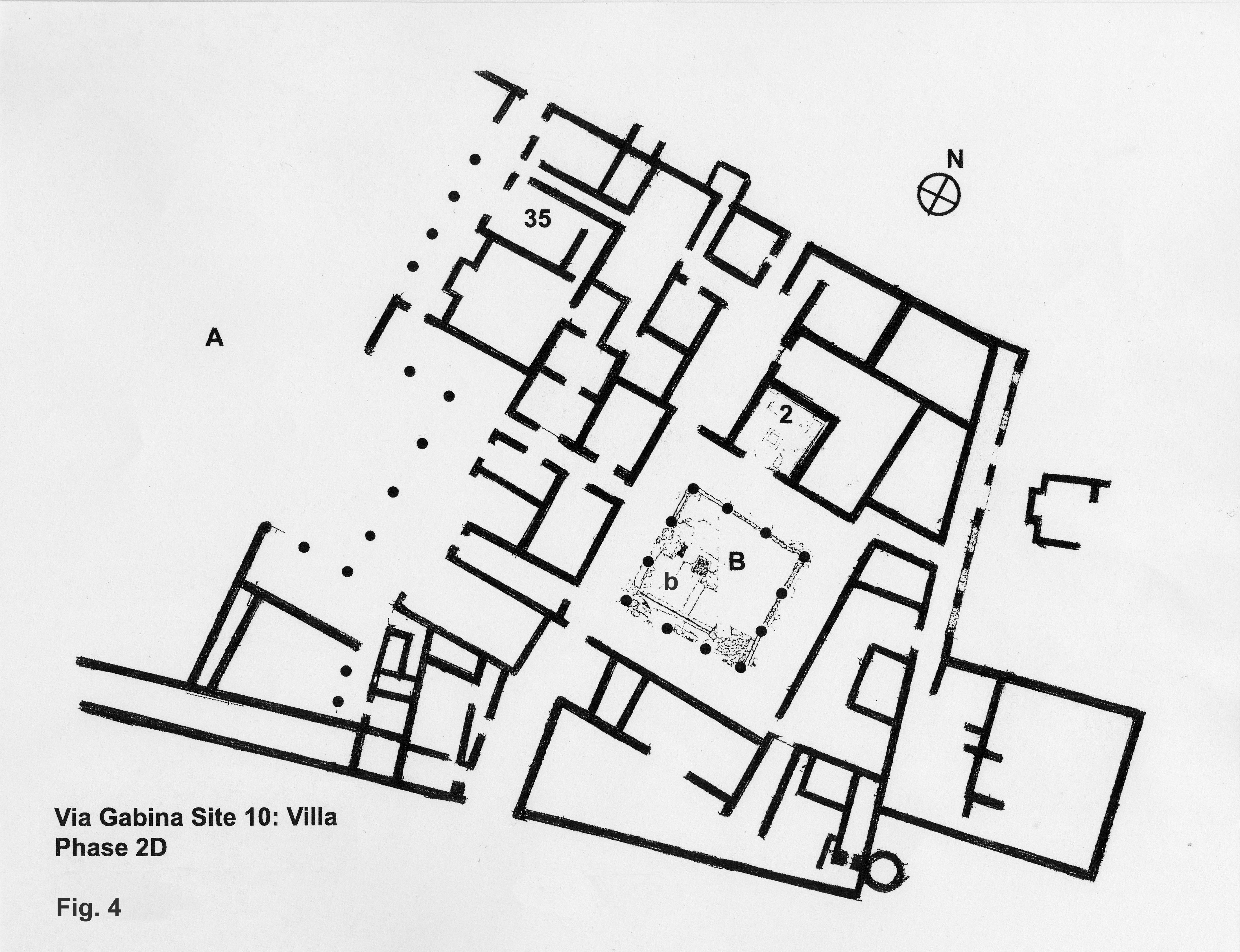
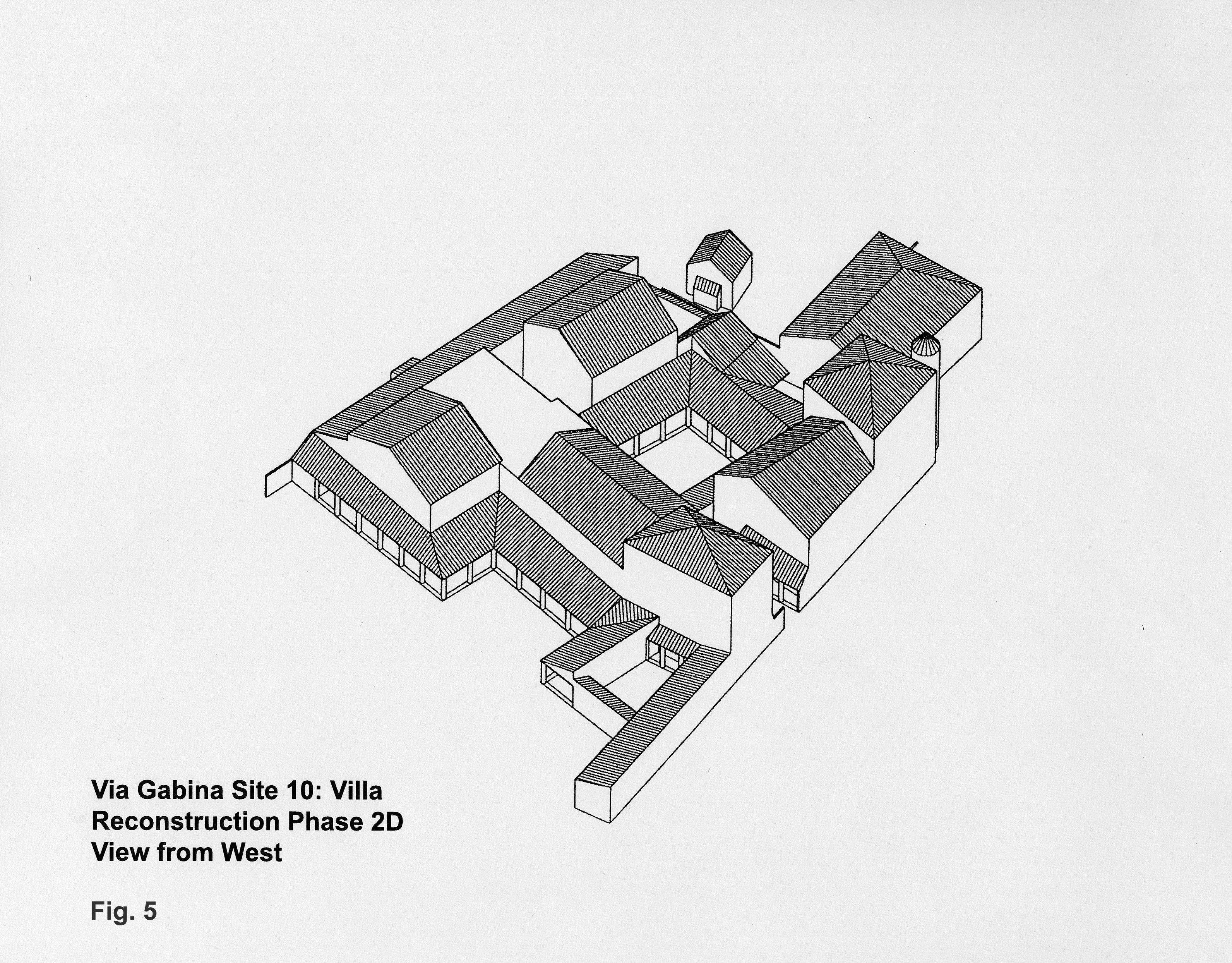
This large complex villa structure was founded in the Augustan period and was abandoned in the early 3rd century A.D, with evidence from pottery of continued occupation that time. Not even the peristyle core of the plan could be dated to what we call Period 1 (the early occupation period of the Via Gabina sites). Pottery, roof tile stamps, and construction technique (revetted concrete) all give four phases to the villa remains – Augustan, Julio Claudian, Domitianic, and Hadrianic. Reconstructions have been accomplished for all the phases of Period 2, but what interests us here with our focus on gardens is the last or Hadrianic phase (Phase 2 D – Figs. 4 and 5).
The villa had a western enclosed garden area (Figs. 4 and 5) framed on the east by a Doric loggia at least from the time of Domitian. It was then that the owners created an elaborately decorated triclinium (Fig. 4, "35") overlooking the garden and affording a view back to Rome (thus setting up the contrast of the serenity of the country with the congestion of the city). This was a major addition to the villa/residence. Phase 2D extended the loggia and gave a greater sense of symmetry to the facade. No pool of any depth was possible because the space of the garden overlaid bedrock-cut chambers for the fermentation of wine. Again, there could be no determination of specific planting; not even flotation material was helpful. It was in this western garden area that a huge horreum/barn was constructed in the late 4th or early 5th century C.E.
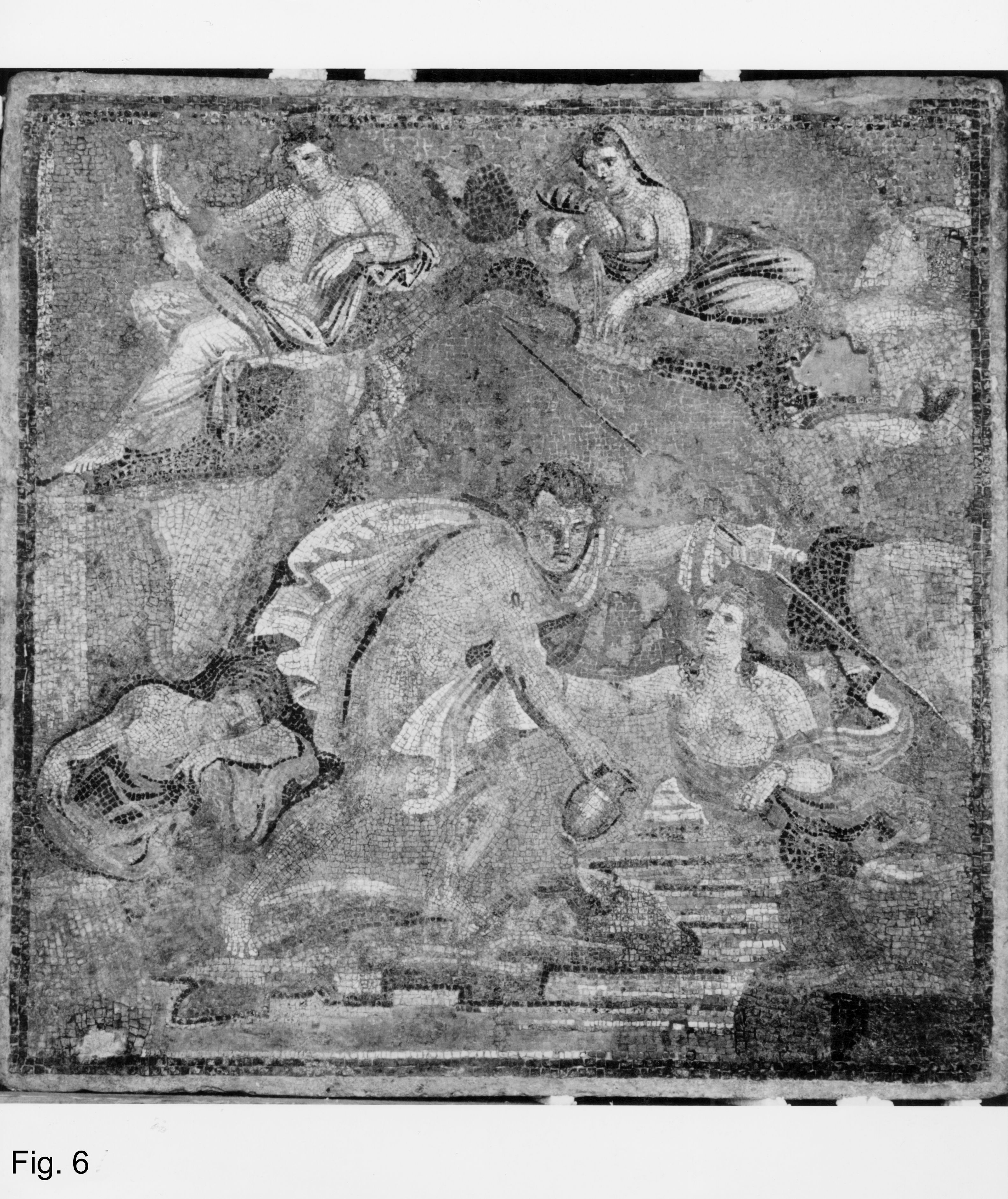
2.B. The peristyle garden of Phase 2D (Figs. 4, "B" and 5) dates from the Augustan core of construction (Phase 2A). Overlooking the peristyle center through a wide double doorway was an oecus or reception/dining room (Fig. 4, "2") with an emblema (59cm x 59cm) at the center of its mosaic floor. The emblema (now on permanent exhibition in the Palazzo Massimo alle Terme di Museo Nazionale Romano) portrays "The Rape of Hylas" (Fig. 6). This depiction was found in situ and oriented to be seen to best advantage from the couch of the padrone or distinguished guest at the back of the room. The location of the couch was indicated in the design of the black and white mosaic surrounding the emblema – unfortunately the Museo Nazionale's restoration has reversed this relationship by turning the emblema so it would be read in proper perspective from the door of the oecus and not the couch). From bedrock cuts (Fig. 4, "b") and a nearby well, it would seem the pool and grotto into which Hylas was abducted was emulated in the open area of the peristyle garden. Hence a view from the principal couch first of the graphic depiction of the rape and then a simulation of the place it occurred. The iconography involved in this sequence and subject relates to the agricultural function of the villa itself and its bucolic character. Because the emblema consists of a single tile containing the tiny tesserae (therefore portable) and can be dated to the beginning of the 1st century B.C., it may well be that the emblema was also an embellishment of the Period 1 villa.
These two sites represent a rare glimpse of the transformation of suburban Rome over more than twelve centuries of occupation.
Plans
Images
Dates
Unspecified
Bibliography
- J.B. Ward Perkins and A. Kahane, ed., The Via Gabina, Papers of the British School at Rome, 40 (1972), 91-126. worldcat
- W. Widrig, Two Sites on the Ancient Via Gabina, British Museum Occasional Paper 24 (1980), 119-141. worldcat
- W. Widrig, Land Use at the Via Gabina Villas, Ancient Roman Villa Gardens (Dumbarton Oaks, 1987), 225-260. worldcat