Villa at site 11
Location
Sublocation
Via Gabina
Sublocation Description
For six and a half weeks each summer from 1976 through 1989 Philip Oliver-Smith and the author (both of Rice University) excavated, often to bedrock, two sites fourteen kilometers east of the center of ancient Rome. The team worked from a surface survey conducted by John Ward Perkins and Anne Kahane in 1964, which traced the path of the via Gabina, a road joining Rome and Gabii and supplanted in the 1st century B.C. by the more up-to-date via Praeneste (today the via Praenestina-Fig.1). This same survey established by the collection of surface material thirty-five occupation sites bordering the via Gabina. From these sites we selected three for further investigation, two of which were fully uncovered to reveal the remains of two suburban villas and a late Roman horreum or giant barn. For recording purposes we kept the site designations of Ward Perkins and Kahane. Therefore the discussion here will refer to the villas at Site 10 and Site 11. In 1976, our first season, two trial trenches located structures at Site 13 (another villa?), but no further digging was done here because of problems involving crop rotation (our work was carried out on the land of a still existing farm), time, and money.
Garden
Villa at site 11
Keywords
- barnsAAT:300004900
- atrium housesAAT:300005451
- courtyards (uncovered spaces)AAT:300004095
- villae suburbanaeAAT:300005519
Garden Description
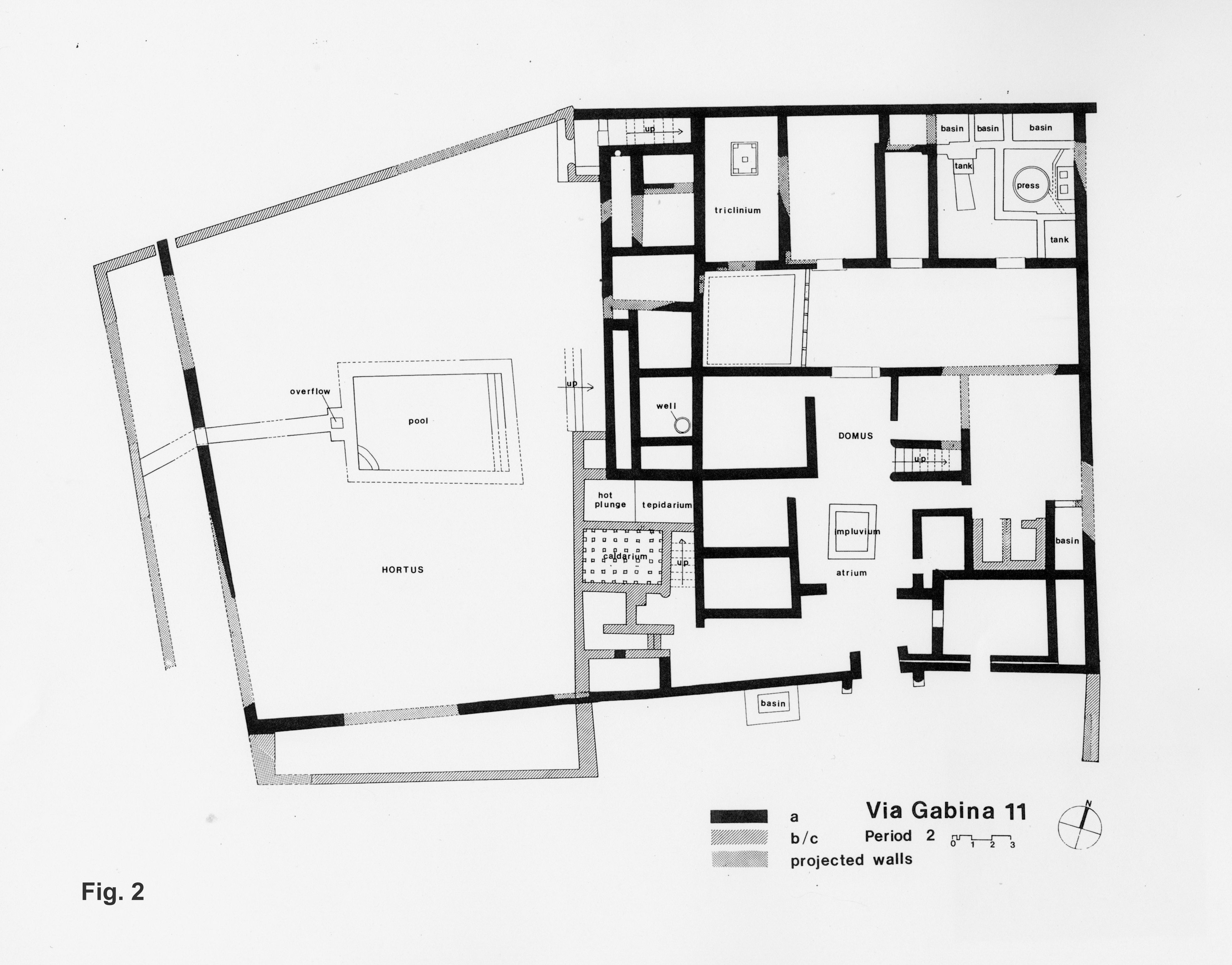
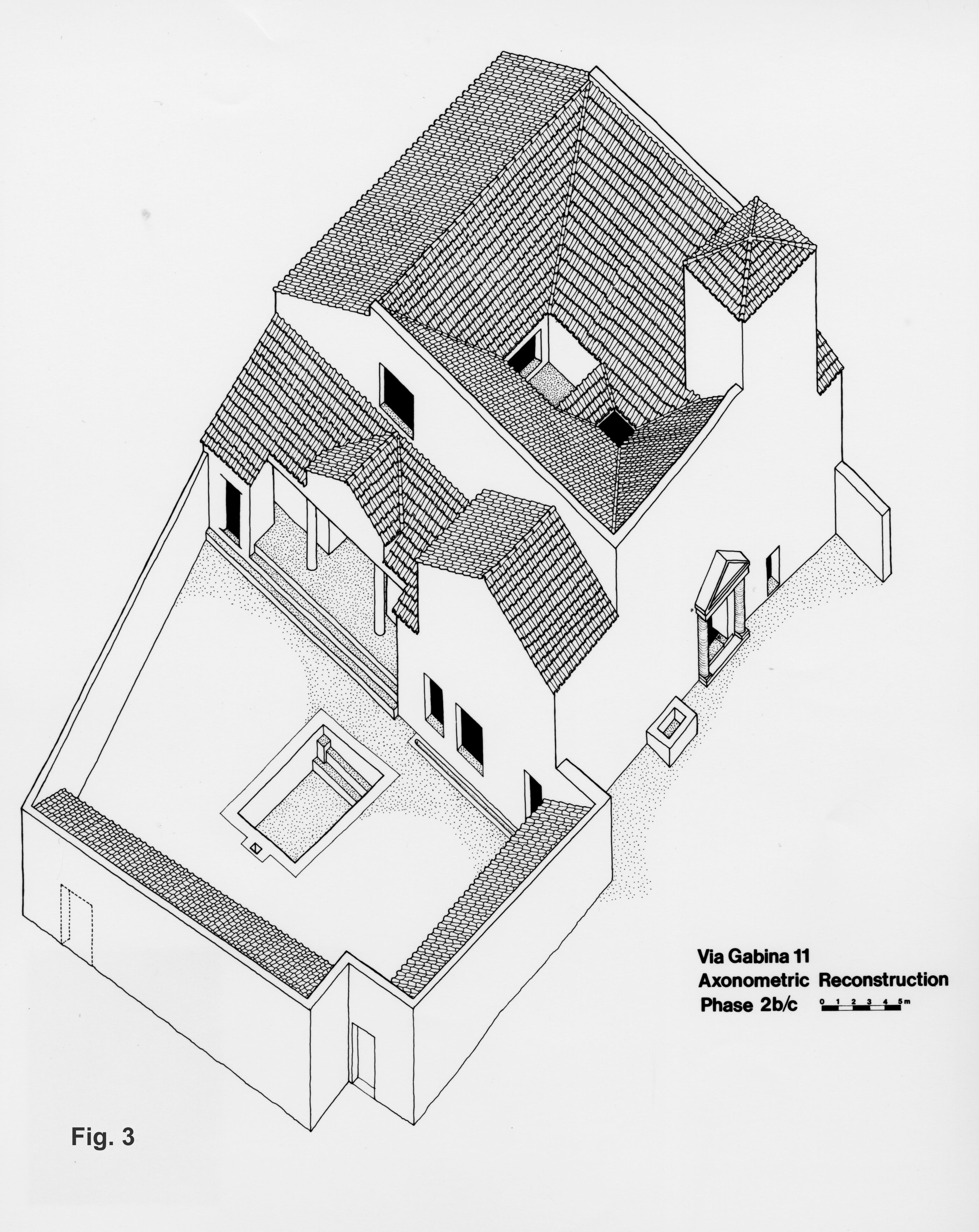
This villa at Site 11 was a simple "U" plan farmhouse initiated at the beginning of the 3rd century B.C. (Period 1). In the Augustan Age this farmhouse was transformed into a more luxurious atrium type villa/residence (Period 2 – Figs. 2 and 3). During the reign of Trajan a bath suite was added as well as an outside plunge pool in what seems to have been a western enclosed garden (hortus) from as early as Period 1. Because of the proximity of bedrock and the fact the slight earth cover had been ploughed for centuries, any evidence of what might have been planted in the garden had long since been destroyed. We know, however, that there must have been surrounding olive groves from the press facilities of the villa, also dating from the time of Trajan. All was abandoned in the second or third decade of the 3rd century of the Christian Era.
Plans
Images
Dates
Unspecified
Bibliography
- J.B. Ward Perkins and A. Kahane, ed., The Via Gabina, Papers of the British School at Rome, 40 (1972), 91-126. worldcat
- W. Widrig, Two Sites on the Ancient Via Gabina, British Museum Occasional Paper 24 (1980), 119-141. worldcat
- W. Widrig, Land Use at the Via Gabina Villas, Ancient Roman Villa Gardens (Dumbarton Oaks, 1987), 225-260. worldcat