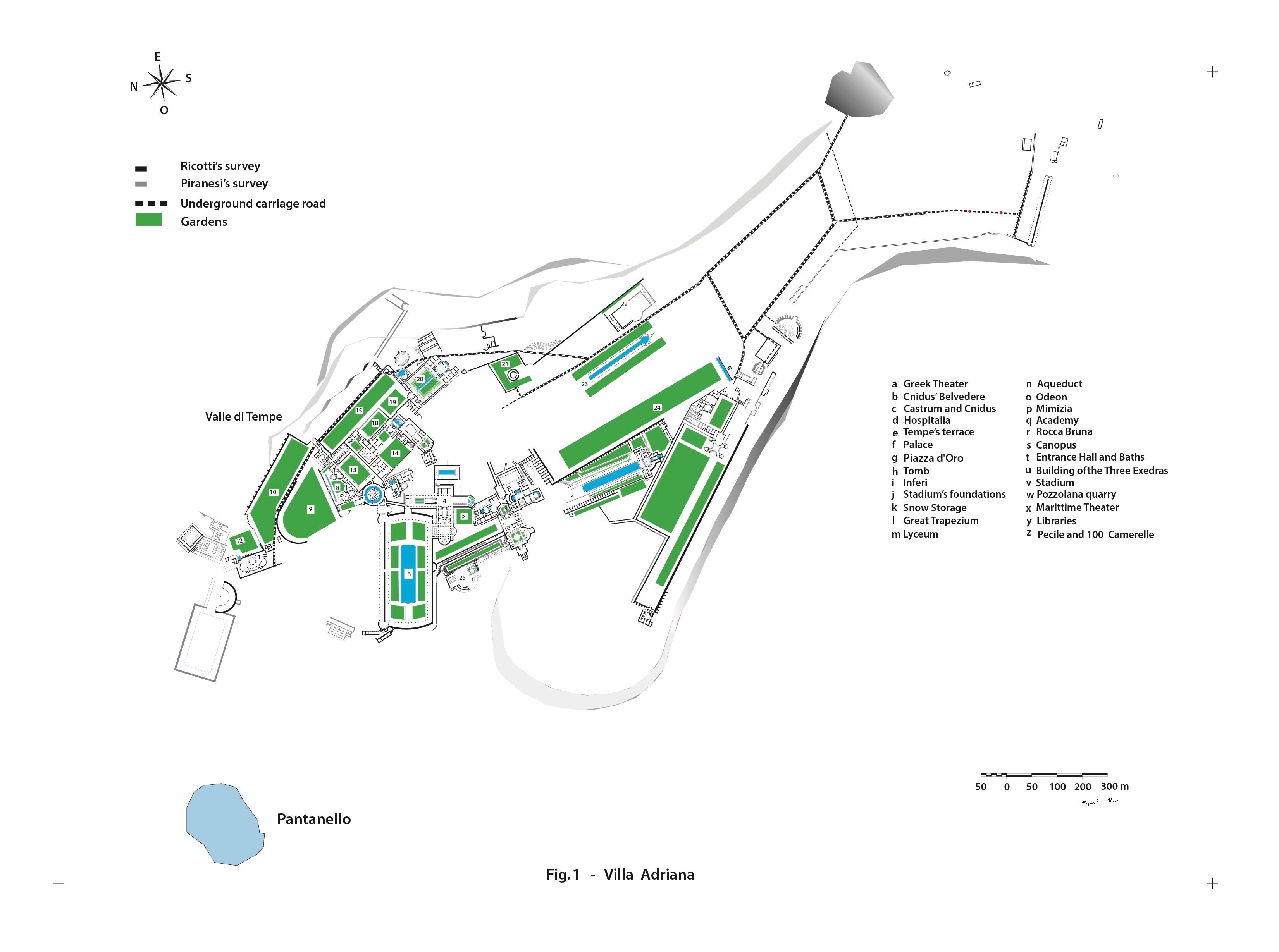
The gardens at the entrance of Hadrian's villa (Fig. 1, n. 3)
Province
Region
Region IV
Location
Location Description
DESCRIPTION
Villa Adriana, erected by emperor Hadrian at the beginning of the II cent. A.D., occupies a vast area of 126 hectares. It was a beautiful estate strategically located near Tivoli and, at the same time, not very far from Rome (WINNEFELD 1895; KÄHLER 1950; AURIGEMMA 1961; RAKOB 1973; BROWN 1964). Prior to the Hadrianic settlement, an ancient villa, dating back to the late republican time, already stood there. Probably it belonged to Hadrian's family and, as a matter of fact, many scholars think that Hadrian chose this estate as the ideal one because he already knew the place and was attached to it (LUGLI 1927). Certainly he preserved and restored the original building and made it the nucleus of his private quarters.
The realization of this magnificent residence must have been a cherished dream of Hadrian, and he must have planned it long before becoming an emperor. This is the only way to explain how the works for its construction began immediately after his election and his return to Rome in 118 A.D. Hadrian died in 138 A.D. when his ideal residence was nearly completed. Nearly, because there was still some work to be done. Some important halls of the Great Baths were not finished, and the model for a Stadium, found among the ruins of his last building-yard in the quarters of the stonecutters (CAPRINO 1996-97; SALZA PRINA RICOTTI 1992-93, p. 73; SALZA PRINA RICOTTI 2000, pp. 144-147), was never brought to the unknown place where Hadrian had planned to build it. The Emperor's death put an abrupt end to all activities, and some of the gardens he planned to create, and for which fountains and pavilions had already been built, were never done or, if ever they were completed, seem to have been soon abandoned (SALZA PRINA RICOTTI 1992-93, pp. 000-000). As a matter of fact after him Villa Adriana was only partially lived in by his successors and was solely used for occasional visits. It became just one of the many country houses pertaining to the imperial praedia. Some of the existing gardens (Fig. 1), the ones nearer to the center of the residence and the monumental ones, were maintained and irrigated up to the end of the Roman Empire, a fact which is now proved by the concentration of extractable lead found in their soil, and which is due to the use of lead pipes for irrigation (FOSS ET ALII 1990; FOSS 1989-90; FOSS 1992; TIMPSON ET ALII 1994; FOSS, SALZA PRINA RICOTTI 1996). As a consequence of Hadrian's death, some others sites, which he had planned to be attractive and important, got no irrigation at all, thus their soil contains only a minimal quantity of extractable lead, about the same amount that is ordinarily found in modern agricultural fields.
Garden
The gardens at the entrance of Hadrian's villa (Fig. 1, n. 3)
Keywords
Garden Description
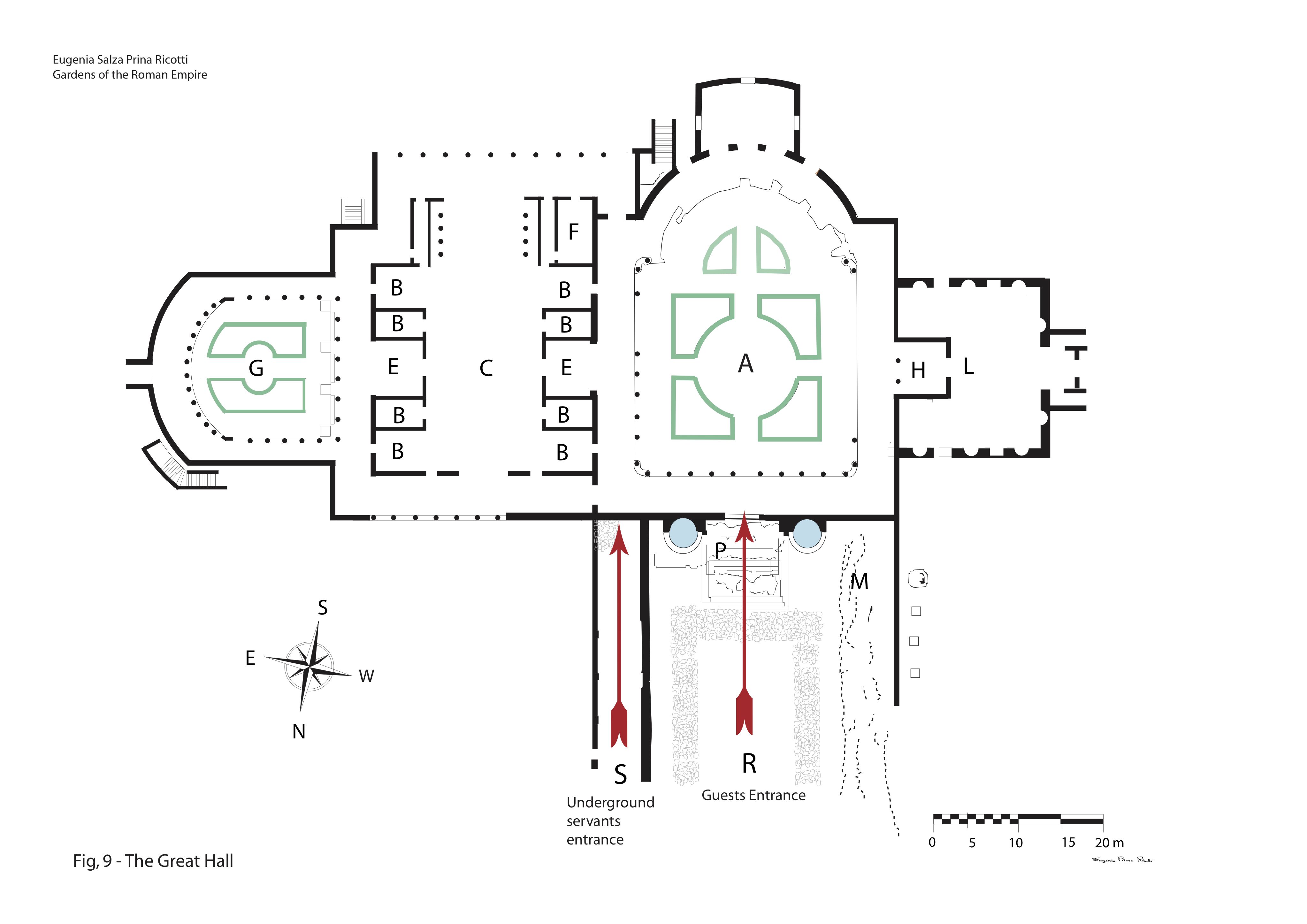
The Great Entrance Hall of Hadrian's villa (Fig. 9) presents three gardens, two of which (Fig. 9, A and G) are peristyle ones.
a – The main gate to the Hadrianic residence opens up on a peristyle garden, the largest one. Having just been excavated by Dr. Anna Maria Reggiani, the Latium's Superintendent, it is published by her at p. 000 .
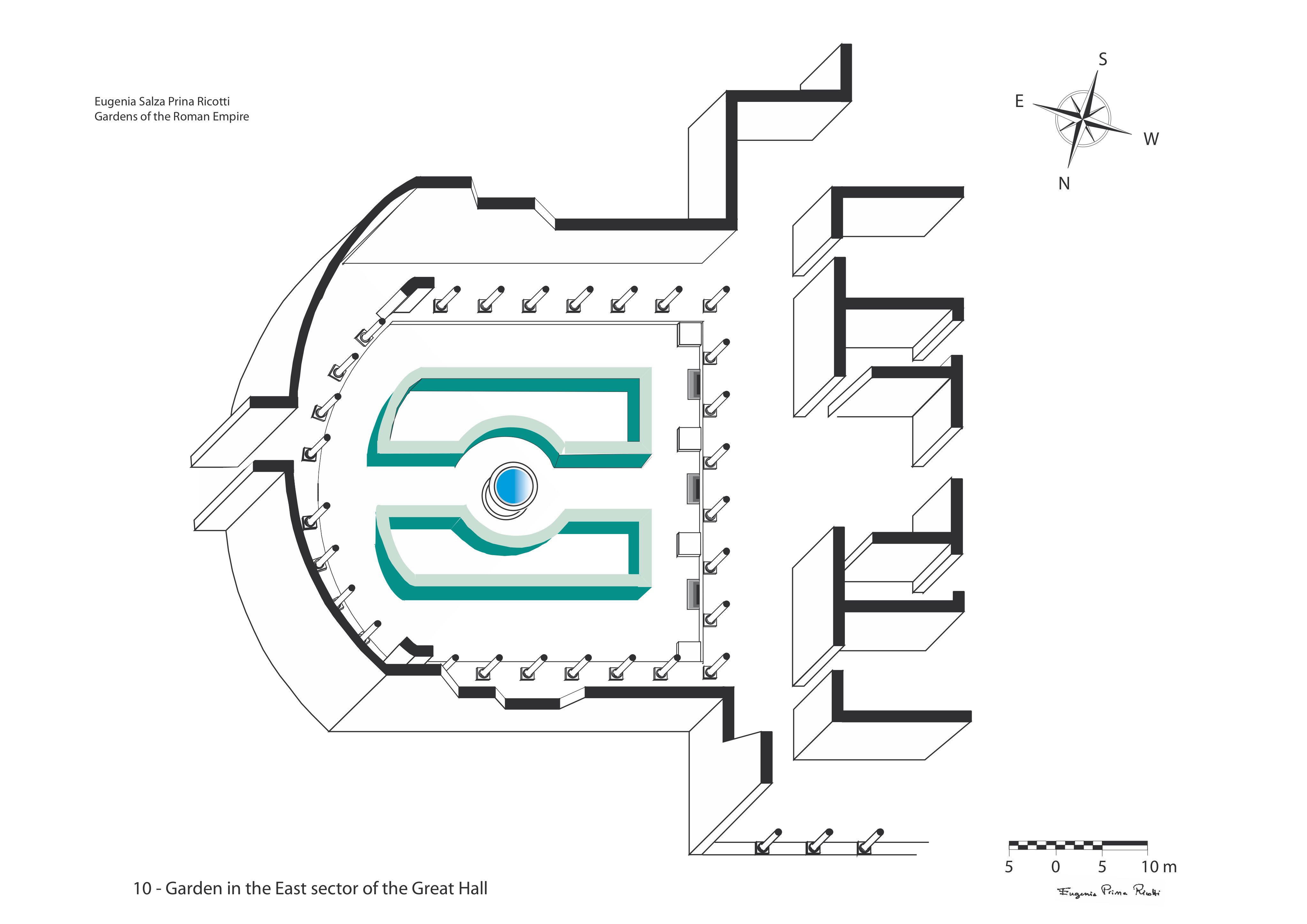
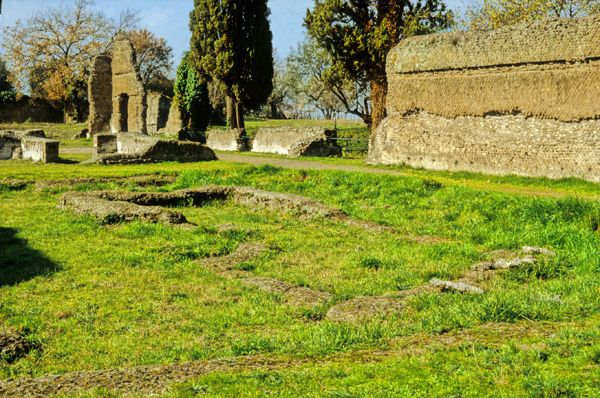
b –The other garden (Figs. 9, G, and 10-11), set at the eastern side of the entrance hall, occupies a smaller peristyle with a curved side toward East (REICHARDT 1933). It was crossed in the middle by a path which had a round-shaped space in the center (SALZA PRINA RICOTTI 1987, pp. 175-178, figs. 13-20; JASHEMSKI, SALZA PRINA RICOTTI 1987-88, p. 147, figs. 1-2; SALZA PRINA RICOTTI 1998, pp. 364-366, fig. 1; MARI, REGGIANI, RIGHI 2000; SALZA PRINA RICOTTI 2000, pp. 323-324, fig. 110). Here some decorative element - a marble vase or a statue - was probably displayed. Two flowerbeds cut in the tufa flanked it (Figs. 10, G, and 11). We are still pretty sure that they were bordered by well-groomed box hedges, a kind of decoration which was afterwards inherited by the "all'italiana" system of landscaping. This fashion, widely employed in many outstanding examples of Renaissance gardens, is still in use nowadays. The presence of well cut green hedges bordering those ancient flowerbeds was a must and it is a sure fact that they existed here, but we know very little about the rest. For instance, what, if anything, could have been set in their central part? Prof. Jashemski found pollen, seeds, roots of flowering bushes and of some trees in her Pompeian gardens, but here at Villa Adriana nothing was left in the ground. We are bound to follow our imagination. Of course there could have been grass in the center of the flowerbeds as well as masses of blossoms. If the latter was the case - but, looking to "all'italiana" gardens, which are basically green gardens, I highly doubt it - the flowers should have been the kinds which were in fashion in ancient Roman times. In his Natural History (nat. 21.10), Pliny the Older explained that Romans didn't use many of them. In their gardens they mainly planted roses and violets. However we must keep in mind that, for Pliny, the word violets meant every kind of small herbaceous species that could produce colored blossoms. He catalogued many kinds of them as the yellow, the purple, and the white kind, and it is highly probable that they must have been pimpernels as well as hyacinths and, of course real violets too. It is, however, evident that any of these plants could create gay clusters of blossoms in the center of a flowerbed and that they could make a very appealing garden.
c – The third garden of the Great Entrance Hall occupies its extreme western part (REICHARDT 1933, pp. 129-130). Here an unpaved courtyard circled a small temple, probably dedicated to the Imperial Lares (Fig. 9, L). The flowerbeds have still to be excavated, but, as in all the Great Entrance Hall's area the tufa is practically surfacing, this must happen also here. Therefore it is highly probable that an excavation will bring to light the flowerbeds cut in the rock for the plants.
Plans
Images
Dates
Built between 118 and 138 CE
Excavation Date
unspecified
Bibliography
- H. Winnefeld, Die Villa des Hadrian bei Tivoli, Berlin 1895, p. 154. (worldcat)
- H. Kähler, Hadrian und sein Villa bei Tivoli, Berlin 1950. (worldcat)
- S. Aurigemma, Villa Adriana, Roma 1961. (worldcat)
- F. Rakob, "Der Bauplan einer kaiserlichen Villa," in W. Hartmann (ed.), Festschrift K. Langheit, Bönn 1973, pp. 113-125. (worldcat)
- F. E. Brown, "Hadrianic Architecture," in L. F. Sadler (ed.), Essays in Memory of Karl Lehmann, New York 1964, pp. 55-58. (worldcat)
- G. Lugli, "Studi topografici intorno alle antiche ville suburbane. VI. Villa Adriana. A. - Una villa di età repubblicana inclusa nelle contruzioni imperiali," Bullettino della Commissione archeologica Comunale di Roma 55, 1927, pp. 139-204. (worldcat)
- C. Caprino, "Plastico marmoreo di uno stadio nella Villa Adriana a Tivoli," Rivista dell'Instuto nazionale di archeologia e storia dell'arte 3 s., 19-20 (1996-97), pp. 113-151. (worldcat)
- E. Salza Prina Ricotti, "Nascita e sviluppo di Villa Adriana," Atti della Pontificia Accademia romana di archeologia: Rendiconti 65, 1992-93, p. 73. (worldcat)
- E. Salza Prina Ricotti, Villa Adriana: il sogno di un imperatore, Roma 2000, pp. 144-147. (worldcat)
- J. E. Foss, J. T. Ammons, M. E. Simmons, S. Y. Lee, R. C. Minter, "Genesis of soil developed in volcanic tufa at Hadrian's Villa near Rome," Agronomy Abstracts ASA, Madison WL 1990, p. 291. (worldcat)
- J. E. Foss, "Appendice. Soils of Hadrian's Villa," in E. Salza Prina Ricotti, "Il sistema di irrigazione della Piazza d'Oro," Atti della Pontificia Accademia romana di archeologia: Rendiconti 62 (1989-90), pp. 151-157. (worldcat)
- J. E. Foss, "Appendice. Soils of Hadrian's Villa," in W. F. Jashemski, E. Salza Prina Ricotti "Preliminary Excavations in the Gardens of Hadrian's Villa: the Canopus Area and the Piazza d'Oro" American Journal of Archaeology, Vol. 96, No.4 (Oct. 1992), pp. 595-597. (worldcat) (jstor)
- M. E. Timpson, J.E. Foss, R. J. Lewis, C. A. Stiles, "Soil interpretation of some Roman archaeological sites in Italy and Tunisia," 15th Int. Congr. of Soil Science, Vol. 6b, 1994, pp. 172-173. (worldcat)
- J. E. Foss, E. Salza Prina Ricotti, "Lead Pipes Use in Ancient Roman Irrigation System and Content of Pb in the Soil of Archaeological Sites," Bulletin of the Metals Museum, Vol. 26 (1996-II), Aoba, Aramaki, Aoba-ku, Sendai, Japan, pp. 33-47. (worldcat)
- W. L. Reichardt, "The Vestibule Group at Hardian's Villa," Memorie. Atti dell'Accademia nazionale dei Lincei, 1933, pp. 129-130. (worldcat)
- E. Salza Prina Ricotti, "The Importance of Water in Roman Garden Triclinia," in Ancient Roman Villa Gardens (Dumbarton Oaks Research Library and Collection), Dumbarton Oaks 1987, pp. 175-178, fig. 13-20, 35-37. (worldcat)
- W. F. Jashemski, E. Salza Prina Ricotti, "I giardini di Villa Adriana: rapporto preliminare," Atti della Pontificia Accademia romana di archeologia: Rendiconti, Vol. 60 (1987-88), pp. 152-162, fig. 11-15. (worldcat)
- E. Salza Prina Ricotti, "Adriano: architettura del verde e dell'acqua," in Horti Romani, Atti del Convegno Internazionale, a cura di M. Cima, E. La Rocca, Roma 1998, 364-366, fig. 1. (worldcat)
- Mari, Reggiani, Righi, "Grande Vestibolo presso le Cento Camerelle. Indagini e restauri," in F. Filippi (ed.), Archeologia e Giubileo. Gli interventi a Roma e nel Lazio nel Piano per il Grande Giubileo del 2000, Napoli 2000, pp. 478-483. (worldcat)
- E. Salza Prina Ricotti, Villa Adriana: il sogno di un imperatore, Roma 2000, pp. 323-324, fig. 80-81, 87, 134-135. (worldcat)