House of the Fountains
Province
Province Description
Despite the prior existence of urban centers like Metellinum, the capital of Lusitania was a new foundation, the Colonia Augusta Emerita (Mérida), which would also serve as the capital of one of the smaller juridical units (conventus) and would be the scene of flourishing activity in the succeeding centuries, its prosperity lasting until the late Roman and Visigothic era. Subsequently, a series of well-known Roman cities were built in what was then Lusitania but is now partly in Portugal and partly in Spain. As well as the capital, there were Conimbriga, Salmantica, Evora, Olisipo (now Lisbon), Pax Iulia (now Beja), and Metallium Viscascense (Aljustrel), this last recognized as the capital of an important mining area. The series of wealthy villae, such as that of La Cocosa, Milreu or San Cucufate are particularly noteworthy. Another of the important elements of the Roman era is the series of still visible ways of communication, of which the Vía de la Plata has most remaining, especially in the sections of Baños de Montemayor in Cáceres or the bridges that cross the rivers, such as that of San Pedro de Alcántara, or of Mérida.
Location
Location Description
The pre-Roman oppidum of Conimbriga was made the capital of a civitas in the Augustan period and, thereafter, a forum, a public bath-house, an aqueduct and city walls were constructed. During the Flavian period, the city was made a municipium with ius Latii. At the end of the third or beginning of the fourth century AD, new fortification walls considerably reduced the area occupied by the city. In the time of the Suevi it was an Episcopal See, which was then transferred to Aeminium (the present day Coimbra) around A. D. 585, when the kingdom of the Suevi was conquered by the Visigoths. Further reduced in area and impoverished, the city survived until 986, at which date, according to Arab sources, it was destroyed by the great Muslim chief Almansor. In addition to the Augustan forum, which was completely rebuilt on a new ground plan under the Flavians, four bath houses have been excavated, and preliminary trial trenches established the plan of the amphitheater. Four domus have been excavated, three of which were left outside the wall built under the late empire. It is in these houses, all built around peristyles, that we find the gardens of Conimbriga.
Garden
House of the Fountains
Keywords
Garden Description
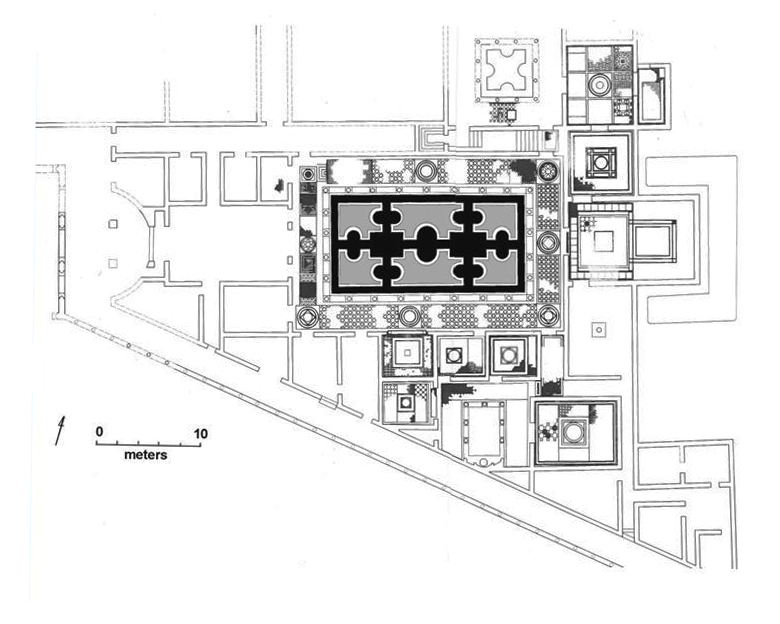
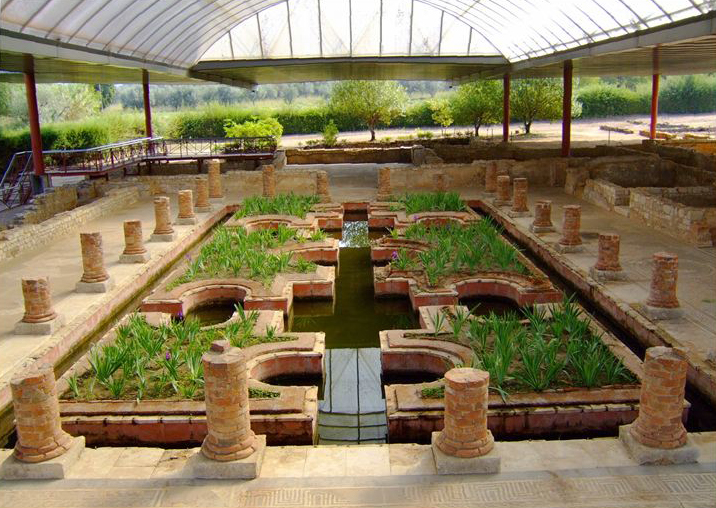
This house is almost entirely excavated, the exception being its north facade, which is still covered by a local lane. It occupies an area of almost 3400 square meters. Its mosaics, published in their entirety, date from the second half of the second century A.D, or the Severan era. The construction of the house dates to between 150 and 175 AD. The house has a central peristyle with twenty-six columns. The area of the large open part (12m x 26m) is completely filled with a pool with a maximum depth of 0.90 meters, inside of which the architect installed six very formal flower-beds. On the edges of these, more than 500 water-jets played continually. The unusual design of this peristyle has its only parallel in the Domus Augustana built in Rome for the emperor Domitian by the architect Rabirius. This parallel, pointed out by L. Cremain 1959 in his L'architettura, has been related by other writers, none of whom has found anything similar in Roman domestic architecture in any part of the Empire.
The house has recently been the subject of a monograph by Isabelle Morand in which she undertakes to recover the geometrical and numerical principles used by the architect and to identify astronomical and astrological allusions in the house.
Plans
Images
Bibliography
- Morand, I., La Maison aux jets d'eau de Conimbriga (Boccard, Paris, 2005). (worldcat)