Houses Under the Museum
Province
Province Description
Despite the prior existence of urban centers like Metellinum, the capital of Lusitania was a new foundation, the Colonia Augusta Emerita (Mérida), which would also serve as the capital of one of the smaller juridical units (conventus) and would be the scene of flourishing activity in the succeeding centuries, its prosperity lasting until the late Roman and Visigothic era. Subsequently, a series of well-known Roman cities were built in what was then Lusitania but is now partly in Portugal and partly in Spain. As well as the capital, there were Conimbriga, Salmantica, Evora, Olisipo (now Lisbon), Pax Iulia (now Beja), and Metallium Viscascense (Aljustrel), this last recognized as the capital of an important mining area. The series of wealthy villae, such as that of La Cocosa, Milreu or San Cucufate are particularly noteworthy. Another of the important elements of the Roman era is the series of still visible ways of communication, of which the Vía de la Plata has most remaining, especially in the sections of Baños de Montemayor in Cáceres or the bridges that cross the rivers, such as that of San Pedro de Alcántara, or of Mérida.
Location
Location Description
Geopolitical and economic motives together facilitated the prosperity of this great center of the Iberian peninsula. Marcus Vipsanius Agrippa, son-in-law of the emperor, was a benefactor of Augusta Emerita. The city was situated on the right bank of the Anas River (Rio Guardiana), today the Guadiana River. The site had the advantage of an easily crossed ford at the mouth of the Barraeca River (Rio Albarregas), and was an ideal site for surveillance and defense. The area immediately surrounding Augusta Emerita had rich granite quarries, sands from the riverbed, and other types of rock for the new constructions. The city's topography determined the new rectilinear urban layout. The variations in ground level, due to small hills in the land, probably necessitated terracing, which is still discernible in today's modern network of streets. The bridge over the Guadiana, the longest in the peninsula with a length of almost 800 meters, provided the N-S axis to which the street grid was aligned. The new colony also had an ambitious system of urban drainage. The sewers and water lines form a complete underground complex of canals. The works of hydraulic engineering, whose dates of construction and later stages of development are debated, support the notion that Augusta Emerita was a city with a grand, forward-looking vision.
At the intersection of the decumanus and cardo were two fora, one for the city's functions and one for the Province's functions. Some of the monumental buildings have been excavated. The Mérida fora, whose layouts resemble those in the other western imperial provinces, have iconographic programs that resemble those of Rome; the forum of Augusta Emerita is a particularly faithful reflection of the Forum Augustum. This imitative trend appears also in the two other provincial capitals of Hispania, Tarraco and Corduba and underscores the power which Augustan images and architecture had in the political, ideological fabric of the provinces.
The area of Augusta Emerita best known today, because of extensive excavations, is around the so-called Temple of Diana. The temple is actually dedicated to the imperial cult. The structures devoted to public performance - theater, amphitheater, and circus - surrounded the urban center. The theater was begun in 16-15 BC and the amphitheater in 8 BC, during the first decades of colonial presence. Augusta Emerita's necropolis ran around the city's urban perimeter and expanded as the city proper grew.
Because most of evidence from Merida was unearthed in old excavations, the context of many ancient objects is unknown. There is also a lack of analytical data on many of the areas which must originally have been gardened. The classification of the gardens of the Colonia Augusta Emerita is still under analysis. The study by Moreno is a basic survey article and should be understood to be part of all the bibliographies for Merida.
Bibliography
- I. C. Moreno, "Los jardines de Mérida," Mérida, excavaciones arqueológicas Nº. 2, 1996 , pp. 303-328. (worldcat)
Garden
Houses Under the Museum
Keywords
- peristyles (Roman courtyards)AAT:300080971
- courtyards (uncovered spaces)AAT:300004095
- porticoesAAT:300004145
- exedrae (site elements)AAT:300081589
Garden Description
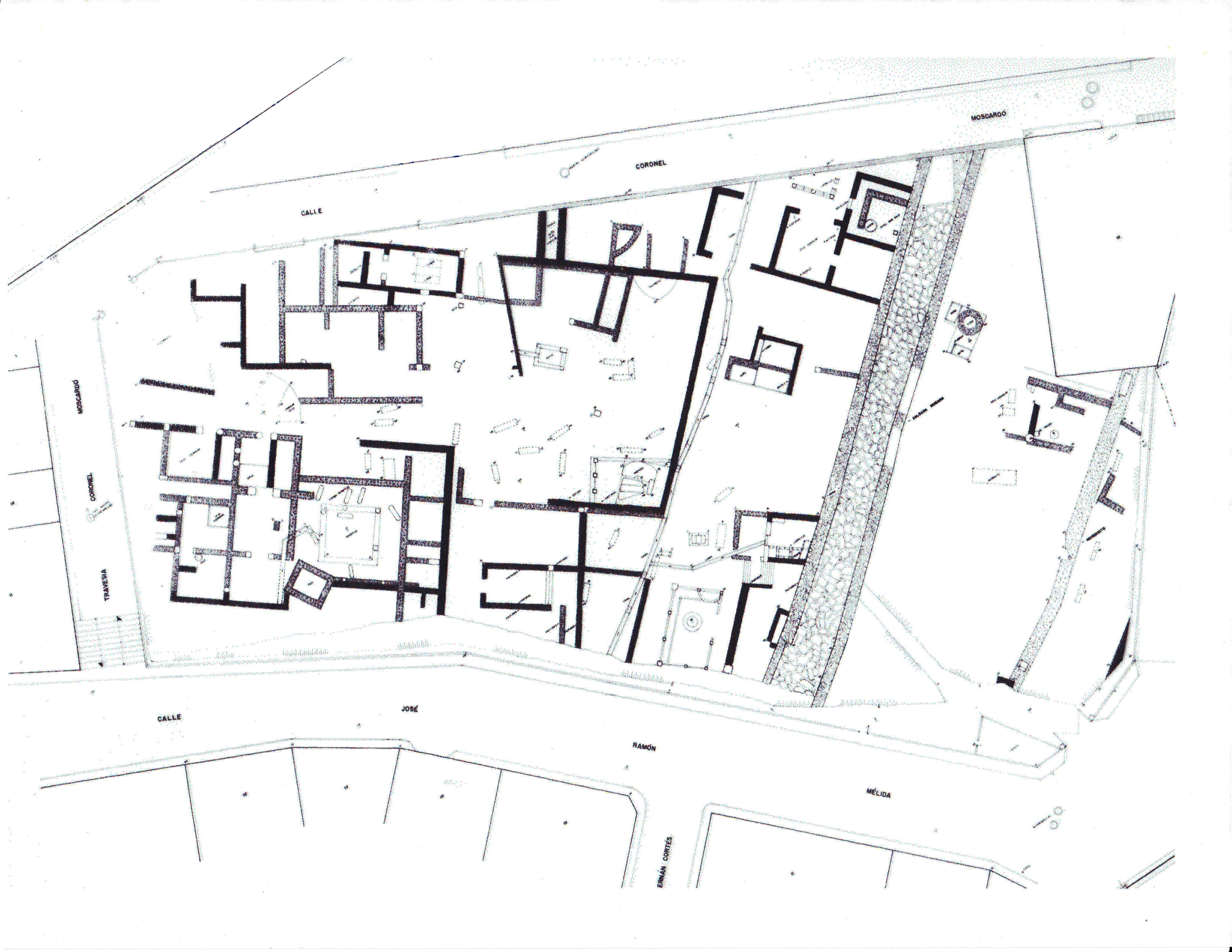
Prior to building the present Museo Nacional de Arte Romano, excavations were undertaken at the site in 1978 and 1979. Two suburban residences were explored and preserved in the crypt of the museum. These contained at least three courtyards. One was a colonnaded courtyard of 'marble,' and this small rectangular courtyard (at the rear of the crypt) consisted of a low wall of mortared rubble with simple marble columns of the Tuscan order. It was surrounded by incompletely excavated chambers, one of which had a program of wall paintings and stuccos which dated the complex to the period first through the fourth century A.D.
Another had a peristyle with an exedra. This was a small rectangular peristyle (near the stairs leading down to the crypt) with stucco-clad brick columns except in the corners where square pilasters were substituted. In the porticoes formed by these, the walls were painted. Wrapping around the courtyard proper were segments of a brick canal revetted with painted stucco. On its interiors, the canal was revetted with opus signinum and its floor had quarter-circle reinforcement. On the courtyard's east side, off center, a semi-circular exedra led to what was probably the most impressive chamber in the house. The remains of another colonnaded court (in the southeast corner of the crypt) consisted of two rubblework walls forming a corner and supporting marble columns of the Tuscan order; the corridor formed by this colonnade was paved with opus signinum.
Plans
Dates
The 4th century A.D
Excavation Dates
1978 and 1979
Bibliography
- J. Barrera Antón (De), "El trabajo estucado en «Augusta Emerita»: los grandes frisos de la casa romana del solar del Museo", in Extremadura Arqueológica, (Homenaje a la Dra Dª Milagro Gil Mascarell Boscá), 5(1995): 221-223. (worldcat)
- J. Hernández Ramírez, La pintura mural romana de Mérida. (Inserta en la estructura urbana y doméstica de la ciudad), UNED (unpublished doctoral disertation), 1993, pp. 1380-1506.