Villa de Hinojal
Province
Province Description
Despite the prior existence of urban centers like Metellinum, the capital of Lusitania was a new foundation, the Colonia Augusta Emerita (Mérida), which would also serve as the capital of one of the smaller juridical units (conventus) and would be the scene of flourishing activity in the succeeding centuries, its prosperity lasting until the late Roman and Visigothic era. Subsequently, a series of well-known Roman cities were built in what was then Lusitania but is now partly in Portugal and partly in Spain. As well as the capital, there were Conimbriga, Salmantica, Evora, Olisipo (now Lisbon), Pax Iulia (now Beja), and Metallium Viscascense (Aljustrel), this last recognized as the capital of an important mining area. The series of wealthy villae, such as that of La Cocosa, Milreu or San Cucufate are particularly noteworthy. Another of the important elements of the Roman era is the series of still visible ways of communication, of which the Vía de la Plata has most remaining, especially in the sections of Baños de Montemayor in Cáceres or the bridges that cross the rivers, such as that of San Pedro de Alcántara, or of Mérida.
Location
Garden
Villa el Hinojal
Keywords
Garden Description
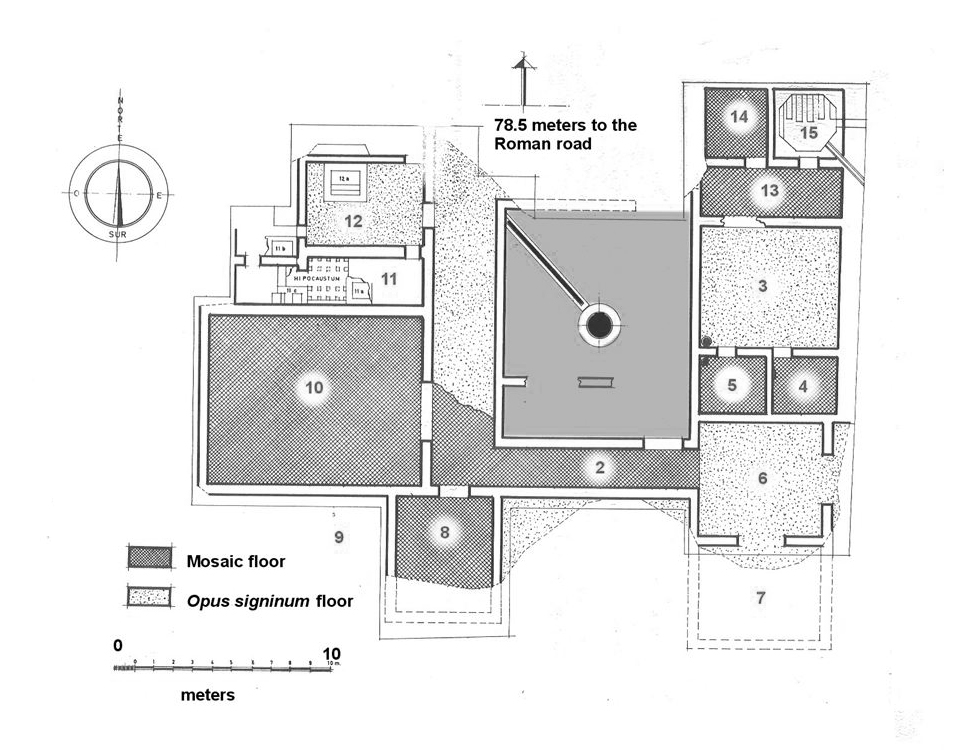
In the early 1970's, J. M. Álvarez Martinez began excavations at this site, whose report appeared in 1976. The villa was built around a central open space (11.7 x 6.3 m), which the archaeologists initially assumed was a peristyle. There was indeed a wall (0.70 meters high and 0.55 meters thick) around the central area, which was judged to a garden. But there was no trace of columns or bases or capitals of even imprints of where they had been. The passageways around the courtyard on the north, west, and south were definitely covered; and on the east, where the entrances to the walled area were, there was probably also a portico, for that wall had painted decoration which would hardly have been left exposed to the weather. The garden gave light to the rooms around it.
Though it seems clear that the principal room [10], with a mosaic representing the hunting of wild boar, was intended to have a view of the garden through its large entranceway, there was no gate to the garden at that point and the view must have been at least partially blocked by the wall around the garden. Inside the garden area there were also some low walls, presumably the edges of planting beds. A well was in the center of the garden, and a water conduit led off to the northwest where there were baths. In an unusual arrangement, there appear to have been baths also in the northeastern corner. Both areas had hypocausts and water-handling facilities.
The house appears to have been built at the end of the third or beginning of the fourth century A.D. However, there were bits of ceramic from the first, second and third centuries used as filler in the foundation beds below the mosaics. Abandonment seems to have come at the end of the fourth or early in the fifth century. The house thus presents a number of unusual features, including a 'peristyle' without columns, two baths in a relatively small house, a grand room with a view of the garden but blocked by a wall, and first century ceramic filler in a house that otherwise appears to date from around 300 AD. The excavation is still incomplete and the definitive report yet to be written.
Plans