House of Iustiniani and Sabini (Maison de Kaid Youcef)
Province
Province Description
An ancient district of Africa in Roman times, Mauretania lay west of Numidia and covered most of present-day Morocco and western Algeria. By the second century BCE, when Jugurtha of Numidia was rebelling against Rome, Jugurtha's father-in-law Bocchus had most of Mauretania under his control. In 25 BCE Augustus appointed Juba II as ruler of Mauretania. Claudius divided it into two provinces: Mauretania Caesariensis, with Caesarea (modern Cherchel) as capital, and Mauretania Tingitana, with Tingis (modern Tangier) as capital. By the end of the 5th century CE, the province had disappeared.
Location
Location Description
A prestigious city on the southwestern shore of the Mediterranean Sea, Caesarea is located approximately 100 km west of Algiers. Situated on the border of an upland plain dominating the sea and bordered on the west and east by the mountains of the Chenoua and of the Cape Ténès, respectively, the city was one of the ports that the Carthaginians established on the coast of the Maghreb.
The city was originally known as Iol. Just after the fall of Carthage during Julius Caesar's reign, the city was controlled by African dynasties and later became the capital of the amalgamated Massyle kingdoms ruled by Micipsa (son of Massinissa) and Bocchus (king of the Maures and ally to Caesar). In 33 BCE after Bocchus' death, Rome annexed the kingdoms and entrusted them to a client king, Juba II. Juba was the son and successor to Hiempsal II, one of Pompey's allies. He was sent as a hostage to Rome in 25 BCE and later married Cleopatra Selenus, daughter of Cleopatra and Mark Antony. Highly learned, Juba was renowned for his achievement in transforming Iol into a Greco-Roman town, renamed Caesarea. Juba II was succeeded by his son, Ptolemy of Mauretania, who was murdered by Caligula in 40 CE. The city then became the capital of the province named after it, Mauretania Caesarea, the eastern part of Mauretania (the western part being a second province, Mauretania Tingitana), administered by a provincial governor.
Under Claudius the city became a Roman colony, Colonia Claudia Caesarea. The old Phoenician port was enlarged and expanded for military use, the most important such port in North Africa after Carthage. The city expanded, with 7 km of walls surrounding an area of about 370 acres. From the end of the second and through the fourth centuries, the city was a flourishing settlement. During the middle of the fifth century, Saint Augustine preached in the principal church. At the end of the fifth century, the city was conquered by Vandals, eventually being annexed by the Byzantine Emperor later during the sixth century.
The city has been continually occupied to the present day, now known as Cherchel. From the Roman period, many archaeological sites have survived, including temples, baths, houses adorned with mosaics and sculptures, a theater, a forum, a judiciary basilica, an amphitheater, a large hippodrome, and a lighthouse constructed on the islet of the city.
Garden
House of Iustiniani and Sabini (Maison de Kaid Youcef)
Keywords
Garden Description
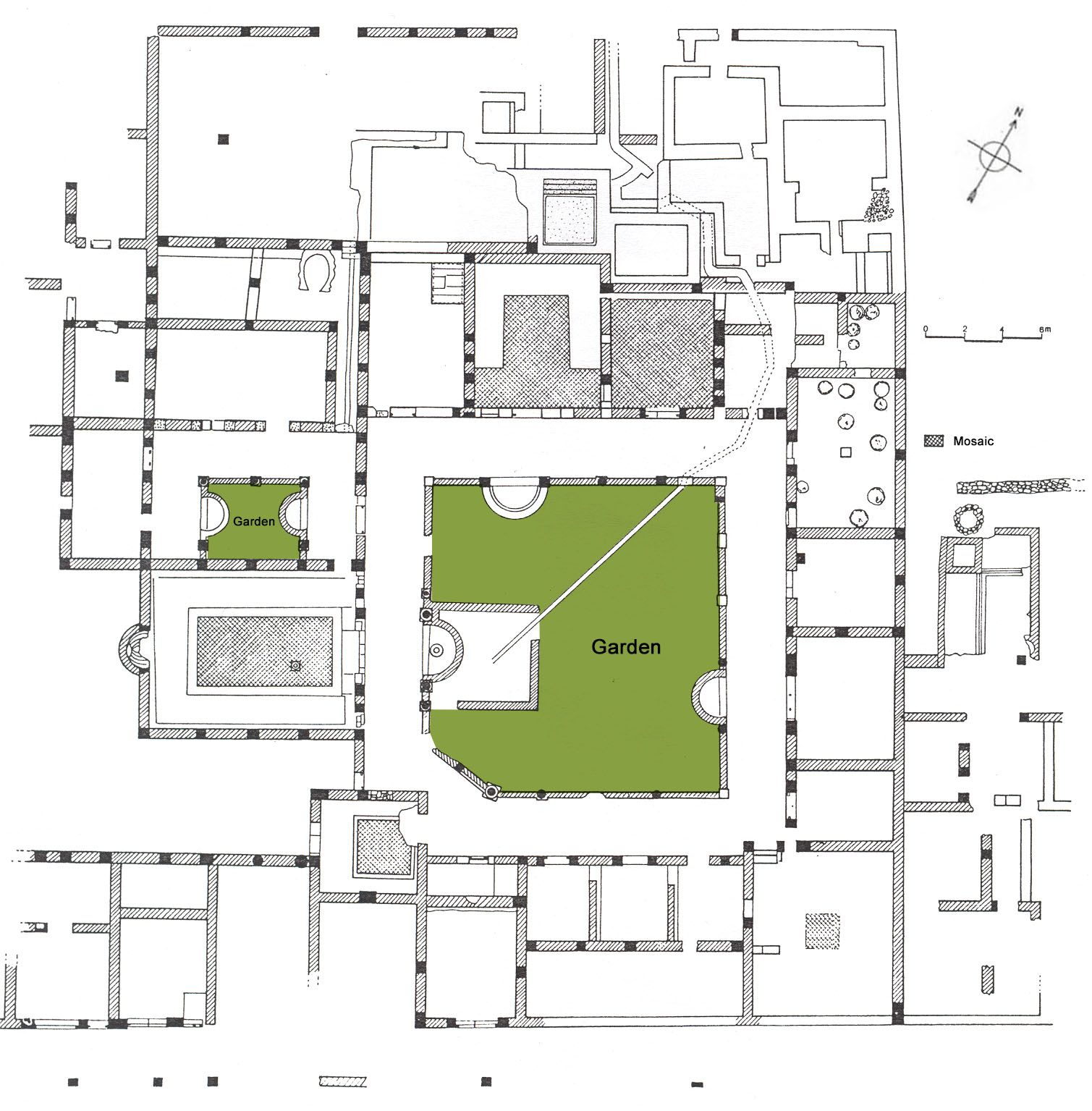
The only house for which it is possible to furnish a complete plan is located to the south of the grand temple, from which it was separated by the decumanus. To the east and west side lie two houses, which have yet to be excavated. It is one of the largest domus discovered in Caesarea, covering over 2330 square meters. Surveys prove that the house dates back to the Augustan era.
This domus, containing both baths and small shops, is arranged around a rectangular peristyle garden of 22 by 24 meters. Four porticoes, supported by six columns on the northern and eastern sides and five on the southern and western sides, surround the open area with a low wall that features three semi-circular basins, each of which faces a reception room.
In the southwestern corner, a small room protrudes into the gallery and opens into both the northern gallery and a rear garden on the south. Along the western gallery, a small door opens up to this second garden that surrounded the large reception room. Opening through a tripartite entry into the peristyle garden, this room was decorated with a mosaic that bore the inscription FL(aui) IUSTIANI ET SABINI (I).
Plans
Dates
1st century CE
Excavation Dates
Bibliography
- Baghli, S. A.,Février, P.-A., "Travaux et recherches en 1966-1967", in Bulletin d'archéologie algérienne, t.2, p.1 and t.3, p.2-4. (worldcat)
- Ferdi S., Corpus des mosaïques de Cherchel, Etudes d'Antiquités africaines, Paris, 2005, p.149. (worldcat)
- Lassus, J., "L'archéologie algérienne en 1959 et 1960", R. Af., 1961, p.441 and "La mosaïque de Thétis et Pélée", in Bulletin d'archéologie algérienne, t.1, 1962-1965, p.103. (hathitrust)(worldcat)
- Leveau, Ph., "Les maisons nobles de Caesarea de Maurétanie", in Antiquités africaines, t.18, 1982, pp.136-38. (worldcat)