Villa of the Frescoes (La villa des Fresques)
Province
Province Description
An ancient district of Africa in Roman times, Mauretania lay west of Numidia and covered most of present-day Morocco and western Algeria. By the second century BCE, when Jugurtha of Numidia was rebelling against Rome, Jugurtha's father-in-law Bocchus had most of Mauretania under his control. In 25 BCE Augustus appointed Juba II as ruler of Mauretania. Claudius divided it into two provinces: Mauretania Caesariensis, with Caesarea (modern Cherchel) as capital, and Mauretania Tingitana, with Tingis (modern Tangier) as capital. By the end of the 5th century CE, the province had disappeared.
Location
Location Description
The etymology of Tipasa means the "crossing bridge" in Phoenician, suggesting that the place had a function of a waystation on the maritime road between Carthage and the Columns of Hercules. After the kingdom of Mauretania was transformed into a Roman province in 40 CE, Tipasa became a municipium with Latin privileges under Claudius in 46 and a colony under Hadrian or Antoninus Pius. In 146-147 a vast city wall was built under Antoninus Pius, extending the previous enceinte that protected the promontory. The new wall had 31 towers running from the eastern promontory to the western hill. During the IVth century, the physiognomy of the city completely changed with the construction of two new major structures: inside the city, the largest Christian Basilica in Roman Africa and outside its walls, an extensive necropolis that spread along the shore, both to the east (on the Algiers road) and to the west (towards Cherchel). A circular mausoleum has also survived to the west of the city. In the Vth century the Vandals invaded the city and controlled it until the Byzantines took over in the VIth century.
Garden
The Villa of the Frescoes (La villa des Fresques)
Keywords
- balneaAAT:300120377
- cisterns (plumbing components)AAT:300052558
- columns (architectural elements)AAT:300001571
- domusAAT:300005506
- peristyles (Roman courtyards)AAT:300080971
Garden Description
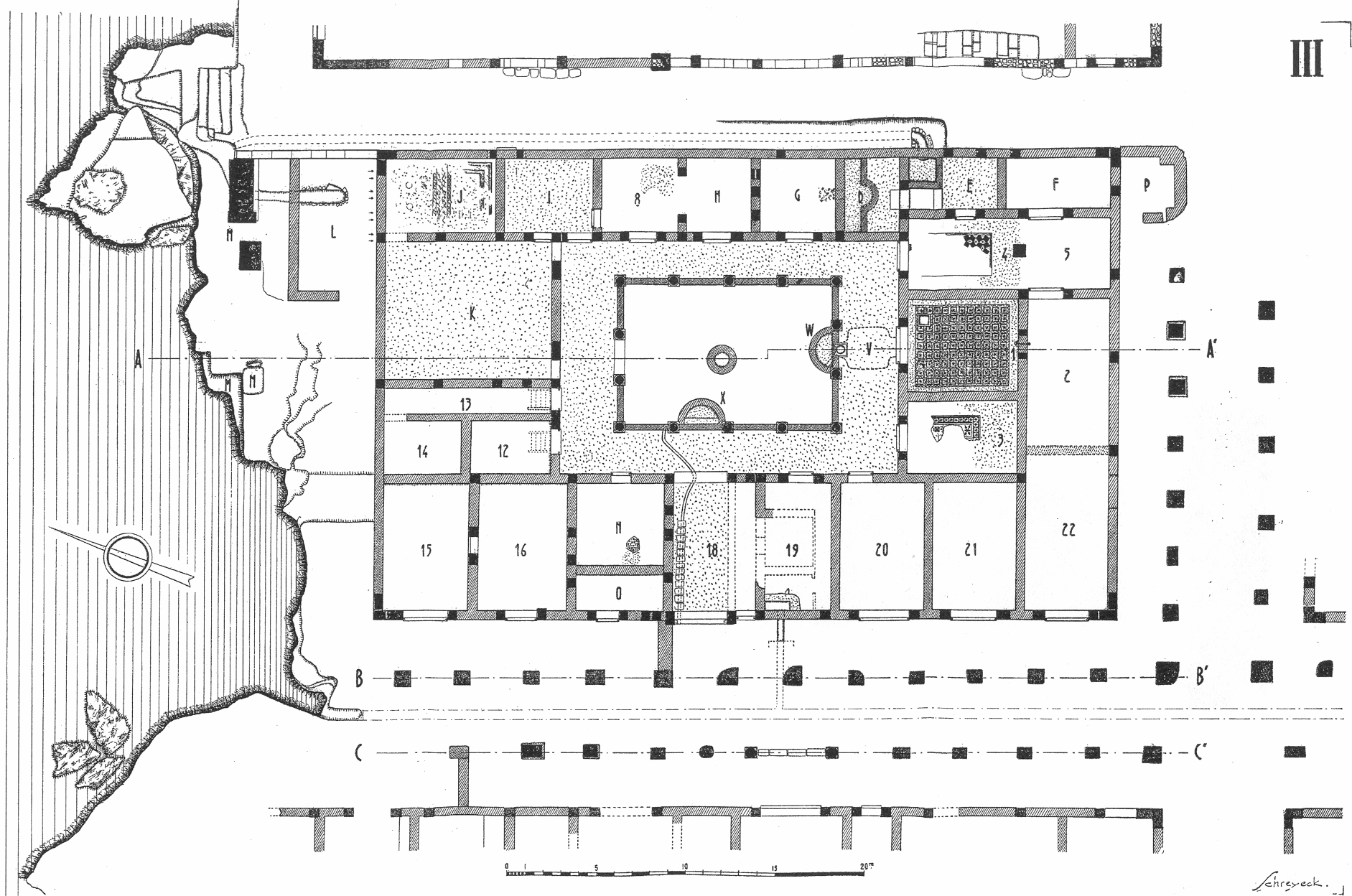
This large domus looking out toward the sea had known two phases. In the second phase, completed during the Severan period, the courtyard of the peristyle was transformed into a garden, and both baths and a reception room opening toward the sea front were added.
The peristyle garden had four porticoes supported by 14 columns and enclosed by a low wall, with an entrance on the north end. Two semi-circular planters (see Fig. 1 labels X and W) extended into the garden facing the oecus (label 1) and the vestibule (label 18). Ceramic planters and the remains of pilasters or building stones were also found near the peristyle. At the time of the construction of the baths, a new cistern was built under portico (label V). The beautiful lid that covered the puteal of the garden was removed to serve as a cistern opening for the new reservoir and was replaced by a masonry curb. Towards the sea side, the level of the solarium (label K) looking into the garden was raised to the level of the new reception room (label J), which previously had been a terrace.
Plans
Dates
2nd century CE
Excavation Dates
Bibliography
J. Baradez, Libyca IX, 1960/1, p. 102-04, Pl. III, fig. 22. hathitrust
J. Lassus, Rapport, Libyca VIII 1960/2, p. 66-7. hathitrust