Villa at Borgellusa di Avola
Province Description
Sicily, the largest island in the Mediterranean, was colonised by Greeks from the later eighth century B. C., with Syracuse becoming the largest and most powerful Greek polis; in time most of the indigenous settlements of the interior also became profoundly Hellenized. The western tip of the island was settled by Phoenicians and later became an outpost of Carthaginian control. In the third century B. C. Sicily became embroiled in the First Punic War which resulted in Rome's acquisition of the island as its first overseas provincia in 241 B. C.; in 211 B. C. Sicily was above all famed for its agricultural fertility and its capacity to produce exceptional grain yields (wheat and barley), and to a lesser extent wine. By the time of the Roman Empire the principal flourishing cities were located on the coast, with much of the interior given over to scattered agricultural villages, villas and farms.
Region
Location
Garden
Villa at Borgellusa di Avola
Keywords
Garden Description
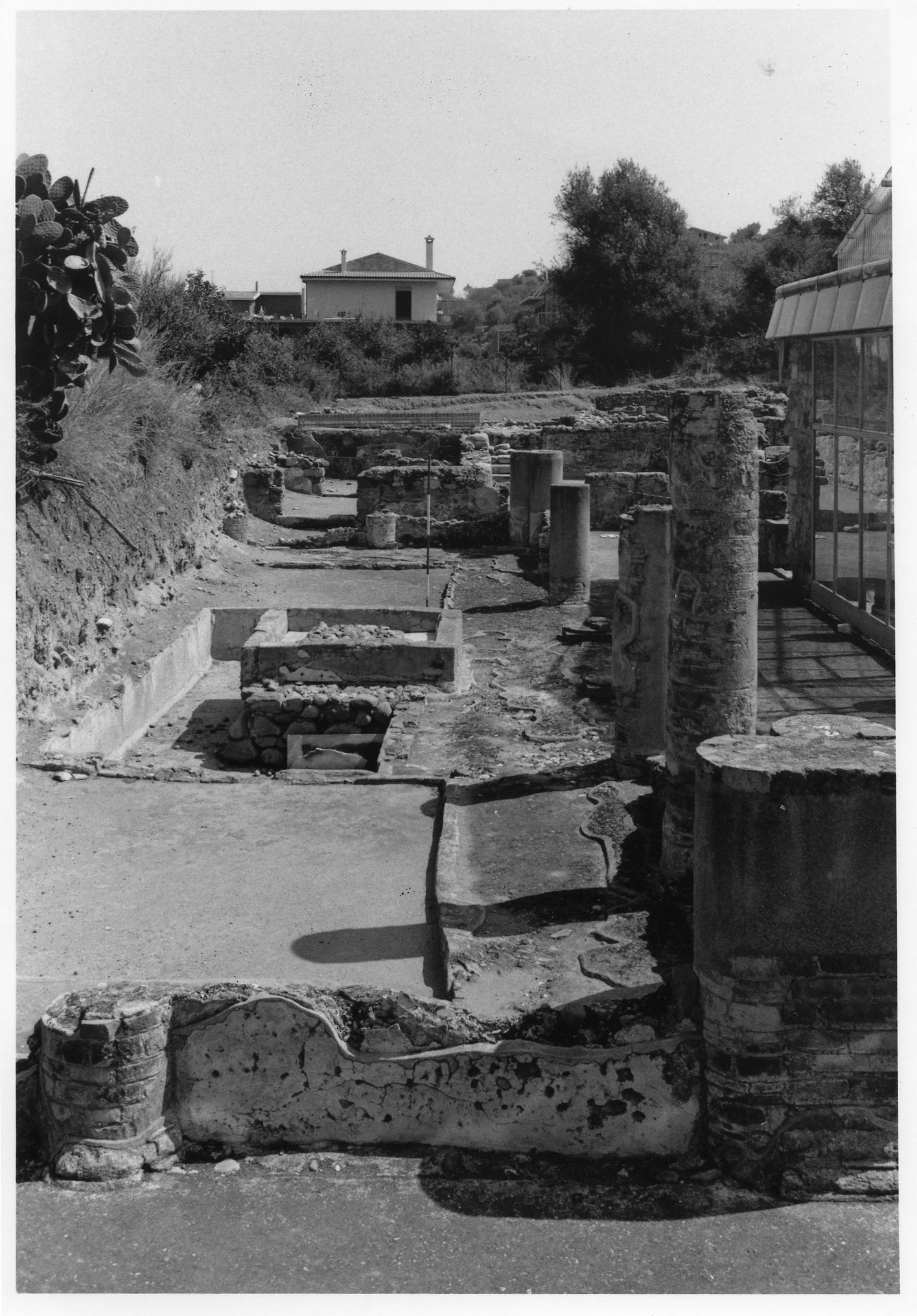
There is a four meter square basin located in the middle of the space enclosed by the peristyle (Fig. 6). Belonging to Farrar's type D, the pool has a square exterior and an inner outline of semicircular corner niches alternating with rectangular recesses. Probably belonging to the first half of the first century A. D., the pool is waterproofed with white mortar inside, and has edges lined with white and grey marble, possibly Carraran (Fig. 7).
Plans
Images
Bibliography
G. M. Bacci, Scavi e ricerche a Avola, Grammichele, Portopalo, Taormina, Kokalos 30-31 (1984-85): 711-13 (worldcat);
R. J. A. Wilson, Archaeological Reports 34 (1987-88): 115, fig. 6 (worldcat) id., Sicily under the Roman Empire, Warminster, 1990, pp. 197-8 with fig. 165.1. (worldcat)